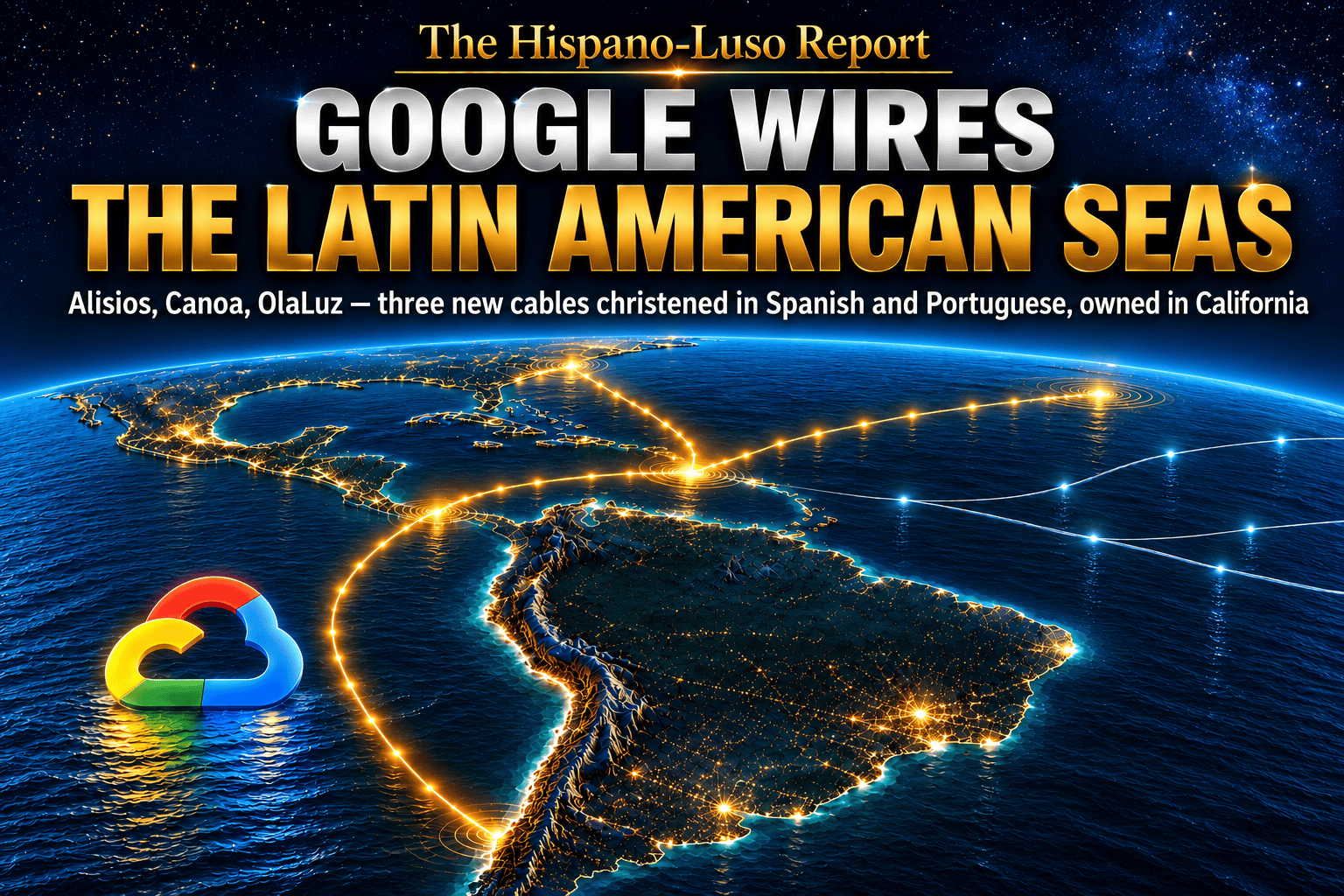
Alisios, Canoa, OlaLuz — three new cables christened in Spanish and Portuguese, owned in California. Inside Americas Connect, and what it means to have your internet built for you
The Hispano-Luso Report
Read the names first, because the names are the story in miniature: Alisios — the trade winds. Canoa — the canoe. OlaLuz — wave of light. On Tuesday, Google announced three new subsea fibre-optic cables for the Americas, and christened every one of them in the languages of the coasts they will serve. The company that owns the anglosphere’s front page is wiring the Latin American seas — and naming the wires in Spanish and Portuguese.
The programme is called Americas Connect, and its geography is sweeping: Alisios will run up the Pacific from Chile to Panama and on to the Dominican Republic, forming a redundant “submarine ring” along a coast where data routes have long been thin; Canoa will link the Dominican Republic to Bermuda; OlaLuz will connect the Dominican Republic to Florida. A fourth move extends the existing Firmina cable — the system that lands at Las Toninas, Argentina — with a new branch into the Caribbean. Stitched to Google’s operating fleet (Curie down the Pacific, Firmina down the Atlantic, Nuvem — switched on just last week, 7,000km from South Carolina to Sines in Portugal — and Sol, due in 2027 into Santander), the new threads complete something remarkable: a private network, owned by one Californian company, ringing the entire Ibero-American world.
The island that won
Every infrastructure announcement crowns a winner, and this one crowns an unexpected monarch: the Dominican Republic, which wakes up as the landing point of three separate systems — the Caribbean’s new digital crossroads. Panama’s president, José Raúl Mulino, was quoted within hours claiming the announcement as vindication of his country’s Digital Hub strategy; Chile’s government celebrated the same afternoon; Bermuda’s minister welcomed her island’s second Google cable in three years. Note the choreography, because regular readers have seen it before — in Cali, ten days ago, where the region’s presidents gathered to compete for foreign capital with statutes as the bait. The investment wars have a digital theatre too: countries now court cables the way they court copper money, because a landing station is a claim on the century. The competition to be wired is as real as the competition to be financed — and Google, not any government, holds the pen.
The full circle
This Report’s very first edition, thirteen weeks ago, covered the sale of Telxius — Telefónica’s subsea cable company — and explained the uncomfortable arithmetic behind its price: the hyperscalers increasingly lay their own cable rather than leasing anyone else’s, and an asset class the security establishment calls critical infrastructure was being valued, by the market, at a discount to its strategic importance.
Tuesday’s announcement is that thesis, drawn on a map. Google is not leasing the Hispanic Pacific; it is laying it. And the detail that completes the circle: when Sol comes ashore at Santander in 2027, the landing infrastructure will be provided by — Telxius. The Spanish incumbent that once owned the Atlantic’s arteries now serves as landlord at its own coastline, collecting rent where it used to collect the traffic. There is no better single image of what has happened to European telecoms infrastructure in a decade: from owning the network to hosting someone else’s.
What the wires buy
The case for celebration is genuine, and Latin American governments are not naive to make it. Subsea capacity is the precondition of everything the region’s economies are chasing — the cloud regions, the AI services, the data centres this Report censuses monthly — and Google’s cables arrive with real co-investment (in Chile, the related Humboldt system toward Sydney is 99% Google-funded, with the state’s Desarrollo País holding a symbolic share). Redundant routes mean a fishing trawler’s anchor no longer threatens a country’s banking system. And no Latin American state, singly or collectively, was going to spend the billions these systems cost. The wires are a gift with a rational giver: Google needs the region’s users close to its cloud, and the region needs the capacity. Interests align.
The honest counterweight
But say the quiet part, because this masthead exists to: when the arteries of two continents’ connectivity belong to one private company from a third, alignment is not the same as sovereignty. The region’s data increasingly travels on infrastructure it does not own, cannot regulate in the laying, and could not replicate — a dependency built with the best intentions and the deepest pockets, and no less a dependency for being benign. Europe reached this realisation late and is now spending painfully to answer it. Latin America is earlier on the same curve, and the honest reading of Tuesday is double: the region got richer in capacity and poorer in control, on the same day, by the same announcement. There is no villain in this story. There is, however, an owner — and it is not anyone who speaks the languages the cables are named in.
The scoreboard
Three new cables, one extended branch, an island crowned, a Pacific ringed — and a thirteen-week-old thesis from this Report’s first edition completing itself in public: the hyperscalers are not customers of the Ibero-American internet; they are its builders, its owners and, with a certain poetry, its poets — Alisios, Canoa, OlaLuz, Nuvem, Sol. The Hispano-Luso world’s digital nervous system now speaks its languages and answers to California. Whether that is a bargain or a mortgage is the decade’s question — and this Report will keep the ledger.
The Hispano-Luso Report tracks the Spanish- and Portuguese-speaking business news that English-speaking coverage overlooks — analysed beyond the English-language headlines. Sources: Google, La Tercera, DPL News, The Clinic, Última Hora.