Gemini and Pixel unveiled as FC Barcelona’s official AI and phone partners, 24 hours after Google wired the Latin American seas. The interesting question is who acquired whom
The Hispano-Luso Report
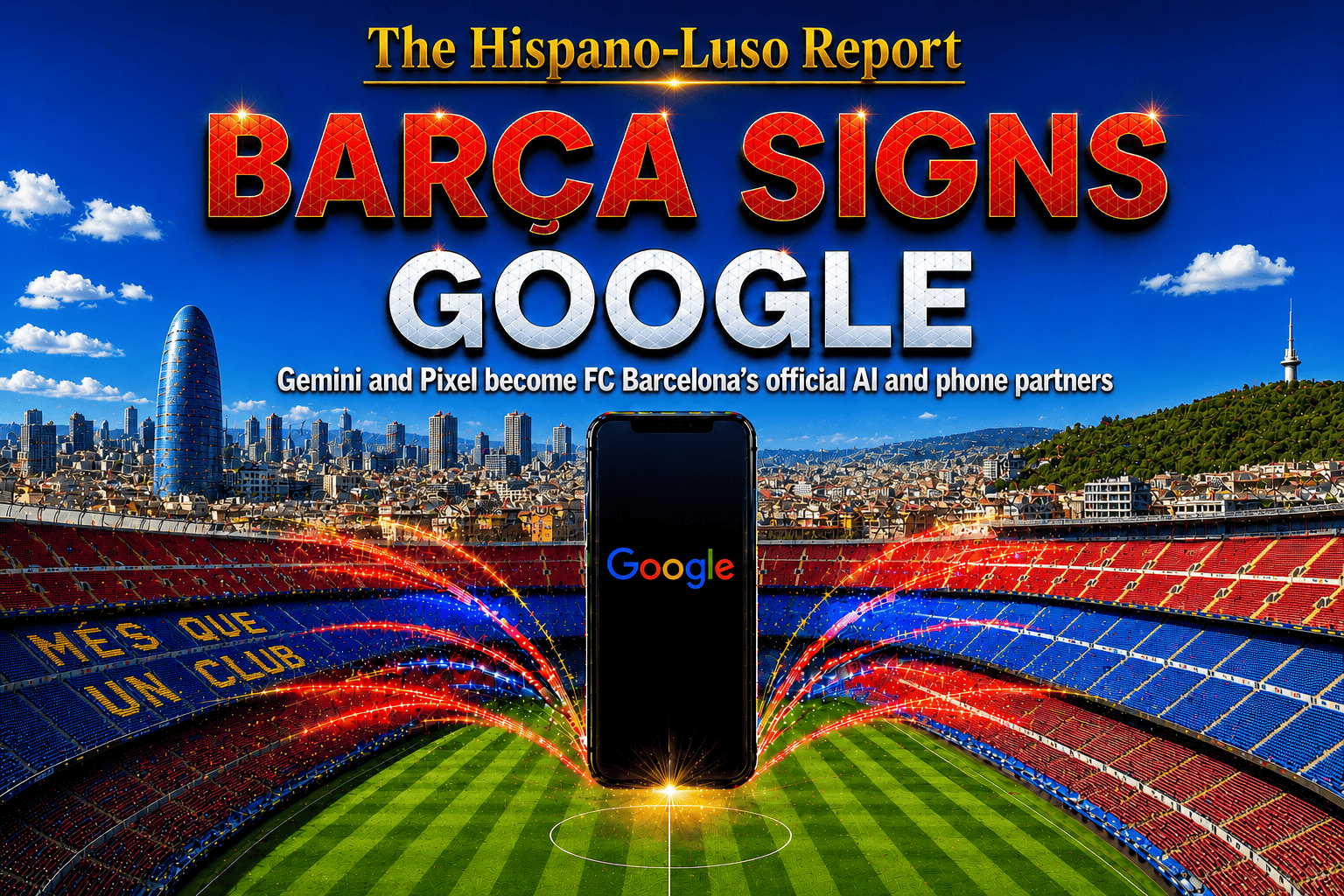
On Tuesday, Google announced three subsea cables for the Latin American seas. By Wednesday, the Spanish-speaking world’s most beloved institution was unveiling its newest signing — and it was Google. FC Barcelona has struck a technology alliance giving the Californian giant two commercial categories inside the club: Gemini becomes Barça’s Official Consumer AI Partner, and Pixel its Official Mobile Phone Partner.
The sports pages will file this under sponsorship. This Report files it under strategy — and asks the question the press release carefully doesn’t: who, exactly, signed whom?
The deal on the table
The mechanics first. Gemini — Google’s consumer AI — will power new match-adjacent experiences: tactical interpretation of games, personalised content for supporters, and applications the partners say will translate matchday emotion into the digital realm, at home and inside the Spotify Camp Nou. Pixel earns a presence in the club’s content machine — productions built around the men’s and women’s first teams — plus Barça-themed personalisation of Google’s devices. Google’s marketing chief Ester Marinas frames it as new ways to “capture, analyse and share” the match experience; Barça’s global sponsorship director Marc Bruix promises exclusive Pixel-shot content married to AI tools. Fees: undisclosed — a detail we will return to.
The case that Barça signed Google
Read from the Camp Nou boardroom, this is the latest execution of a strategy in which Barça is not the sponsored party but the platform. The club that put Spotify on its shirt and its stadium has spent years converting itself into a media company that rents its global audience to technology giants — and stacking them: streaming on the crest, now AI and devices in the commercial structure, each category sliced and sold separately. Two categories to one buyer is efficient inventory management — and the unveiling grammar is deliberate: the club presents its partners the way it presents players, because in its own theology, the institution is always the one doing the signing.
And the context makes the revenue anything but decorative: the same week’s reporting notes the club studying an expansion of the financing behind the Espai Barça stadium redevelopment — the billion-euro project whose debt service shapes every commercial decision the club makes. Barça needs blue-chip, multi-year, dollar-denominated partners the way Google needs cultural intimacy. From this angle, the club just signed one of the deepest-pocketed recurring revenue streams in world sport — and gave up nothing but shelf space.
The case that Google signed Barça
Now read it from Mountain View, where the logic is a continuation of Tuesday’s announcement by other means. The cables are the infrastructure of Google’s Hispanic decade; Barça is the affection. Gemini’s strategic problem in Europe and Latin America is not capability but intimacy — OpenAI owns the chatbot habit, and habits are cultural before they are technical. There is no faster road into the Spanish-speaking world’s daily life than the institution 400 million people follow with something close to devotion. Football tactics, match highlights, the argument at the bar about whether the press was too high — that is the conversational territory where a consumer AI becomes furniture. And Pixel’s war with the iPhone in Europe needs exactly what Barça sells: emotional distinctiveness in a market where specification sheets long ago stopped persuading anyone.
Notice, too, what this makes of the week: Google spent Tuesday buying the Ibero-American world’s connectivity and Thursday buying a seat in its living room. Infrastructure and intimacy, one announcement apart. Readers of this Report’s AI doctrine will recognise the pattern — the edge thesis in club colours: artificial intelligence arriving in the Hispanosphere not through laboratories, but through the objects and passions of ordinary life.
The honest ledger
What the celebration omits, this Report supplies. The figures are undisclosed, which means neither party wants the number compared to anything — and a partnership’s grandeur in prose is usually inverse to its disclosure. The provenance is a joint marketing release, the least adversarial document in commerce; every quoted sentence was negotiated. Sponsorships are rented affection, not owned — categories change hands each cycle, and today’s official partner is tomorrow’s former one. And the deeper exchange deserves naming: what Gemini ultimately gains from tactical chat and personalised highlights is not visibility but behavioural intimacy — the conversational data of how a football civilisation talks about the thing it loves. That is a real price, even if no one prints it.
The scoreboard
So: Barça signs Google, or Google signs Barça? The honest answer is yes — it is a transaction between two platforms that each believe they acquired the other, which is what the best partnerships always are. For this masthead’s ledger, the week’s shape is what endures: in five days, the anglosphere’s defining company laid claim to the Hispanic world’s seabed and its Sunday afternoons — the arteries and the heart. The cables carry the data; the Camp Nou supplies the feelings; and both, as of this week, run through California. Barça’s motto insists it is més que un club — more than a club. Google is betting a great deal of money that this is precisely true.
The Hispano-Luso Report tracks the Spanish- and Portuguese-speaking business news that English-speaking coverage overlooks — analysed beyond the English-language headlines. Sources: Expansión, FC Barcelona and Google statements.