The major that never left will invest $7bn to double its output — the first named company and the first capital behind Washington’s deal
The Hispano-Luso Report
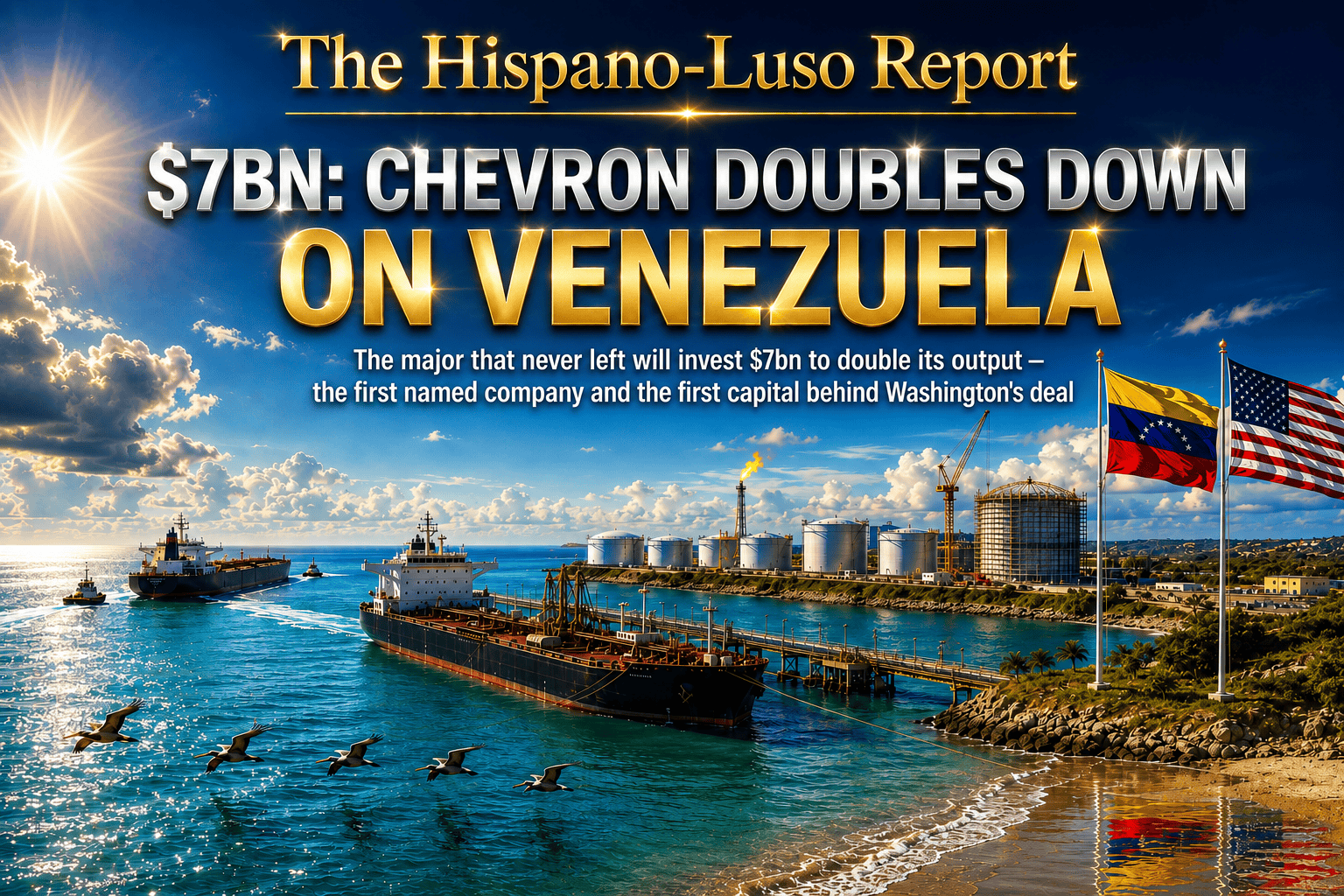
Last week this Report filed Venezuela’s “biggest oil deal in history” under a question mark, and named the gate that would take it off: the first named companies, and the first committed capital. Five days later, the first name arrived — and it was the one name that never left. Chevron will invest $7 billion in Venezuela to double its production, per elEconomista’s reporting this week: the incumbent American major, holder of the licence that survived every political weather, converting Washington’s announcement into the reopening’s first corporate receipt. The question mark stays on the deal — its text is still unpublished — but it comes off the direction: a balance sheet has now said what a lectern said on Friday.
The announcement, precisely
The tongs, as ever: “invertirá” is a future tense — a commitment declared, capital not yet spent — and this Report grades it as intention-with-a-number, two rungs above a government framework (a company’s own money, its own target) and one rung below the thing itself (rigs turning, barrels rising). The shape as reported: $7bn, a doubling of Chevron’s Venezuelan output, under the reopening’s new terms. Chevron’s Venezuelan production has run at a modest fraction of the country’s total; doubling it makes the American major the single largest engine of whatever revival follows — and makes the number the first measurable promise the reopening has produced: output can be counted, quarter by quarter, in a way that 65 billion barrels of announced scope cannot.
The major that stayed
The lens the story demands is incumbency, because it inverts the usual reopening narrative. When Venezuela expropriated the industry two decades ago, the majors split: some walked (and litigated for a generation); Chevron stayed — through nationalisation, sanctions, licence renewals granted and narrowed and granted again, at real reputational and political cost. The doubling is the incumbent’s dividend: the company that kept its people, its joint ventures and its licence through the dark years is the company positioned to expand the moment the door opens — no re-entry negotiation, no lost institutional memory, no cold start. The graveyard this masthead keeps of foreign ventures that fled and failed to return has its mirror here: the venture that endured, rewarded first. That is also why the drawer title stays drawn — “American oil returns” waits for a departed major to re-enter; Chevron’s story is the harder, quieter one: it never had to.
What it does to Friday’s inventory
Update the exists/doesn’t-exist ledger from the question-mark edition. Now exists: a named company; a dollar figure attached to a corporate decision rather than a diplomatic claim; a production target. Still absent: the government agreement’s text; the sanctions paper that operationalises it; Caracas’s detailed account; a second company — and, above all, a returning one. The reopening now has its incumbent’s vote; it awaits the newcomers’ — the departed majors, the independents, the service companies — whose entry would prove the framework is a market, not a single relationship. Five currents became six; the file wants the seventh to carry a name that left.
The mountain, revisited
The production reality from last week stands, sharpened by a real number. Venezuela pumps near a million barrels a day; a Chevron doubling adds a meaningful but bounded increment to that — the revival’s first tranche, not its sum. The Orinoco’s heavy crude, the decayed infrastructure, the lost engineers, the power and port constraints: $7bn addresses one company’s assets, not the country’s industry. The honest reading is that Chevron’s commitment is the proof of concept the wider bet needed — capital deployable, returns bankable, licences workable — and the invitation to everyone still watching from outside.
The politics, in one paragraph
Unchanged from Friday and restated without adjudication: any operative expansion requires the sanctions architecture to permit it, both governments frame the reopening to their own advantage, and both operate under political clocks that could reverse the direction as fast as it turned. Chevron’s $7bn is the first private actor pricing that risk with real money — which is the most eloquent judgment on it yet, and still a judgment, not a guarantee.
The honest ledger
Compressed: the investment is announced, not spent; the timeline as stated runs years; the doubling target is the company’s and will be graded against output data; the government deal’s text remains unpublished; and the fifth check hums — an incumbent announcing expansion the week of a political framework serves the framework’s authors and the company’s licence position alike. The tongs held last week’s superlative; they hold this week’s number.
The scoreboard
Mark what changed: the reopening has a corporate signature. The question-mark edition asked for terms; the first term printed as $7 billion and a doubling, signed by the major that stayed. The watch-list takes its gates in order: Chevron’s timeline and first rigs, the second named company, the first returning major (the day the drawer title fires), the framework’s text and OFAC’s paper. Venezuela’s revival is now a number rather than a claim — one company’s number, in a country that needs many. The incumbent voted with $7bn. Watch who votes next.
The Hispano-Luso Report tracks the Spanish- and Portuguese-speaking business news that English-speaking coverage overlooks — analysed beyond the English-language headlines. Sources: elEconomista, Chevron statements, industry production data.