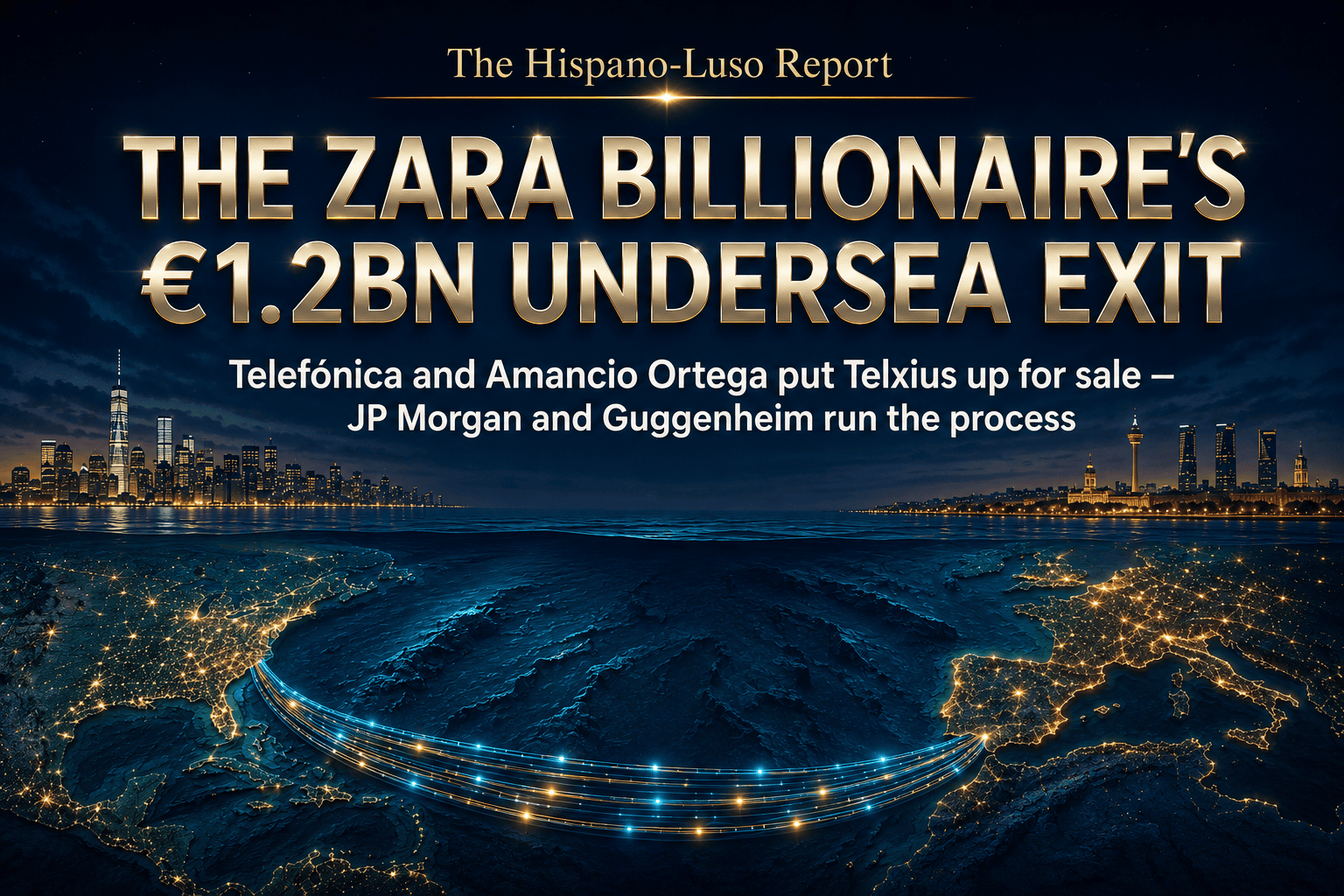
Telefónica and Amancio Ortega put Telxius up for sale — and the price tag tells a story of its own
The Hispano-Luso Report
Amancio Ortega is not a man known for selling. The Inditex founder’s investment vehicle, Pontegadea, has spent two decades hoovering up trophy real estate and infrastructure stakes across Europe and the Americas, almost never letting anything go. Which is why the news that broke in the Spanish financial press on Thursday deserves more anglophone attention than it has received: Ortega and Telefónica have agreed to sell Telxius, the company that owns some of the most strategic submarine cables crossing the Atlantic.
According to reporting first advanced by El Confidencial and since confirmed across the Spanish financial press, the two shareholders — Telefónica with 70%, Pontegadea with 30% — have mandated JP Morgan and Guggenheim to find a buyer for the subsea fibre business, at a valuation of up to €1.2 billion. On Telxius’s estimated EBITDA of around €150 million, that works out at a multiple of roughly 6.8 times.
If a deal closes at that level, Telefónica would pocket in the region of €840 million, with the remaining ~€360 million completing Pontegadea’s exit from the asset.
Why this matters beyond Spain
Submarine cables have migrated from telecoms-trade-press obscurity to the centre of the geopolitical conversation. The overwhelming majority of intercontinental data traffic travels through fibre on the seabed, and questions of who owns, operates and can interfere with that fibre now occupy security ministries as much as network engineers. Telxius sits squarely in that conversation: its flagship systems, including the Marea cable running between Virginia Beach and Bilbao, form part of the digital plumbing connecting the Americas with Europe.
That is precisely why the buyer list will be the story to watch. Infrastructure funds have spent years hunting digital assets with contracted, utility-like cash flows, and a sale process run by two American banks will not struggle to fill a data room. But the strategic sensitivity of transatlantic connectivity means governments will be watching who reaches the finish line — and Spain, like the rest of the EU, has foreign investment screening tools it has not been shy about using.
The price is the plot
For readers who followed Telxius’s earlier chapters, the valuation is the most telling number in the story. When Telefónica first tested the market in 2020, the cable business was generating EBITDA of more than €200 million and the operator aspired to a multiple of nine to ten times — a valuation in the region of €2 billion, in a process run by Société Générale and Greenhill that attracted binding offers but never closed. A year later, the fund I Squared reportedly offered €1.6 billion; that didn’t close either.
Today’s asking price of up to €1.2 billion, at 6.8 times EBITDA, sits far below the double-digit multiples the market still pays for other telecoms infrastructure. Financial sources quoted in the Spanish press attribute the discount to two structural headwinds. First, Telxius’s exposure to Latin America, which investors penalise relative to purely transatlantic systems. Second, the awkward economics of subsea fibre itself: the assets demand constant reinvestment, depreciate quickly as technology advances, and face an existential competitor in the hyperscalers — Google, Meta, Microsoft and Amazon have increasingly laid their own private cable systems, shrinking the addressable market for third-party capacity.
In other words: this is prized strategic infrastructure whose owners are accepting a haircut of roughly 40% against their 2020 ambitions. That is a data point with relevance far beyond Spain for anyone pricing digital infrastructure.
A decade of financial engineering
Telxius’s corporate history doubles as a case study in how Spanish corporates have monetised infrastructure over the past decade. Telefónica created the company in 2016 to house around 15,000 telecom towers and 31,000 kilometres of submarine cable. KKR bought 40% in 2017 for roughly €1.275 billion; Pontegadea entered in 2018 with an initial 9.99% stake.
The masterstroke came in 2021, when Telxius sold its towers division to American Tower Corporation for €7.7 billion at what Telefónica trumpeted as record multiples, cutting the operator’s debt by €3.4 billion. That deal, however, gutted the value of KKR’s position: in 2023, Telefónica and Pontegadea bought back the fund’s 40% for just €215.7 million — around a sixth of what KKR had paid six years earlier — leaving the current 70/30 structure via the holding company Pontel Participaciones.
The final act now under way fits neatly into the simplification and deleveraging agenda of Telefónica’s chairman Marc Murtra. It is no coincidence that Telxius’s new president, appointed this year, is Javier de Paz — who also serves as deputy to Murtra himself.
What the English-language coverage missed
At the time of writing, this story has circulated widely in the Spanish financial press but barely registered in English-language media — a familiar pattern for corporate Spain. Yet the ingredients could hardly be more exportable: the world’s most famous fashion billionaire selling undersea cables, two Wall Street banks running the process, and a valuation that quietly reprices an entire asset class. For investors in digital infrastructure, for followers of the Ortega empire, and for anyone tracking the security politics of the seabed, this is a deal worth watching all the way to signing.
Banco Sabadell’s analysts summed up the market’s early read: strategically positive for Telefónica, but of limited immediate impact until a transaction is confirmed. That confirmation — and above all the identity of the buyer — is where this story goes next.
The Hispano-Luso Report tracks the Iberian business stories that anglophone coverage overlooks. Sources: El Confidencial (via MarketScreener, Bolsamanía, Europa Press), Merca2, Mobile World Live.