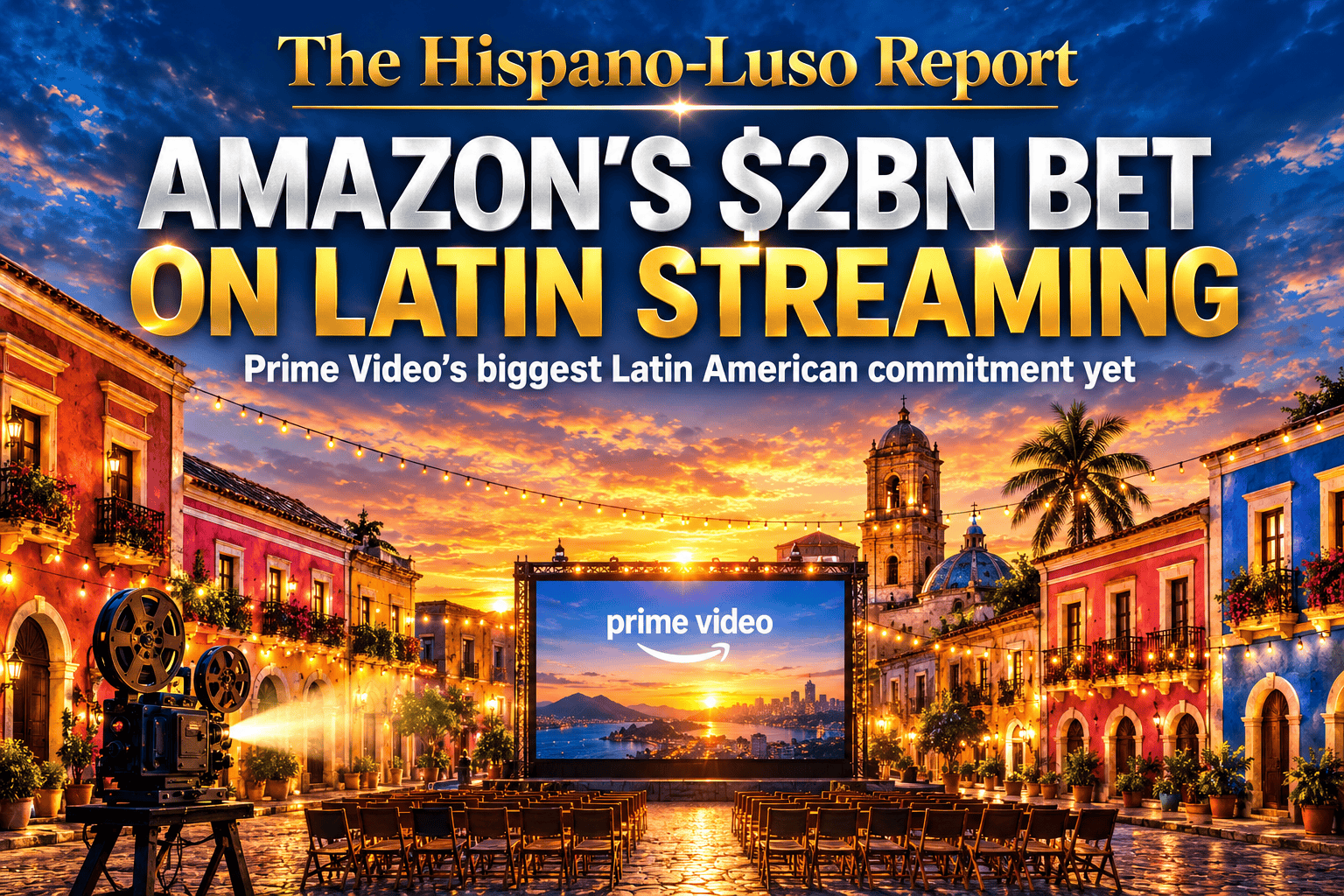
Prime Video’s biggest Latin American commitment yet — and the third layer of the anglosphere’s quiet acquisition of the region’s attention
The Hispano-Luso Report
Amazon will invest US$2,000 million in Prime Video in Latin America — the streaming giant’s largest commitment yet to the region’s screens, announced this week and aimed at the layer of the economy that never appears in trade statistics: the stories Latin America tells, watches, and increasingly exports. Two billion dollars is serious capital by any of this Report’s yardsticks — double what the Zara fortune just paid for its share of Australia’s docks — and it lands in a sector where the anglosphere’s giants have spent the month proving a thesis this masthead has been assembling piece by piece: the English-speaking world’s platforms are buying the Hispano-Luso world’s affection, layer by layer.
The pledge, precisely
The tongs first, because the genre demands them. A streaming investment commitment is a multi-year pledge, not a purchase order: the figure will span years, its split between new commissions, existing operations and marketing is rarely disclosed at announcement, and content billions are the entertainment industry’s favourite press-release currency — every studio announces them; fewer itemise them. What converts a pledge of this species into steel is the commissioned slate: named productions, greenlit seasons, soundstage leases, and the local hiring that follows — all watchable, all dated, and all now on this Report’s list. The honest tense: Amazon has committed $2bn; Latin America will receive it one greenlight at a time.
The affection economy
Now the assembly, because the pattern is the story. Count the anglosphere’s Hispano-Luso acquisitions this month by layer. The arteries: Google’s three new subsea cables — Alisios, Canoa, OlaLuz — wiring the region’s data to California’s network. The heart: forty-eight hours later, the same company took FC Barcelona’s shirt-front for Gemini — buying cultural intimacy no data centre can generate. And now the dreams: Amazon pricing the region’s storytelling at two billion dollars — the telenovela’s descendants, the narco-epics, the Mexico City comedies and São Paulo thrillers that stream from Buenos Aires to, increasingly, Birmingham and Boston. Infrastructure, affection, imagination: three layers of the same continent, acquired in the same month, by two companies headquartered eleven kilometres apart in California. The capital, as this Report keeps finding at every altitude, speaks English — and it is no longer content to carry the region’s data; it wants to commission its self-image.
The language dividend
Why does the maths work? Because the last decade quietly repriced Spanish- and Portuguese-language content from regional product to global inventory. The streaming era proved that subtitles are no barrier a good story can’t cross — Spain’s heist dramas and Mexico’s prestige films conquered anglophone couches, Brazilian series travel the lusosphere and beyond, and the production economics compound the case: world-class crews and locations at a fraction of Los Angeles cost, serving both a 600-million-strong home market and the global catalogue. A dollar spent on a Latin American original buys audience twice — once in the region, once in the world. Amazon’s $2bn is not philanthropy toward Latin culture; it is arbitrage on it — the affection economy’s version of buying an undervalued asset with two revenue streams.
The soundstage war
And where, precisely, will the money land? Here the investment-wars franchise gains its gentlest theatre: the region’s production hubs compete for streaming capital the way its treasuries compete for mining capital — Mexico City’s studio complexes against São Paulo’s, with Bogotá, Buenos Aires and Montevideo bidding tax incentives and crew depth behind them. Every commissioning decision is a small adjudication in that contest, and the pledged billions will distribute according to the same logic the RIGI and the tax-freeze statutes serve at vaster scale: predictability, incentives, talent. The watch-list takes the hub decisions alongside the slates — where the soundstages rise is where the pledge becomes payroll.
The honest ledger
The counterweights, in their standing place. Pledge mechanics, as above: the number is a horizon, not a cheque, and this Report will count greenlights, not press releases. The incumbent is formidable: Netflix spent a decade and its own billions building Latin American production muscle — Amazon is escalating a war it has not been winning in the region, and escalation announcements are what trailing competitors make. The sovereignty question has a cultural register too, and the Report prints both sides: the investment funds local crews, writers and industries at unprecedented scale — and it concentrates the commissioning power over a continent’s stories in two Californian boardrooms, a dependency the region’s broadcasters, film boards and content-quota advocates already contest. Both things are true; the ledger holds both. And the trade context hums quietly underneath: the same season Washington’s tariffs squeeze the region’s goods, its platforms expand purchases of the region’s intangibles — commerce retreating, content advancing, a divergence the file will keep watching.
The scoreboard
Mark the layer count: cables, shirt-fronts, and now stories — the anglosphere’s acquisition of Hispano-Luso attention has reached the imagination itself, priced at $2bn. The watch-list takes its gates: the first commissioned slate under the new money, the hub allocations (Mexico versus Brazil, and who else wins soundstages), and the rivals’ answering bids — because content wars escalate in rounds, and Netflix’s response is now due. The affection economy has become a theatre of this Report’s permanent coverage: the region’s data was bought, its passions sponsored, and its dreams are now commissioned in California. What remains sovereign, for now, is the telling — the writers’ rooms are still in Spanish and Portuguese, whoever signs the cheques. Watch the greenlights.
The Hispano-Luso Report tracks the Spanish- and Portuguese-speaking business news that English-speaking coverage overlooks — analysed beyond the English-language headlines. Sources: Diario Financiero, Amazon statements.