The Hispano-Luso Report · Saturday 18 July 2026
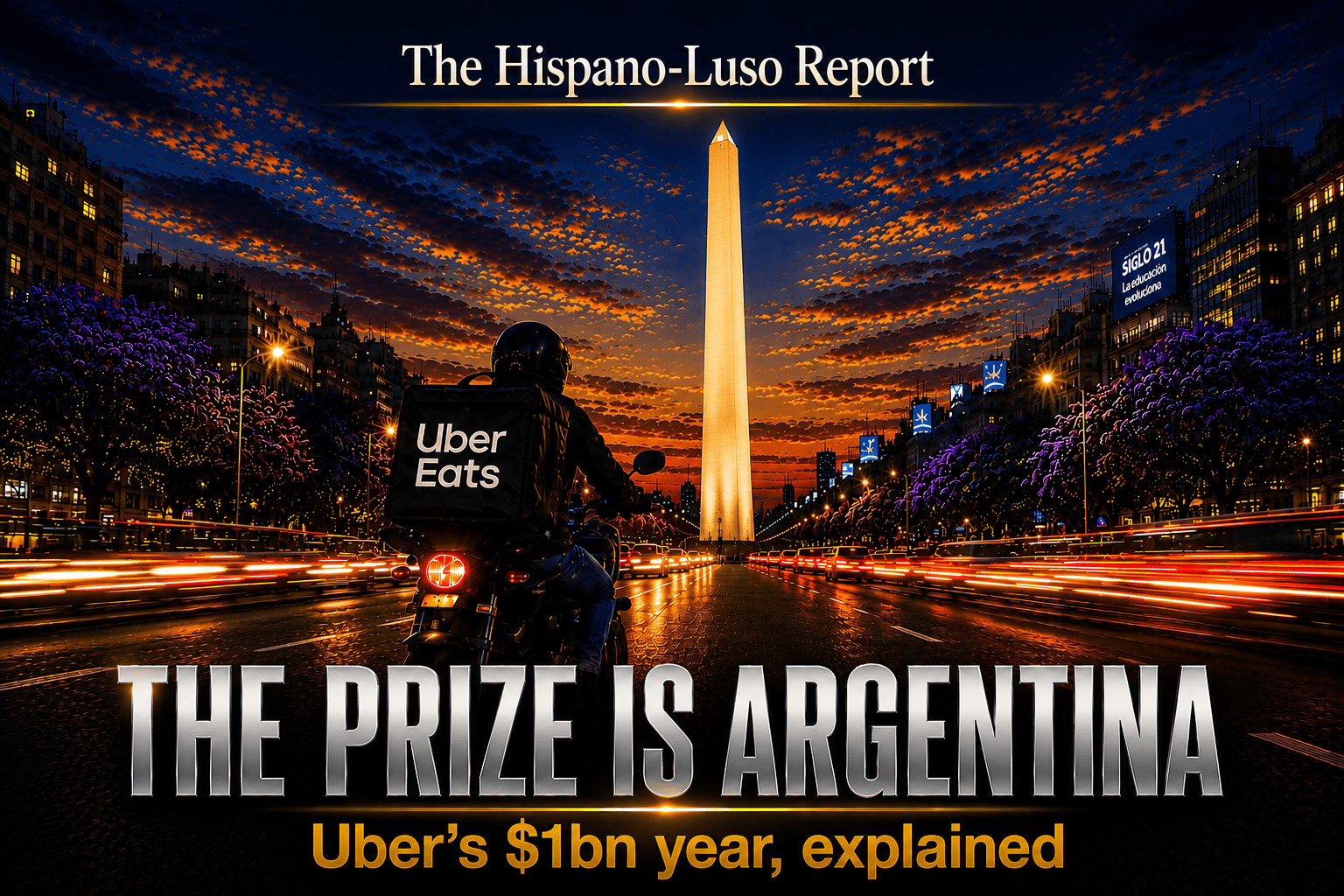
On Thursday, Uber announced the biggest acquisition in its history: US$14.8 billion for Delivery Hero, the German group behind delivery apps in dozens of countries. On Friday, before the ink was dry, Uber’s President and COO Andrew Macdonald was on the phone with Argentina’s economy minister, Luis Caputo — and came away pledging an additional US$500 million of investment in the country over the next three years.
That takes the Uber Argentina investment commitment for 2026 alone to US$1 billion. For a market most global coverage still files under “volatile,” it is a remarkable vote of confidence — and it tells you what the Delivery Hero deal is really about.
The billion-dollar year
The first half of the money arrived in March. Marking ten years in the country, Uber’s global CEO Dara Khosrowshahi met Caputo’s economic team at the Palacio de Hacienda and announced US$500 million over three years to expand operations, relaunch Uber Eats, and consolidate Argentina as a priority market for the company.
The second half arrived on Friday, and this time the context was explicit. Macdonald framed the new US$500 million as part of the intended acquisition of Delivery Hero, calling Argentina one of Uber’s “most dynamic markets.” Caputo, for his part, amplified the announcement within hours, attributing the investment to confidence in the government’s economic direction.
Two pledges, four months apart, one billion dollars. Companies do not do this by accident — and they rarely do it for a market they consider peripheral.
What came inside the German box
To understand why Argentina, look at what Uber is actually buying. Delivery Hero’s most valuable Latin American asset is PedidosYa — the app that dominates food delivery in Argentina and much of the Spanish-speaking south of the continent.
And PedidosYa is a Hispano-Luso story in miniature. It is neither German nor American: it was founded in Montevideo in 2009, a Uruguayan startup that conquered delivery across Latin America before being acquired by Berlin — and is now, pending the deal’s closing, headed for San Francisco ownership. Three owners on three continents; the same app on every corner of Buenos Aires.
The strategic logic is sharper still. Uber Eats withdrew from Argentina in 2020. It confirmed its return only this January — which means Uber spent the first half of 2026 preparing to fight PedidosYa in its strongest market, and will now, if regulators approve the deal, simply own the incumbent instead. The relaunch machinery doesn’t go to waste: it becomes the integration plan for a combined mobility-and-delivery platform.
One precision worth noting, because the deal’s structure rewards close reading: Uber is not keeping everything. Fourteen overlap markets were carved out to the investment firm SSW Partners at signing — including, strikingly, Glovo in its home market of Spain. Argentina’s PedidosYa is not among the carve-outs. It stays with Uber. The markets Uber chose to keep are the map of where it believes the growth is.
Why Argentina, why now
The timing is not incidental. Uber Eats’ return was announced into a changed environment: a maturing delivery market and a labour reform that has streamlined the rules for platform and temporary work. Add a government actively courting foreign direct investment, and Argentina offers Uber something scarce — a large, tech-adopting consumer market where the regulatory direction is moving in its favour.
The English-language press has largely covered the Delivery Hero deal as a US–Europe story: San Francisco buys Berlin. But the growth thesis inside the deal is Latin American, and Argentina is its clearest expression. Uber is not spending US$14.8 billion for Germany’s margins.
The paper trail follows the money
For anyone operating between the Anglophone and Hispano-Luso worlds, commitments of this size are leading indicators. A billion dollars deployed into Argentina means contracts, filings, regulatory submissions, labour agreements and commercial negotiations — most of it generated first in Spanish. Cross-border deals of this kind put Spanish- and Portuguese-language business and financial documents and contracts on Anglophone desks, and the companies that read them earliest move first.
That, in the end, is the story the headlines missed: the biggest acquisition in Uber’s history was announced in English — but its consequences will be written, first, in Spanish.
Sources: Andrew Macdonald via X; reporting by La Nación, Bloomberg Línea and the Argentine financial press.