The Hispano-Luso Report · Friday 17 July 2026
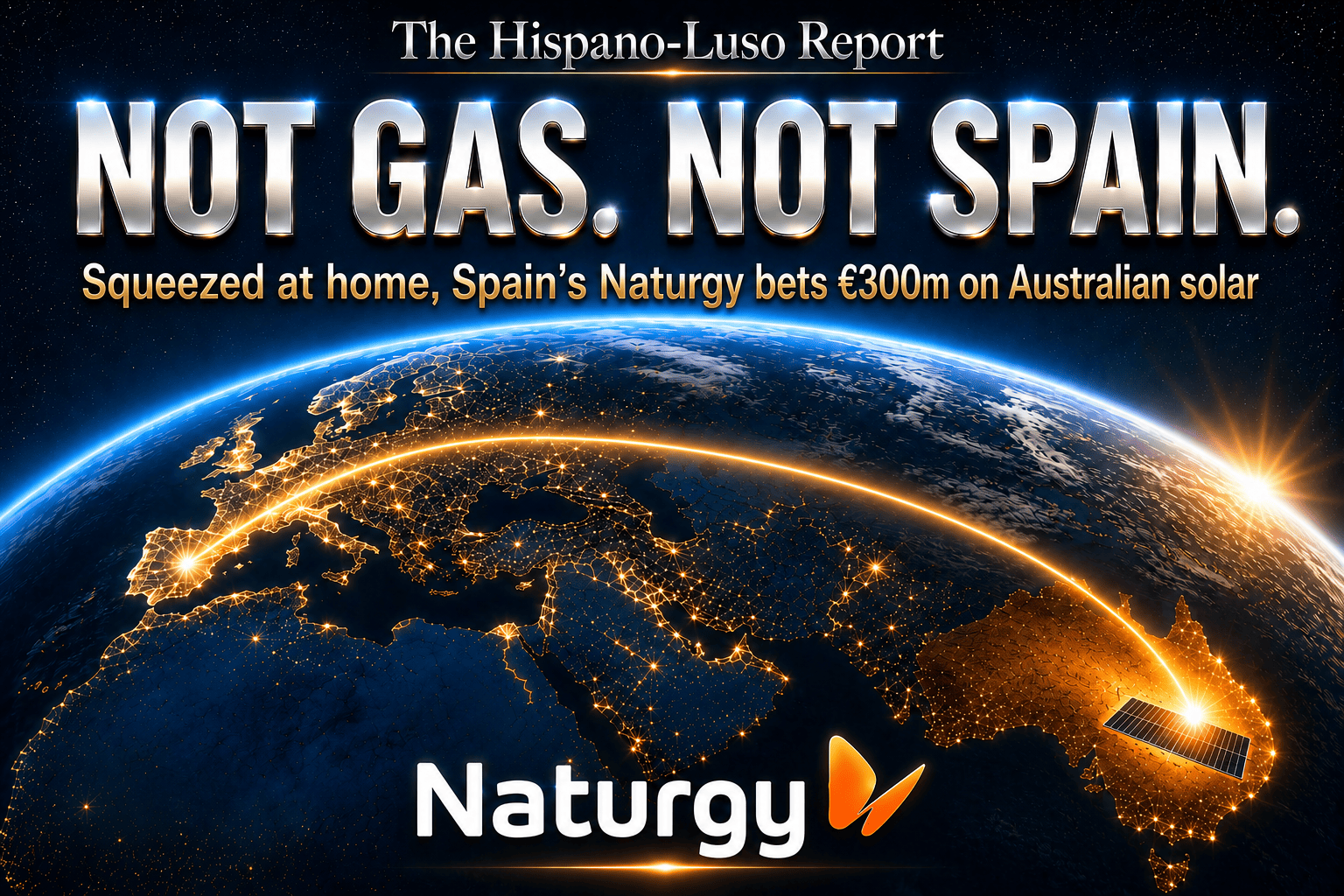
Spain’s biggest gas company announced its largest Australian project yet this week — and it has nothing to do with gas. Naturgy, Spain’s leading gas utility and its third-largest electricity company, will invest more than €300 million in a plant on Queensland’s Fraser Coast combining 330 megawatts of solar generation with 180 megawatts of battery storage: the second-largest hybrid solar-and-storage facility in Australia. Construction begins now; the electrons start flowing in 2028. And the electricity is already sold — a ten-year power purchase agreement guarantees the plant’s output before a single panel stands, an arrangement chairman Francisco Reynés says reinforces the project’s revenue visibility.
On its own, that is a solid piece of corporate news. What makes it a story is everything around it.
The reversal
In late 2023, Naturgy and its Kuwaiti partner hired Morgan Stanley to explore selling this very business, with a price tag around €2.4 billion; by spring 2024, after bids came in below expectations, the sale was suspended — parked, the company said, until new projects lifted the valuation. The Naturgy Australia portfolio — held through Global Power Generation, its international generation subsidiary — had drawn bids from heavyweights including TotalEnergies and Octopus, and still the owners said no. Instead, the company has now done the opposite of selling: doubled down with its biggest commitment in the country to date, on top of an operating fleet of 1.3 gigawatts spanning six wind farms, two solar plants, the group’s first battery-storage installation anywhere in the world, and its first hybrid solar-storage project. When a company rejects €2.4 billion for a business and then builds its largest asset yet inside it, that is not drift. It is a decision.
The squeeze at home
To understand the decision, look at what is happening in Naturgy’s home market — because the picture there is remarkable. An analysis published by Expansión this week, nearly 500 days after the April 2025 blackout that plunged Spain into darkness, finds the country’s retail electricity market turned upside down. The reinforced grid-security measures adopted after the blackout raised system costs, dislocated prices, and handed an opening to every flexible newcomer willing to undercut the incumbents.
They have taken it. On the official price comparison maintained by Spain’s competition regulator, the best household offers are dominated by oil majors — Repsol, TotalEnergies and Italy’s ENI, all pivoting into electricity — and a swarm of low-cost suppliers ranging from Britain’s Octopus Energy to South Korea’s Hanwha to the energy arm of department store El Corte Inglés. Iberdrola, the most aggressive incumbent, has fought its way to two offers in the top ten. Endesa’s best sits beyond twentieth. Naturgy’s best offer ranks outside the top thirty.
Read those two facts together and the Australian announcement stops looking like a curiosity. At home, Naturgy is losing a price war in a market where the regulated tariff is now, extraordinarily, among the cheapest options available. Abroad, it can build utility-scale renewable assets with decade-long contracted revenues and none of the retail knife-fight. Capital goes where it is treated best. This week, for Spain’s biggest gas company, that was a solar farm on the other side of the planet.
The Kuwaiti layer
One more detail, routinely omitted from the headlines: Naturgy holds its Australian business through Global Power Generation, in which it owns 75% — the remaining 25% belongs to the Kuwait Investment Authority, the Gulf state’s sovereign wealth fund. The “Spanish” project chasing Australian sun is, more precisely, Spanish-Kuwaiti capital. Readers of our Embraer analysis will recognise the theme of the week: the corporate passport and the corporate centre of gravity are separating, and the name on the door is an increasingly poor guide to what a company actually is. Naturgy’s name says gas. Its money says solar, batteries and the southern hemisphere.
What is not settled
The usual precision. The plant is entering construction, not operation — 2028 is a target, and Australian grid-connection queues have humbled better-laid plans. The counterparty to the ten-year power purchase agreement has not been disclosed, which matters: a contract’s strength is its signatory. And none of this resolves Naturgy’s home-market problem — a €300 million Australian asset does not win back a single Spanish household from Octopus. If anything, it signals where management believes the winnable battles are, which is itself the most honest commentary on the state of Spanish energy retail that Naturgy could offer.
For energy-sector readers, the wider signal is worth sitting with: when a vertically integrated Southern European utility with a century of home-market incumbency directs its flagship investment to contracted renewables twelve time zones away, that is a data point about where European utility capital is heading — and about what the blackout’s long tail is doing to the economics of being an incumbent in Spain.
The name over the door will catch up eventually. The balance sheet already has.
The Hispano-Luso Report publishes analysis of the companies and commerce of the Spanish- and Portuguese-speaking world. The first full edition arrives this Sunday — subscribe to receive it.