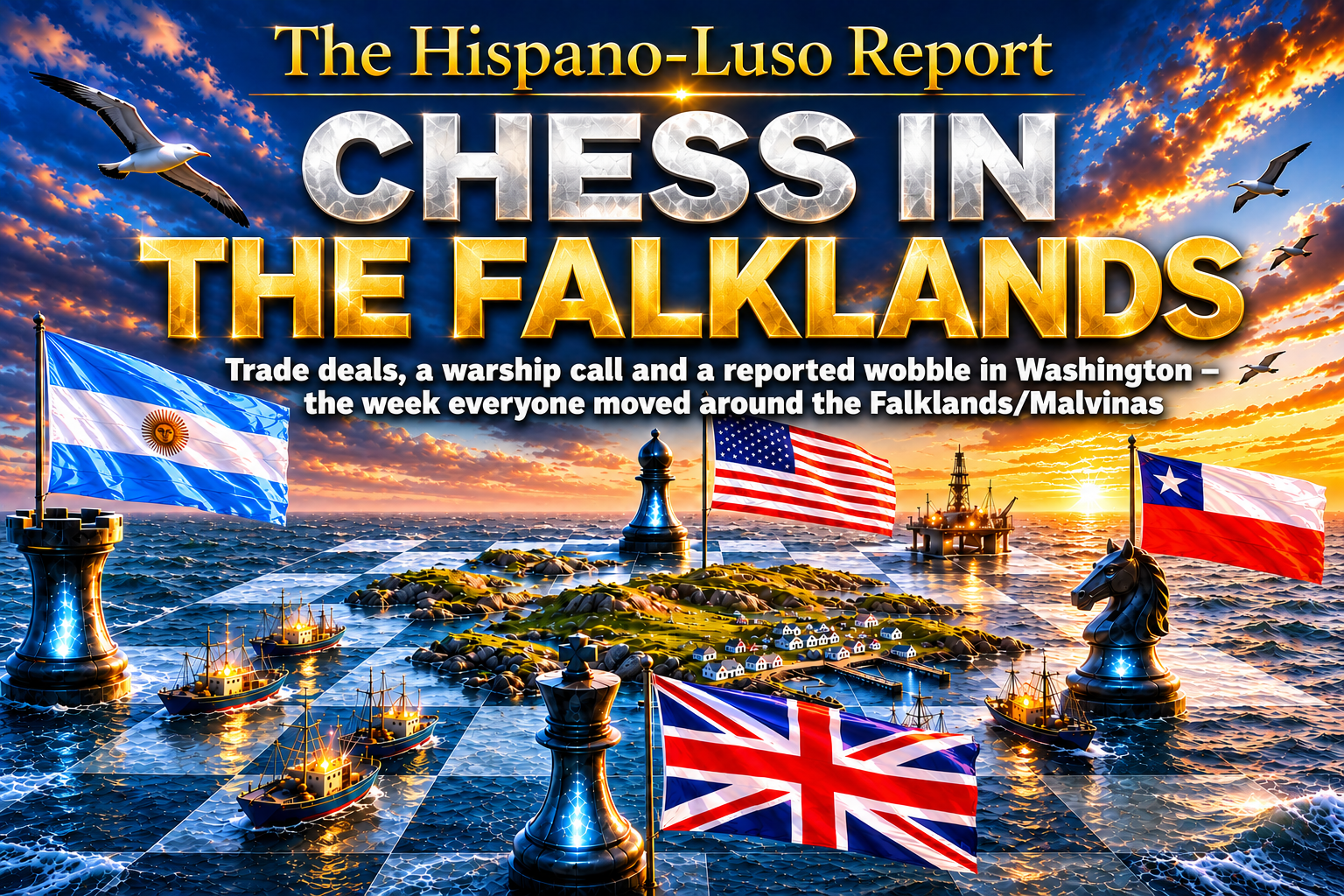
Trade deals, a warship call and a reported wobble in Washington — the week everyone moved around the Falklands/Malvinas
The Hispano-Luso Report
Four stories in one week, each reported as a brief, none connected by anyone: London deepens its economic bet on the islands; Santiago formalises a trade agreement with them; a British vessel’s mooring in Ushuaia stirs Argentine discomfort; and a London newspaper reports that Washington could rethink its support for British sovereignty if UK defence spending disappoints. This Report covers business, not sovereignty — and files this edition because the economy of the Falklands/Malvinas is suddenly a board on which several players are moving at once. The politics are the weather. The pieces are commercial. The board is the story.
The board
Understand the prize before the moves. The islands’ economy rests on two sectors — fisheries (squid above all, one of the South Atlantic’s richest licensed grounds) and the long-deferred hydrocarbons question: the Sea Lion project, an offshore oil development that has crawled toward a final investment decision for over a decade, its barrels contested by geography as much as geology. Small population, large exclusive waters, and beneath them a field whose sanction would transform the islands’ economy — and whose risk pricing depends on exactly the sovereignty certainty this week’s moves disturbed. Every player at the board’s edge knows it.
Move one: Santiago’s agreement
The consummated piece, and the one this masthead would have covered alone: Chile and the islands have formalised a commercial agreement to promote each other’s products — the lightest instrument in commerce, a promotion pact, but a signed one, between a South American state and the islands its neighbour claims. The context makes it extraordinary: in the same week, Chile sealed the Andean strategic-minerals alliance with Argentina. The pact this Report analysed days ago — Santiago and Buenos Aires courting the world’s capital together — coexists with Santiago trading with the islands Buenos Aires contests. The alliance piece asked whether the bedfellows’ differences were a strength or a fault line; the file did not expect an answer within the week.
Move two: London’s bet
Reported earlier and filed then: the UK reinforcing the two sectors that sustain the islands’ economy — policy intention rather than transaction, but directional: London investing in the board’s value at the moment others reposition around it.
Move three: the reported wobble
Reported by The Telegraph and relayed across the Argentine press: that the United States could withdraw support for British sovereignty over the islands if London does not raise military spending. This Report prints it as what it is — a single-outlet report of a conditional, in the middle of a spending negotiation, unconfirmed as policy — and notes only its commercial consequence: any question over the alliance backing the islands’ status is a question every lender, insurer and board weighing Sea Lion will price.
Move four: the temperature
A British vessel’s mooring at Ushuaia drew public discomfort in Argentina — a diplomatic incident, not a transaction, filed here for one reason: it measures the temperature in which every other move is being made.
The honest ledger
The counterweights, and this edition carries extra. Scale: the Chile agreement is a promotion pact for a 3,500-person economy — its significance is contextual, not material. Sourcing: the US report is conditional and single-sourced; the file grades it accordingly. This masthead adjudicates nothing: the sovereignty question has its claimants and this Report is not among them — the naming protocol (both names, throughout) is the policy, and the piece’s only verb toward the dispute is “reported.” And the counterpoint the file keeps: while the contested basin waits, Argentina’s own Vaca Muerta ships record crude — the South Atlantic’s barrels are already flowing, from the mainland.
The scoreboard
The watch-list takes commercial gates only: Sea Lion’s investment decision (the queen on the board), the Chile agreement’s first executed trade, any movement of the US report from newspaper to policy, and the Andean alliance’s clauses — where Santiago’s two commitments will have to coexist in writing. Four players moved in a week. The board — squid, fish, and barrels under a question mark — did not move at all. Watch Sea Lion.
The Hispano-Luso Report tracks the Spanish- and Portuguese-speaking business news that English-speaking coverage overlooks — analysed beyond the English-language headlines. Sources: elEconomista, Infobae/The Telegraph, government statements.