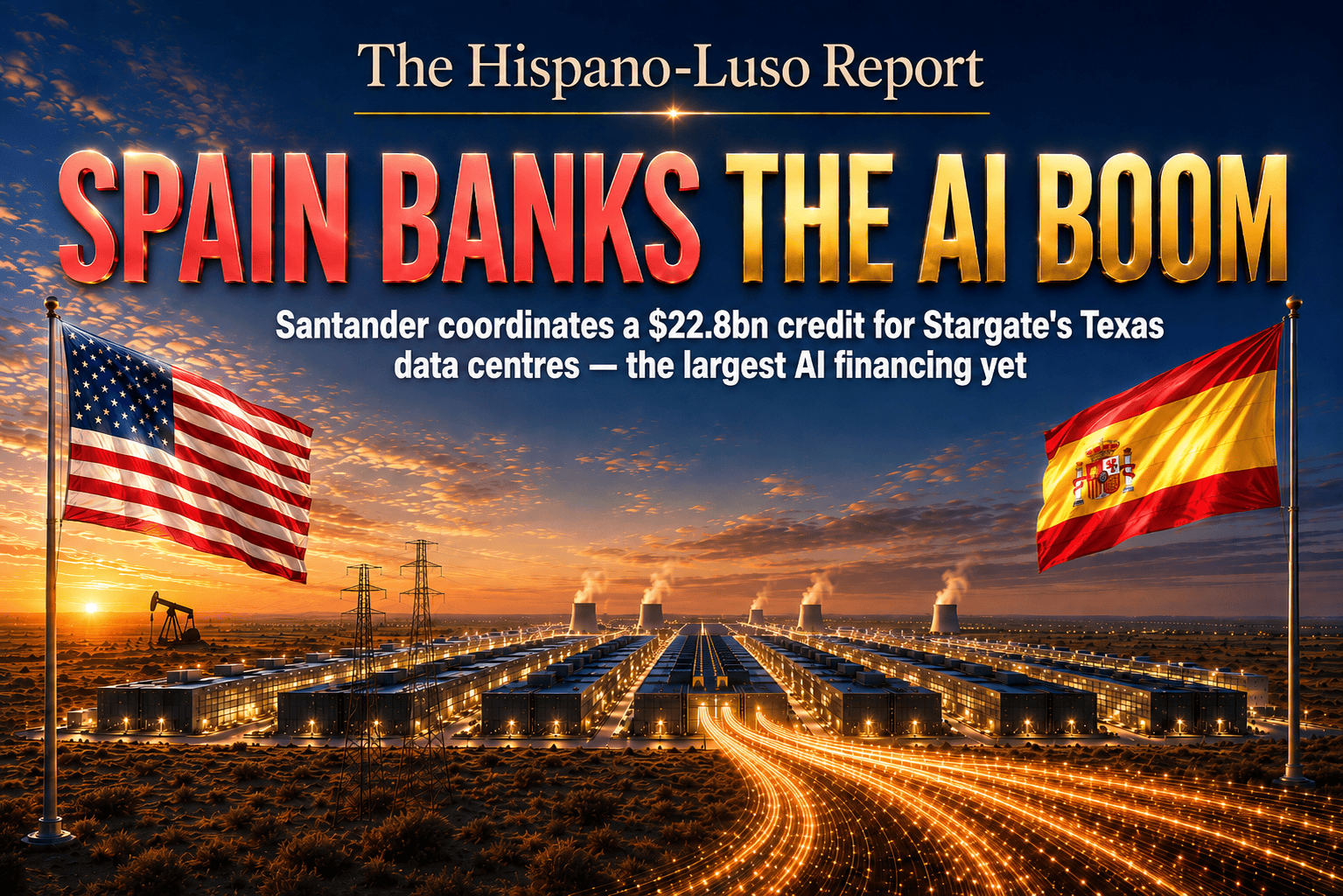
Santander coordinates a $22.8bn credit for Stargate’s Texas data centres — the biggest AI financing yet, arranged from Madrid
The Hispano-Luso Report
The largest infrastructure project on earth right now is not a dam, a railway or an airport. It is Stargate — the $500 billion programme to build the data centres OpenAI needs — and when its Texas flagship went looking for the largest slug of debt in the history of artificial intelligence, the bank coordinating the lenders was not one of the Wall Street houses that dominate the league tables.
It was Banco Santander.
Per elEconomista’s reporting, Santander has secured the role of lead coordinator on a $22.8 billion credit for Vantage Data Centers’ Texas campus — the vast Shackelford County complex that Oracle will operate to serve OpenAI’s computing demand. The financing forms the heart of a package of some $38 billion across two US sites, reported as the largest debt raising the AI infrastructure boom has yet produced. A Spanish bank, in other words, now sits at the coordination desk of American AI’s money supply.
What the money builds
Stargate is the industrial answer to a mathematical problem: OpenAI’s models need more computing than exists. The programme — OpenAI, Oracle, SoftBank and partners — is planting gigawatt-scale campuses across the United States, and the Texas site is among its largest: hundreds of hectares of windowless halls, cooling plant and substations on the plains, with Oracle as operator and OpenAI as the tenant whose appetite underwrites everything.
The developer, Vantage Data Centers, builds and owns the physical layer. And physical layers are financed with debt — which is where the banks come in, and where the hierarchy of the AI boom quietly reorders itself. The equity story of artificial intelligence belongs to Silicon Valley; the credit story is being written by whoever can assemble, structure and distribute tens of billions in project finance. That is a different skill, with a different league table.
Why Santander
On that league table, the Spanish bank is not an outsider. Santander’s corporate and investment bank has spent five years building precisely this franchise — structured and project finance, infrastructure credit, the unglamorous machinery of large assets — and ranks among the world’s leaders in structured finance by deal count. Data centres are the asset class of the decade, Texas is their capital, and the bank that finances Iberian motorways and Latin American grids has carried the same toolkit to the AI build-out.
There is a pleasing echo in the timing. A week ago this Report covered JPMorgan’s research desk doubting Spanish banks — Sabadell’s options, BBVA’s investment-banking ambitions. The same fortnight, Spain’s largest bank out-coordinated the traditional arrangers on the largest AI financing ever assembled. The scepticism and the scoreboard continue their argument.
The Doctrine’s missing piece
Regular readers will recognise where this story sits. The Iberian AI Doctrine, as this Report has mapped it, holds that Spain and Portugal are not trying to build the artificial brains — they are positioning to own everything the brains need: the landlord (Merlin’s data-centre empire), the compressor (Multiverse shrinking the models), the edge evangelist (Telefónica arming devices rather than fighting OpenAI).
Santander’s coordination role supplies the layer the Doctrine was missing: the lender. Spain now participates in the AI boom at four altitudes — property, models, networks and credit — while owning no frontier lab at all. It is the picks-and-shovels strategy executed across an entire national financial system: when the gold rush came, Iberia sold the shovels, leased the land, compressed the cargo — and now finances the mine.
The honest counterweight
The role carries the risk the fees pay for. Concentration, first: the Texas financing’s credit rests substantially on Oracle’s commitments, and Oracle’s on OpenAI’s — a tower of correlated promises that the market has begun to price warily; reporting around the broader package has noted arrangers working hard to distribute Oracle-linked exposure to end investors. Circularity, second: the AI economy’s financing loops — chipmakers investing in customers, tenants underwriting landlords — have drawn comparisons to previous infrastructure manias, and a coordinator’s prestige on the way up becomes a coordinator’s exposure if the music slows. Santander’s art, like every arranger’s, is to structure, syndicate and keep the fee while passing the risk. The scale of this deal will test that art at altitudes no one has flown.
And the caveat this Report applies to all such stories: the coordinator role reached print through Spanish financial media with sources close to the operation — the flattering version of events, told first at home. The mandate is real; the framing deserves its pinch of salt.
The scoreboard
Count what Spain now touches in the machine that is supposed to define the century: the largest AI-infrastructure credit ever assembled, coordinated from Madrid; Europe’s data-centre pipeline, developed from Madrid; the model-compression layer, engineered in San Sebastián; the edge doctrine, evangelised from Telefónica’s tower. No Spanish company builds a frontier model — and no part of the frontier gets built without someone doing what Spanish firms have quietly become excellent at. The gold rush has its prospectors. Iberia, as ever, is running the bank.
The Hispano-Luso Report tracks the Spanish- and Portuguese-speaking business news that English-speaking coverage overlooks — analysed beyond the English-language headlines. Sources: elEconomista, Bloomberg, company statements.