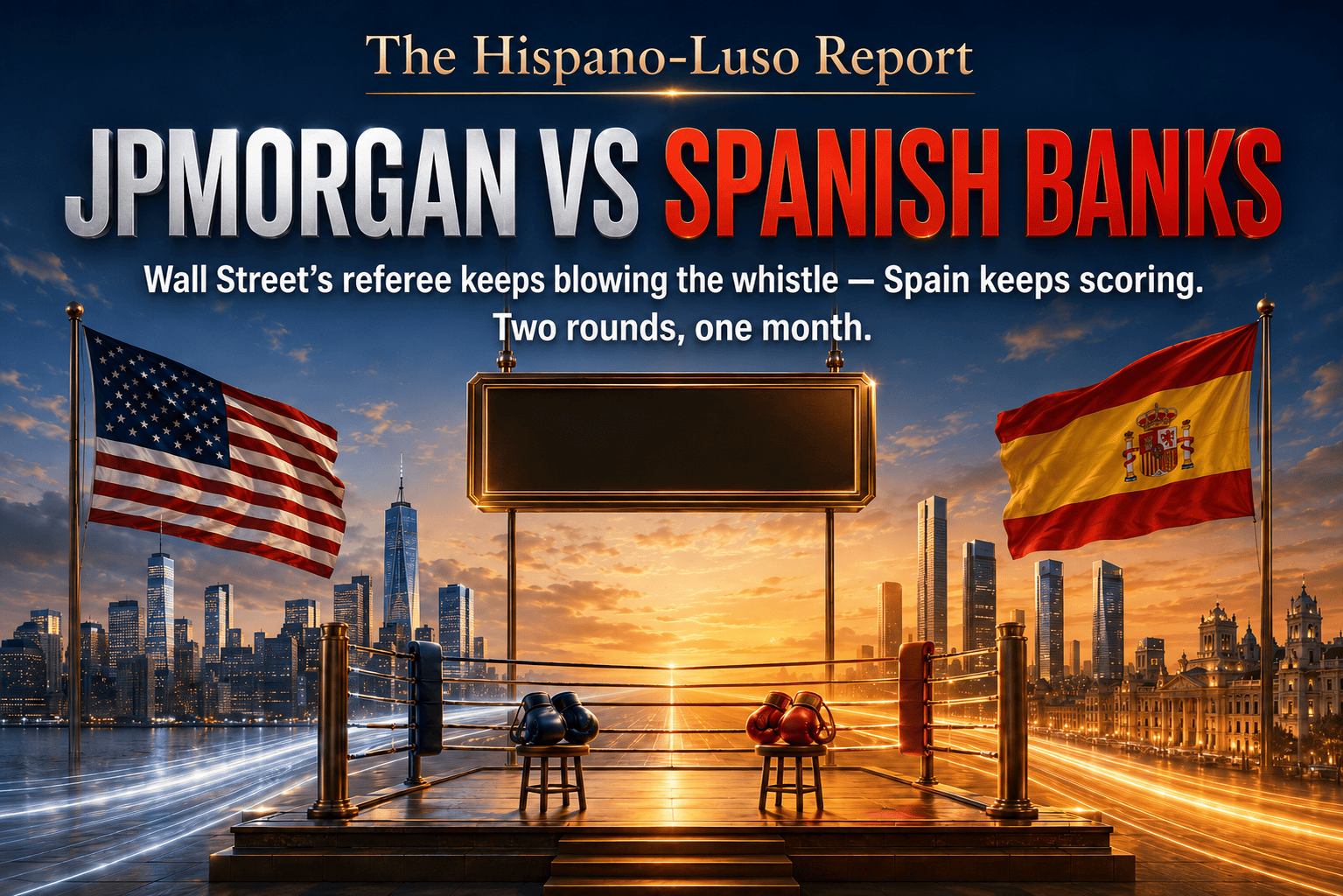
Wall Street’s referee keeps blowing the whistle — Madrid keeps scoring. Two rounds in one month, and what the argument reveals
The Hispano-Luso Report
Twice in one month, the research desk of the most powerful bank on Wall Street has delivered a sceptical verdict on a Spanish bank. Twice, the Spanish bank in question has answered — not with press releases, but with numbers.
Individually, each episode is a routine of modern markets: analysts doubt, companies rebut. Together, read from Madrid, they form a pattern worth naming — because who JPMorgan chooses to argue with, and how the argument is going, says as much about Spanish banking’s new position in the world as any league table.
Round one: Sabadell
The first whistle came after Banco Sabadell completed the sale of TSB, its British subsidiary, to Santander. JPMorgan’s analysts were brutal: with the proceeds pledged to shareholders, they judged Sabadell’s capital “fully committed,” its management left without strategic options, and cut their price target on the stock. The subtext was sharper than the arithmetic: a bank that had just sold its growth story to fund its defence — this was written in the aftermath of BBVA’s failed takeover pursuit — had, in their reading, mortgaged its future to buy its independence.
Eight days later came Sabadell’s half-year results, and with them the reply. The TSB sale generated €971 million in capital gains. On top of the €2.5 billion in shareholder distributions already promised, the board announced a further €331 million buyback. The capital that was “fully committed” had, it turned out, found room for more — and the bank’s message, delivered entirely in figures, was that selling Britain had not left the cupboard bare. It had filled it.
The argument is not settled — a buyback is a return of capital, not a growth strategy, and JPMorgan’s deeper question about what Sabadell now is remains open. But as rebuttals go, €1.3 billion of fresh shareholder value in a single results day is an eloquent one.
Round two: BBVA
The second whistle was aimed higher. A sceptical JPMorgan report questioned the strategy behind BBVA’s investment-banking expansion — the aggressive build-out of its Corporate & Investment Banking division across New York, London and Asia.
The response came from the division’s global head, Javier Rodríguez Soler, in an interview with Expansión. The report was received, he said, “with respect, like all opinions about the business — but confident that we have a very solid, very profitable growth plan.” Then he itemised the confidence: CIB has tripled in size since 2021. Its contribution to group profit has risen from roughly 20% to 30%. Headcount has grown from 3,000 to more than 5,000 — while revenues grew faster than costs. Two-thirds of the companies in the S&P 500 are now BBVA clients, served along the US–Mexico corridor the bank considers its structural advantage.
Read that last statistic again: an American index, banking Spanish. Whatever JPMorgan’s models say about the risks of the build-out — and expanding investment banking in the world’s most competitive market is genuinely risky — the incumbents’ own clients keep signing.
Why the whistle matters
JPMorgan’s research desk is the closest thing global capital has to a referee. Its notes reallocate billions; its doubts become other investors’ questions; its price targets anchor negotiations. When it speaks about Spanish banks, money moves — which is precisely why the subject of its scepticism matters more than the scepticism itself.
A decade ago, Wall Street’s notes on Spanish banking were about survival: capital holes, bad loans, the sector as Europe’s patient. The 2026 vintage is different in kind. The Sabadell note argues about capital allocation choices. The BBVA report argues about expansion strategy. These are the arguments you have with contenders, not patients — the scrutiny that is the entry fee to the top table.
There is a pleasing irony in the referee’s own diary this month, too. While its analysts doubted Sabadell and BBVA, JPMorgan advised Multiverse Computing’s €500 million round — the largest Spanish startup financing in six years — and its asset-management arm prepared the sale of its Spanish gym chain into a hot market. The house doubts Spanish banks and does brisk business in Spain. Both things are true, and neither is hypocrisy; it is what full-service finance looks like. But it does rather underline that the question is no longer whether Spain is investable — only which parts, at what price.
The honest counterweight
The analyst case deserves its due, because this Report’s job is the argument, not the cheerleading. Post-TSB Sabadell genuinely is smaller, more concentrated in one economy, and — buybacks aside — still owes the market a growth narrative. BBVA’s CIB expansion genuinely does carry execution risk: many European banks have marched into Wall Street’s home market with a plan and retreated with a write-down. JPMorgan’s scepticism is not absurd; it is the base rate talking.
What the balance sheets are arguing back is that this cycle may be different: record sector profits, Europe’s boldest buyback programmes, and — for the trophy cabinet — Euromoney naming Santander the world’s best bank this month. The referee keeps whistling. The team keeps scoring.
The scoreboard
Perhaps the truest reading is the simplest: Spanish banking has become interesting enough to argue with. The analysts see risks; the balance sheets see room; and the argument itself — conducted in price targets and buybacks across the Atlantic — is the surest sign of a sector that has traded its decade of apologies for a seat at the table it once feared.
The Hispano-Luso Report tracks the Spanish- and Portuguese-speaking business news that English-speaking coverage overlooks — analysed beyond the English-language headlines. Sources: Expansión, elEconomista, Banco Sabadell and BBVA disclosures, J.P. Morgan research coverage as reported in the Spanish financial press.