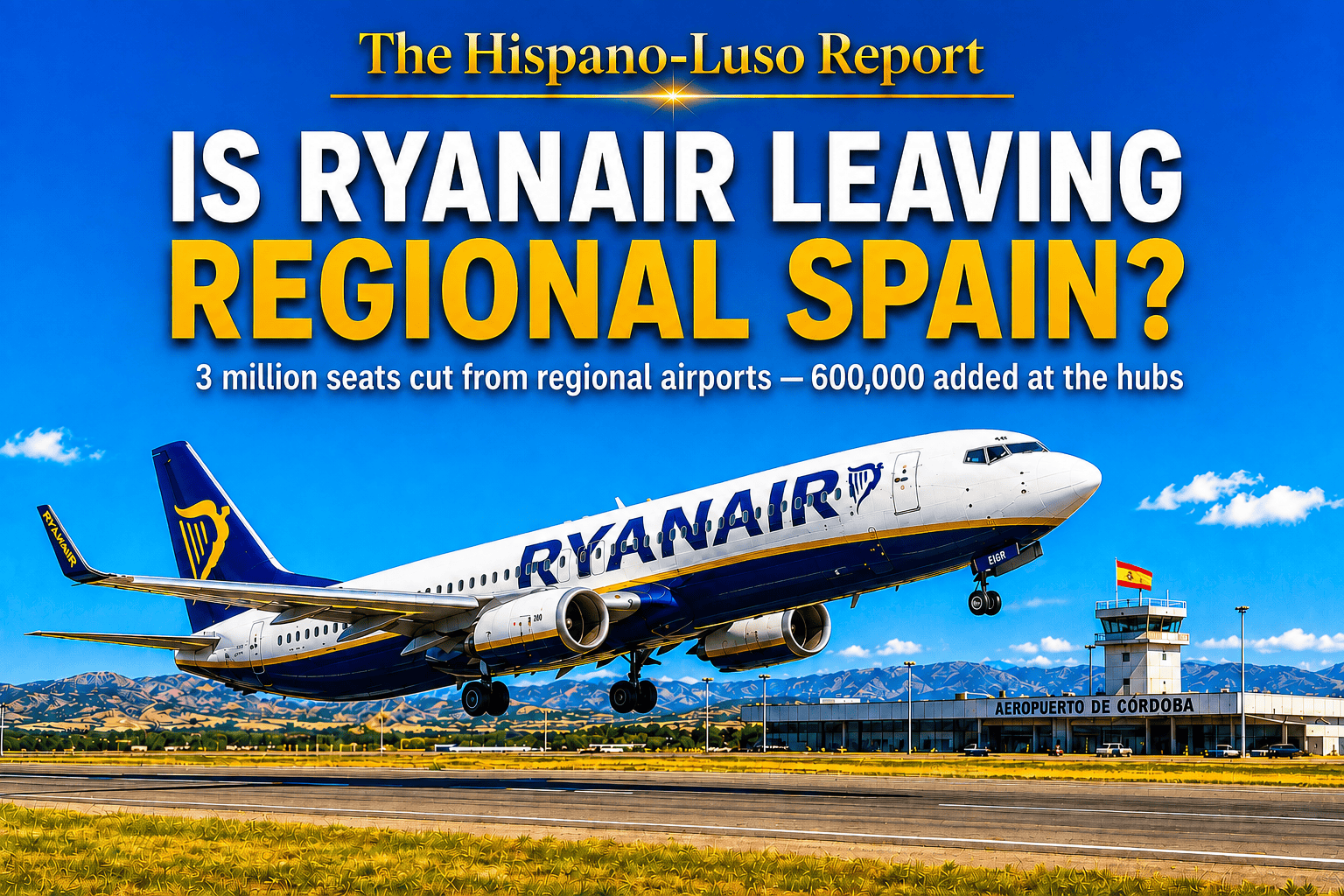
3 million seats cut from regional airports, 600,000 added at the hubs — the map, the fight over why, and the 300 aircraft that will settle it
The Hispano-Luso Report
The question sounds dramatic; the map answers it precisely. Between 2025 and 2026, Ryanair has cut some three million seats from Spain’s regional airports — the Valladolids, the small-city airfields whose entire international connectivity often wears one shade of blue and yellow — while adding around 600,000 seats at the great hubs: Madrid, Barcelona, Palma, Málaga. So: is Ryanair leaving regional Spain? Partially, measurably, and by design — the airline is not leaving Spain; it is leaving the Spain that doesn’t pay. And note the arithmetic the reallocation framing softens: three million out against six hundred thousand in is a net reduction of some 2.4 million seats in the country overall. This is not a neutral reshuffle. It is a shrinkage, aimed.
The two stories — printed, not adjudicated
Why is it happening? Spain’s government and Europe’s biggest airline tell two different stories, and this Report prints both at full strength. Ryanair’s version, per Eddie Wilson, chief executive of its main airline: Spanish airport fees are the problem — and with 300 new aircraft arriving in the coming years, the allocation is a live auction: cut the tasas, and Spain gets jets; hold them, and the growth goes elsewhere. Capacity, in this telling, is a price signal wearing wings. The government’s version, delivered this week by transport minister Óscar Puente with unusual directness: the airline is “disguising its problems” — an aircraft-delivery shortage afflicting the whole industry (“the orders aren’t arriving”) — as a fee dispute, using capacity cuts as leverage against public coffers. His evidence: Ryanair keeps flying, profitably and at scale, from Madrid-Barajas — “very profitable” despite the highest fees in the country — while pulling out of cheaper Valladolid. If fees decided everything, the map would run the other way.
Both stories contain verifiable truth: the delivery crisis is real and industry-wide; the fee sensitivity is real and Ryanair-native; and the airline’s Barajas behaviour does complicate its own argument. The reader referees. What neither side disputes is the map itself — and the map is the story.
The prize: 300 aircraft and a €13bn network
Understand what the war is actually about, because it is not about last winter’s cuts — it is about the next decade’s growth. Ryanair’s incoming fleet of 300 aircraft is among the largest capacity waves in European aviation history, and every government on the continent understands that its allocation is negotiable. Spain’s counter-position is its own infrastructure programme: DORA III, the 2027-31 framework, carries some €13 billion of investment across the airport network — the state’s argument that its fees buy world-class capacity, not bureaucracy. And behind the fees stands Aena — a company this masthead notes with its standing interest, because Spain’s airport operator is the world’s largest by passengers and runs, among other things, London Luton: in the two-way invasion this Report chronicles, the Irish airline dominating Spanish skies is answered by the Spanish operator collecting fees at a London airport. Puente’s boast — “there’s no country in the world that wouldn’t want Aena managing an airport” — is a minister talking his book, and it is also, awkwardly for his adversary, roughly true.
The domestic investment wars
Here is the frame regular readers will recognise, shrunk to provincial scale. This Report has spent a season covering nations competing for capital with statutes, tax freezes and incentives. Spain’s regions are now running the same auction for Irish aircraft — Valladolid against Barajas, the small airfields against the hubs, each with its cost structure as its bid — except the regions hold almost none of the levers: airport fees are set through the national framework, which means the communities losing connectivity cannot simply outbid the hubs even when their underlying costs are lower. The result is the quiet casualty of this war: regional connectivity — the small city whose direct flight to London or Brussels was its business community’s artery, now rerouted through a two-hour drive to a hub. The 100-million-tourist milestone Spain is chasing will be delivered through Barajas and El Prat regardless; the question the reallocation asks is what happens to the Spain between the hubs.
The honest reality
The counterweights, in their standing place. Both sides talk their books — an airline negotiating fees and a minister defending a state operator are equally interested witnesses, and this piece adjudicates neither. “Leaving” overstates and understates at once: Ryanair remains massively committed to Spain — the hub growth is real — and yet the net national seat count is falling, so neither the airline’s “reallocation” framing nor the dramatic “exit” framing survives the arithmetic intact. The minister’s own saturation admission complicates the state’s case: Puente concedes Barajas’s “seams are at their limit” — a hub-concentrated model has physical ceilings, which is quietly an argument for the regional capacity his adversary is cutting. And the delivery shortage is genuinely industry-wide — whatever its use as rhetorical cover, the aircraft really aren’t arriving, which means some of these cuts would exist under any fee regime. The dispute is real; so is the fog.
The scoreboard
The watch-list takes its gates, and they are unusually concrete: Ryanair’s winter schedule (the next capacity map, where rhetoric becomes routes), the DORA III approval (Spain’s €13bn counter-argument, formalised), any fee negotiation that breaks the deadlock — and, above all, the running answer to the war’s true question: where do the 300 aircraft land? Every allocation announcement is a scoreboard update. Is Ryanair leaving regional Spain? The honest answer this piece files: it is leaving the parts of Spain that lose the auction — and the auction has years left to run. Watch the winter schedule.
The Hispano-Luso Report tracks the Spanish- and Portuguese-speaking business news that English-speaking coverage overlooks — analysed beyond the English-language headlines. Sources: Europa Press interview, ministerial and company statements, Aena and Ryanair communications.