Bank of America’s investor survey puts Chile back on top — and the shift says more about the region than a monthly ranking
The Hispano-Luso Report
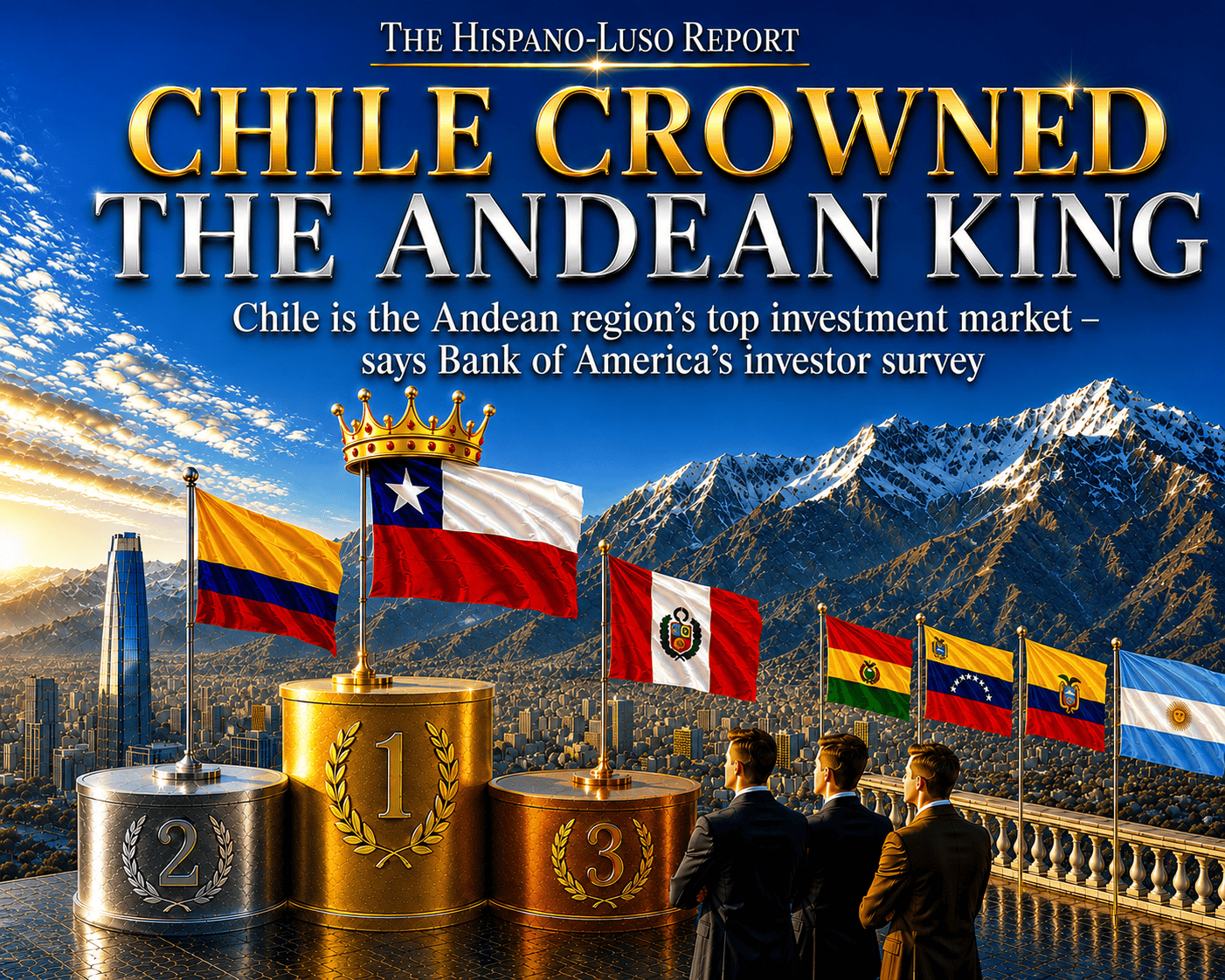
The crown moved, and now it has moved back. In June, Colombia displaced Chile as investors’ preferred Andean market; by July, it had consolidated the lead. This month, the throne is Chile’s again. Bank of America’s latest investor survey puts Chile first among the Andean markets for expected outperformance over the next six months, with close to one-third of respondents backing it to beat the rest of Latin America. Colombia, once the clear favourite, has slipped to around 30%, down from 37% in July; Peru sits further back at roughly 20%. The percentages are not enormous. The message is. Chile has reclaimed the Andean crown — and it has done so at precisely the moment international investors are becoming more selective about where they put their money. That is the interesting part. This is not simply a league table. It is a snapshot of what global capital currently wants from Latin America — and Chile is once again looking like the cleanest answer.
The survey, precisely
Bank of America asked 30 fund managers overseeing approximately US$90 billion in assets which Andean markets they expected to outperform Latin America over the following six months. Chile emerged first, with close to one-third of respondents choosing it. Colombia followed at around 30%, while Peru attracted roughly 20%. And the movement matters more than the ranking itself: Colombia’s support fell from 37% in July to around 30% in August, while Peru also declined, from approximately 27% to 20%. Chile, meanwhile, moved into first place. So date-stamp the rotation: Colombia up, Chile down; Colombia down, Chile up. The crown is not being handed to Chile because investors suddenly discovered the country. They are reassessing the alternatives.
The arc — the crown changing hands
Regular readers can recite the sequence, so simply date-stamp it. Chile began the year as the preferred Andean story. Colombia then took the lead, reflecting stronger investor enthusiasm for its valuation and political opportunity. Chile subsequently regained ground as expectations around its political direction improved. Bank of America itself has highlighted the significance of Chile’s political shift, arguing that the outcome increases the probability of more market-friendly policies and better governability. The market had already been doing some of the talking: the IPSA rose 53% during 2025, according to Bank of America, moving above its post-2019 average, while the bank subsequently increased its exposure to Chile as it reduced its view on Brazil and highlighted Chile and Colombia as better positioned within the regional environment.
Then there is the independent confirmation. Credicorp Capital’s 2026 Andean strategy calls Chile its top market choice, citing pension reform, higher lithium prices, strong retail earnings and a more stable regulatory environment; LarrainVial is similarly constructive, preferring Chile and Peru over Colombia and forecasting 17% earnings growth for the IPSA in 2026, driven by recovery in lithium, stronger financial-sector earnings and improved operating performance. One survey can move. A thesis supported by several investment houses is harder to dismiss.
The crown
Sit with the reason Chile keeps returning to the top. It is not simply copper. It is not simply lithium. It is not simply politics. It is the combination. Chile offers something unusually valuable in emerging markets: deep capital markets, established institutions, a sophisticated financial system and exposure to the commodities the global economy increasingly needs. Copper sits at the centre of electrification, grids, infrastructure and the energy transition. Lithium remains strategically important to the battery economy. Chile has both. But resources alone do not make an investment destination. The market needs a mechanism for turning those resources into returns. That is where Chile’s institutional depth matters.
Credicorp notes that liquidity in Chile has continued to recover, with average daily trading volumes rising from US$122 million in 2023 to US$183 million, while local investors have returned amid pension reform and expectations of business-friendly political outcomes. That is the less glamorous half of the story. And it may be the more important one. Chile does not merely possess the commodities. It possesses the financial infrastructure to monetise them.
Colombia’s crown slips
None of this means Colombia has suddenly become unattractive. Quite the opposite. Around three in ten investors still expect it to outperform over the next six months. But the direction matters. A month ago, 37% of respondents backed Colombia. Now it is around 30%. Chile has moved ahead. Peru has fallen further behind. That tells us something about the market’s current hierarchy. Colombia remains the high-upside proposition: lower valuations, substantial energy exposure and the possibility of a political and fiscal re-rating. But that possibility is exactly the point. Chile increasingly looks like the market where investors can see the path. The distinction is subtle but important: Colombia offers the possibility of a rerating. Chile is increasingly being priced as if the rerating is already becoming structural. And in a region where politics can change the investment case overnight, that visibility has value.
The honest reality
The counterweights, at full weight, because crowns are where complacency begins. Copper is the obvious vulnerability. Bank of America investors identified a fall in copper prices as the principal extreme risk for the Andean markets, ahead of oil prices and climate events, while lithium prices and pension reforms also featured among the risks. Chile is no longer undiscovered. The IPSA has already enjoyed a substantial run, and valuation multiples are above their three-year averages; Credicorp puts Chile’s forward 12-month P/E at 11.6x, compared with 14.1x for Peru and 7.7x for Colombia.
The global backdrop is less forgiving. Higher US interest rates and a stronger dollar are now the principal external risks cited for Latin American equities. Only 16% of respondents to the latest survey planned to increase their equity exposure over the next six months — the lowest proportion since October 2024 — while average cash levels had risen to 6%. And then there is the political discipline: a more market-friendly Chilean direction is an opportunity, not a guarantee. The crown is the market’s judgement, not a constitutional entitlement.
The Argentina question
There is one comparison worth making because it exposes what makes Chile’s position so interesting. Argentina is the region’s great transformation trade. Vaca Muerta. Energy exports. Economic liberalisation. A potentially profound change in the country’s relationship with international capital. The upside can be enormous. But the risk is enormous too. Chile represents almost the opposite proposition. It does not need to reinvent its economic model to become investable. It needs to execute better on an existing platform. That distinction explains why Chile can win investor preference even when Argentina is generating some of the region’s most exciting headlines. One is a turnaround story. The other is a compounding story. For institutional capital, those are very different things.
The scoreboard
Mark the milestone at its true size: Chile has retaken the Andean crown from Colombia. Not because Colombia has collapsed. Not because Peru has disappeared. And certainly not because investors have stopped worrying about Latin America. Quite the opposite. They are becoming more discriminating. And when the question is which Andean market can outperform the rest of the region over the next six months, the answer from Bank of America’s latest survey is now Chile.
The watch-list therefore becomes unusually clear: copper prices, the delivery of Chile’s more business-friendly political agenda, the earnings trajectory of the IPSA, lithium prices, pension reform and — because crowns in emerging markets rarely stay still — whether Colombia can take the throne back again.
That is the real story behind the survey. The Andean crown has changed hands twice. For now, Chile has it. And the market is telling us why: when global capital becomes more selective, the winner is not necessarily the country with the biggest turnaround story. Sometimes it is the country that already has the institutions, the resources and the market — and has finally given investors a reason to believe all three can work together again.
Chile is crowned the Andean king.
The Hispano-Luso Report tracks the Spanish- and Portuguese-speaking business news that English-speaking coverage overlooks — analysed beyond the English-language headlines. Sources: Bank of America investor survey, Bloomberg Línea, Credicorp Capital, LarrainVial.