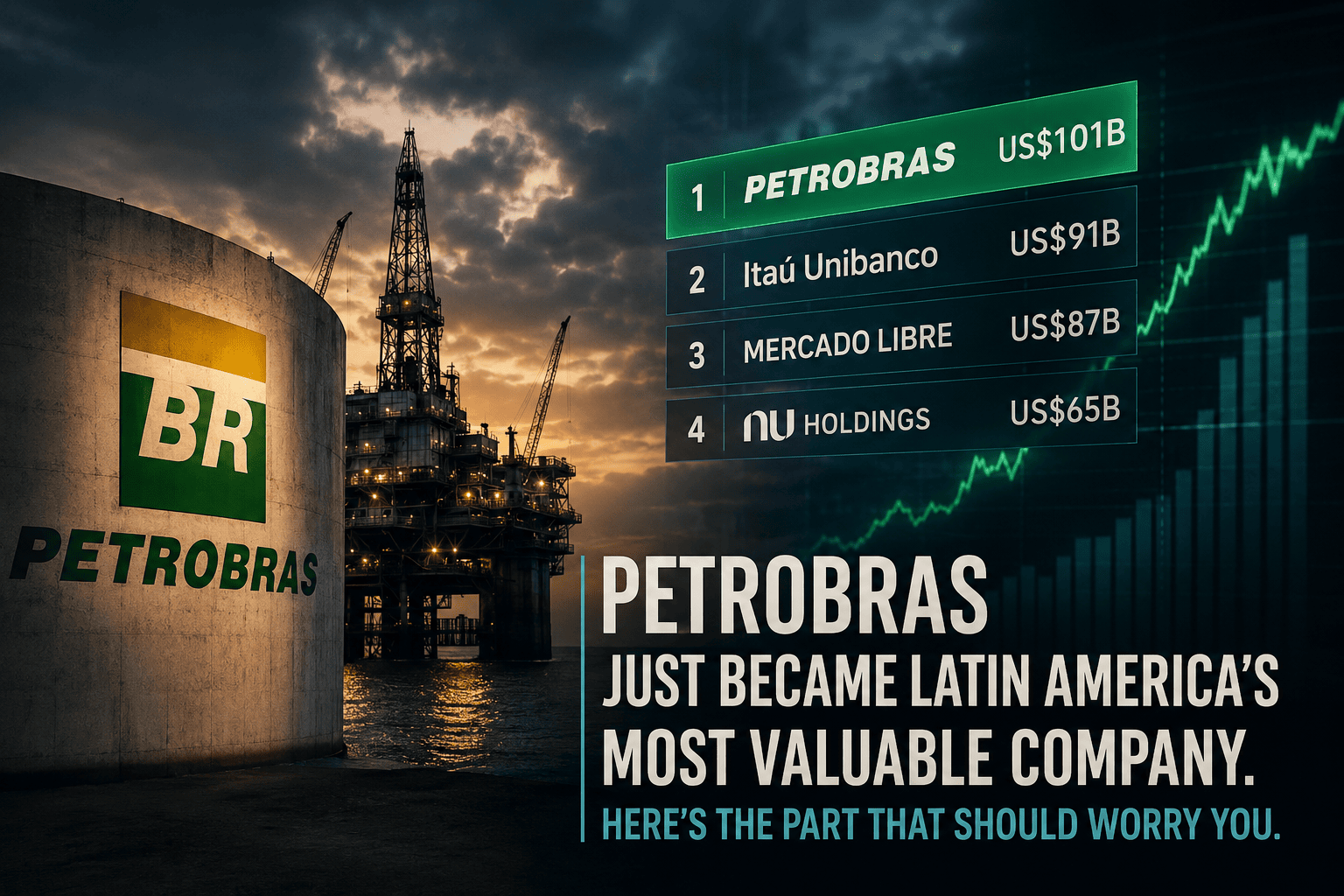
This week, Petrobras overtook Mercado Libre to become the most valuable publicly traded company in Latin America, with its market capitalisation jumping from roughly US$75 billion to more than US$101 billion. Itaú Unibanco also leapfrogged Mercado Libre in the regional rankings. Nu Holdings, the fintech that once looked unstoppable, slid down the table.
Most coverage will stop there — a leaderboard shuffle, a stat for the markets pages. But the interesting part is found in the why.
Petrobras didn’t get more valuable because it drilled a transformative well, launched a breakthrough product, or restructured its balance sheet. It got more valuable because oil prices spiked on the back of the US-Iran conflict — a war with no direct connection to Brazil, Latin America, or anything Petrobras itself did this quarter. The company’s market value moved because a geopolitical shock eight thousand kilometres away made the thing it pumps out of the ground more expensive.
That’s worth sitting with for a moment.
The story everyone will skip
For the better part of a decade, the dominant narrative about Latin American markets has been one of transition — away from commodities, towards platforms, fintech, and consumer tech. Mercado Libre was the poster child of that story: an e-commerce and payments giant built on network effects and reinvestment, not barrels or ore. Its rise to the top of the regional rankings was treated, reasonably, as a signal that the region’s growth engine was changing.
This week’s reshuffle quietly complicates that story. The company that knocked Mercado Libre off the top spot isn’t a disruptor. It’s a partially state-owned oil major whose fortunes just moved on the back of a war in the Middle East. And it wasn’t alone — Itaú, a traditional bank benefiting from a higher-rate, risk-off environment, also climbed past Mercado Libre, while Nu Holdings, the region’s highest-profile digital bank, lost ground.
Put plainly: when global markets got nervous this week, capital rotated out of Latin America’s growth story and back into the region’s oldest and most familiar hedges — oil and traditional banking. That’s not a condemnation of Mercado Libre or Nu, whose underlying businesses haven’t changed. It’s a reminder of something less comfortable: Latin America’s most-valuated company can still be reshuffled overnight by a conflict its own governments have no say in.
Why this matters beyond the leaderboard
For readers outside the region, this is worth watching for two reasons that have nothing to do with which logo sits at the top of a ranking.
First, it’s a live data point on how exposed Latin American markets remain to global commodity and geopolitical cycles, even after a decade of diversification rhetoric. Investors who’ve allocated to the region on a “new economy” thesis got a reminder this week that the old economy — oil, banking, hard assets — still has the power to reassert itself in a single trading session.
Second, it’s a signal worth reading alongside the other regional story this week: the Mercosur summit in Asunción, where the bloc formally opened trade talks with Japan while leaving its EU quota dispute unresolved. Both stories point the same direction — a region trying to build new, diversified economic relationships (with Japan, with the EU, with tech-driven growth companies) while remaining, for now, structurally tied to the commodity cycles and legacy institutions that have defined it for decades. The aspiration and the reality are pulling in different directions, and this week’s market data sided with reality.
What the English-language coverage is missing
Here’s the detail that’s largely absent from this week’s English-language wires: this is not the first time in 2026 that Petrobras has retaken the crown.
Back in late February, Petrobras reclaimed the title of Latin America’s most valuable company at roughly US$107.8 billion — and it wasn’t alone. BTG Pactual and Itaú Unibanco also overtook Mercado Libre in that same stretch, making the top three companies in Latin America entirely Brazilian for the first time on record. English-language outlets covered that moment as a landmark, a one-off changing of the guard.
It wasn’t. Mercado Libre clawed its way back to the top in the months since, and now Petrobras has retaken it again. That’s the real story: the leadership of Latin America’s markets isn’t just shifting — it’s oscillating, and it’s oscillating faster than it has in years, in step with global risk sentiment rather than anything happening on the ground in São Paulo or Buenos Aires. Cover this week’s swap in isolation, as most English-language finance desks will, and you get a tidy headline. Cover it as the second reversal in five months, and you get a genuinely uncomfortable insight into how thin the “new economy” story’s grip on the top spot has become.
Part of this gap is structural. Much of the English-language coverage of Latin American markets is sourced secondhand — from wire summaries and Bloomberg terminal data rather than from the primary reporting done by outlets like Chile’s Diario Financiero or Brazil’s Valor Econômico, who track the local nuance (which exchange, which currency conversion, which local index provider) that gets flattened by the time it reaches an English-language desk. It’s a smaller-scale version of the same localisation problem I wrote about a few weeks ago with Google and Brazil: the version of the story that travels is rarely the version built with the full context intact.
Why this is a translation-industry story too
There’s a more direct professional angle here, and it’s one I’d be remiss not to flag: overnight reshuffles like this one are exactly the moments when the demand for precise financial and legal translation spikes.
Petrobras is dual-listed — its primary disclosures are filed in Portuguese with Brazil’s CVM, but as a NYSE-listed ADR it also owes SEC filings in English, and any material gap between the two versions is a genuine legal and market risk, not a stylistic quibble. The same is true of its ESG and pre-salt environmental compliance reporting, which international investors increasingly scrutinise before allocating capital, and of the legacy Lava Jato-related litigation documentation still working its way through US courts, where mistranslated evidentiary material has real consequences. When a stock like this suddenly reappears at the top of every investor’s watchlist, the bilingual paper trail behind it — filings, disclosures, court records — gets scrutinised harder and faster than usual.
It’s the invisible infrastructure behind a headline like this one: nobody writes the story “translators kept Petrobras’s disclosures accurate this week,” but the accuracy of that infrastructure is precisely what lets a story like this be reported reliably at all.
The uncomfortable question
None of this means Petrobras “deserves” the crown less than Mercado Libre did, or that the transition story was wrong. Markets reward what they reward, and a state oil major benefiting from a war is not a moral failing — it’s just what happened.
But it does raise a question worth asking plainly: if Latin America’s most valuable company can change hands overnight because of a conflict in the Middle East, how much of the region’s “new economy” narrative is actually structural — and how much is still riding on commodity tailwinds that could reverse just as fast as they arrived?
That’s not a question this week’s headlines will ask. It’s the one worth asking anyway.
This is this Wednesday’s Hispano-Luso Report. If you found it useful, I’d welcome your thoughts in the comments — particularly if you cover Latin American markets and have a different read on the rotation.