Hispano-Luso Report — from the Spanish- and Portuguese-language press, before it reaches the English-language news
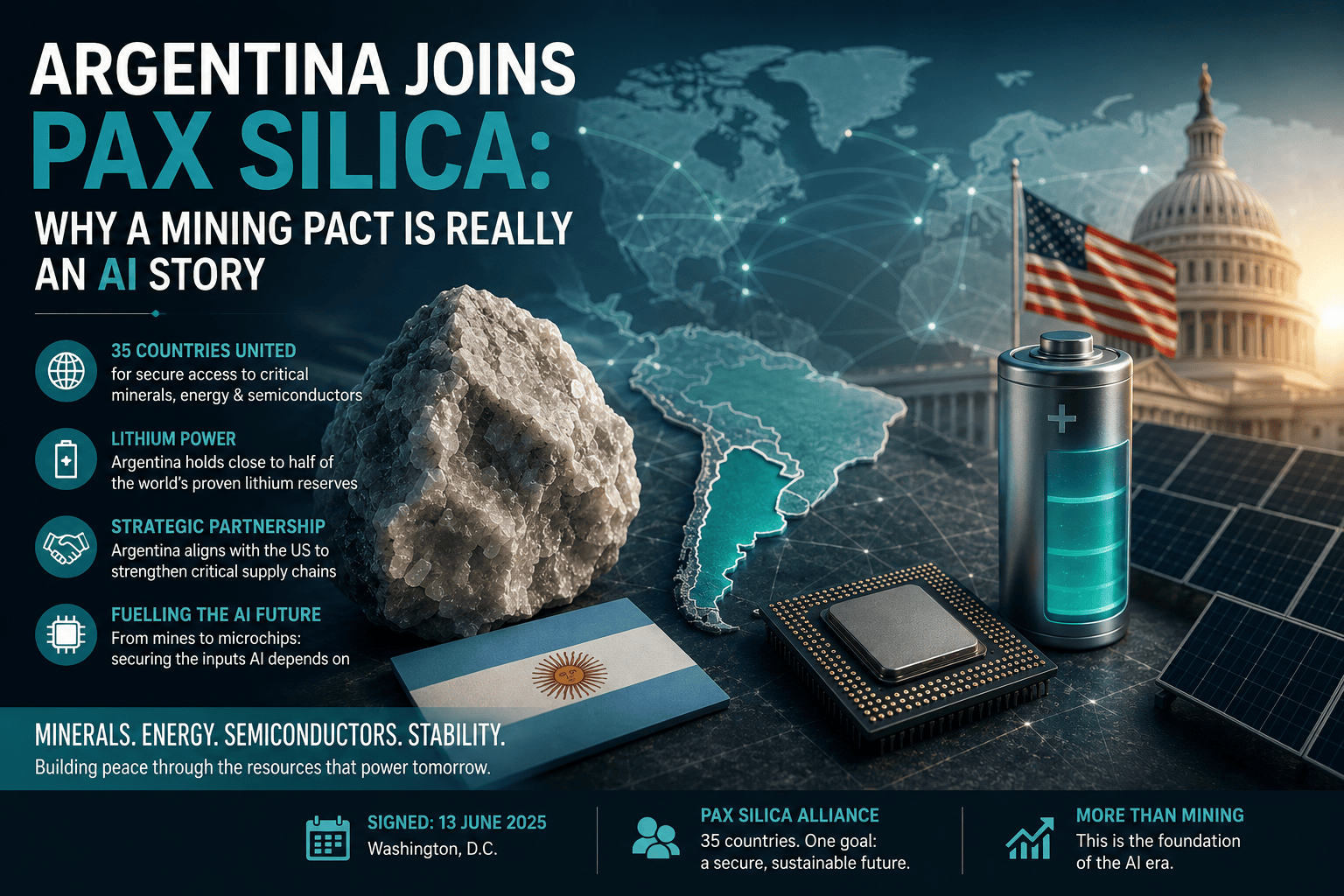
On Friday, Argentina signed up to Pax Silica, a US-led alliance of 35 countries built to secure the raw materials, energy and semiconductors that artificial intelligence depends on. The declaration was signed in Washington by Argentina’s ambassador to the United States, Alejandro Oxenford, at the US Institute of Peace. It barely registered in the English-language press over the weekend — which is precisely why it is worth your attention. This is not a mining story dressed up in technology language; it is one of the clearer signs yet of how the AI build-out is quietly redrawing the map of who supplies what to whom.
What Pax Silica actually is
The name is worth pausing on, because it tells you how the alliance wants to be understood. Pax is the Latin for peace; silica is the silicon at the heart of every semiconductor. The pact frames secure access to critical minerals, energy and chips as a matter of collective stability rather than commercial advantage — a notable piece of positioning at a moment when supply chains have become an instrument of geopolitics.
The grouping now spans 35 states, among them Chile, Australia, Japan, the United Kingdom, South Korea, Israel, Italy, Germany, India and Portugal. The shared aim is to lock down the full chain that AI runs on: the strategic minerals and energy at one end, the semiconductors, data-centre infrastructure and logistics at the other. For a country that can supply the first half of that chain, membership is less a diplomatic courtesy than an invitation to the table.
Why Argentina, and why now
Argentina belongs in this alliance for a single, concrete reason: lithium. Together with Chile, it holds close to half of the world’s proven lithium reserves — the metal at the centre of the batteries and energy storage that both electrification and AI’s power-hungry data centres require. That geological fact is what turns a mid-sized economy into a strategic supplier, and it is what the country’s officials were selling in Washington.
The pitch leaned heavily on the RIGI, Argentina’s incentive regime for large investments, which offers tax and customs benefits over a 30-year horizon for major projects. The message to foreign capital is straightforward — the resources are here, and so is a regulatory framework designed to keep them accessible for decades. Whether that stability holds is the open question any investor will weigh, but the intent is unambiguous.
It is also worth being clear-eyed about what was actually signed. This is a declaration of cooperation and intent, not a binding contract with capital attached. The value is in the signal and the access it confers, not in any guaranteed flow of investment — and the gap between the two is where these arrangements are often won or lost.
The 18-month arc behind the headline
The detail most English-language coverage will miss is that Friday’s signing was not a standalone event. It was the culmination of an alignment that has been building for a year and a half. In August 2024, Buenos Aires signed a memorandum of understanding with the US State Department on the governance and security of critical-mineral supply chains. In February of this year, after a meeting with US Secretary of State Marco Rubio, the two countries signed a framework instrument on strengthening mineral supply and processing. Pax Silica is the third step in a deliberate sequence, not a one-off photo opportunity — which is why it should be read as a settled direction of travel rather than a gesture.
That sequence sits inside the broader foreign policy of President Javier Milei, who has repeatedly positioned Argentina alongside the United States. For anyone tracking the country, the takeaway is that its resource diplomacy and its geopolitical alignment are now moving as one.
Why it matters to you
If your business touches AI infrastructure, energy or cross-border supply chains, the relevant shift here is structural. The contest to secure the inputs for artificial intelligence is no longer confined to chips and the companies that design them; it now reaches all the way back to the mines, and it is pulling resource-rich emerging economies into formal alignment with Washington. Argentina has just declared which side of that line it intends to sit on, and it has done so as a supplier the alliance genuinely needs rather than a peripheral signatory.
For European and North American firms, that has two practical implications worth holding in view. The first is that critical-mineral access is increasingly bundled with political alignment — where you can source from may depend on alliances as much as on price. The second is that a country actively courting investment under a 30-year incentive regime is, for the right operator, an opening rather than a risk. As ever, the interesting question is not what was announced, but what the people who signed it intend to do next.
Paul Brown is a Spanish & Portuguese to English translator specialising in legal and financial documents — paulbrowntranslation.com.