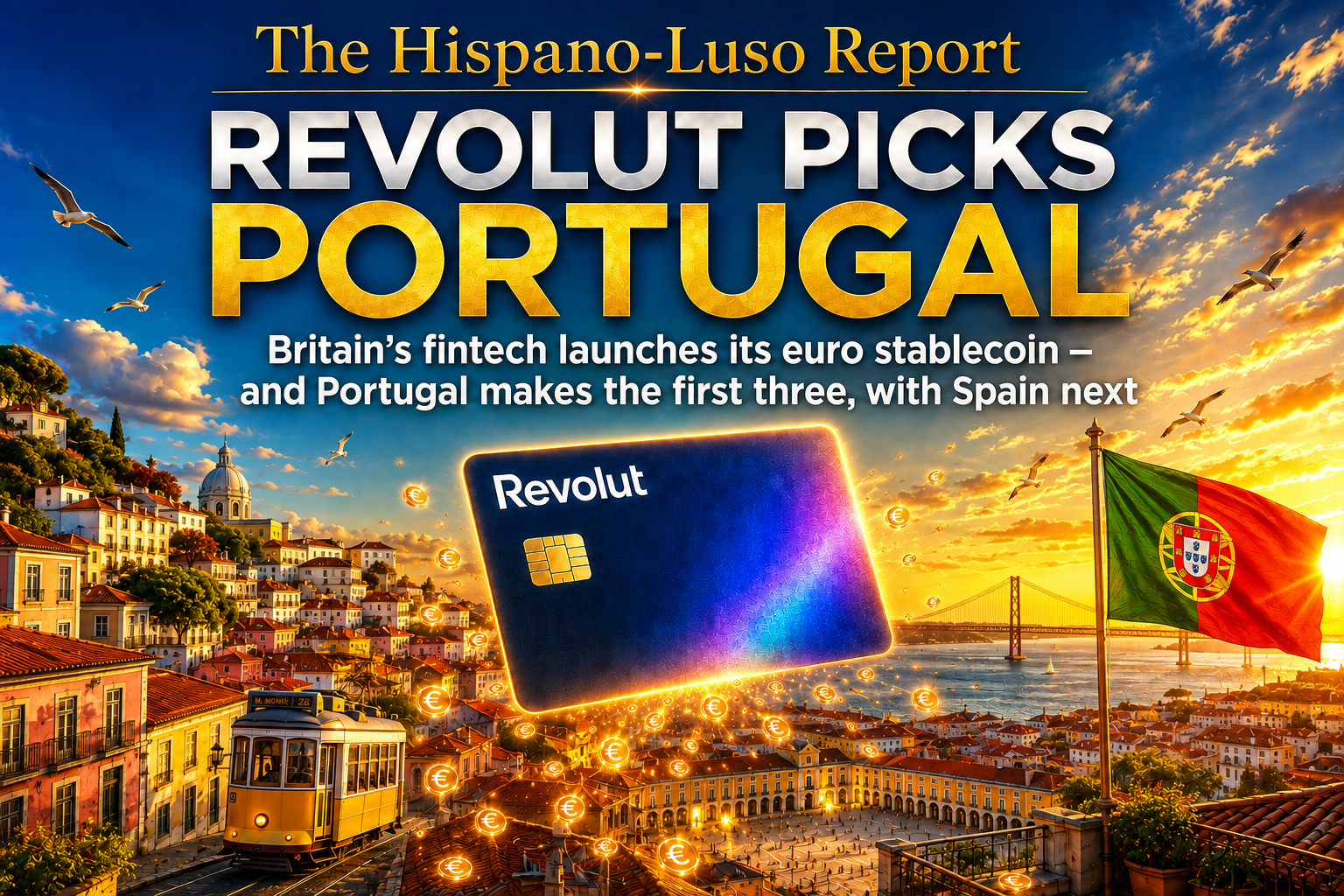
Britain’s fintech launches its euro stablecoin — and Portugal makes the first three, with Spain on the next-up list. The invasion’s first product ashore
The Hispano-Luso Report
The watch-list entry read, for weeks: Revolut’s Iberia switch-on — await the first product. This week it arrived, and it arrived with a compliment attached: Revolut has launched a euro-indexed stablecoin in three countries — and Portugal is one of the chosen three, with Spain sitting on the announced next-up list. Britain’s most valuable fintech, fresh from its French banking licence and its declared Western European ambitions, has put its first Iberian boot ashore — in Lisbon, before Madrid, before most of the continent.
What launched, precisely
The tongs first, because the product deserves plain description rather than crypto-glamour. A euro-indexed stablecoin is a digital token designed to hold a fixed one-to-one value with the euro — a euro that lives on blockchain rails, spendable and transferable at internet speed, redeemable at par. Under the EU’s MiCA framework, such tokens are now regulated instruments rather than crypto-frontier experiments, and the major fintechs are racing to issue them. What Revolut launched, then, is not a bank, not a branch network, and not the full Iberian banking operation its Paris-licensed entity has promised — it is one product, in three test markets, of which Portugal is one. The precision matters: this is the invasion’s first boot, not its army. But first boots are how invasions are dated.
Why Portugal
The selection is the story’s flattering half, and the pattern behind it is one this Report’s Luso file has been assembling for a season. Portugal keeps being chosen as the anglosphere’s Iberian test kitchen: the crypto-friendly tax regime that made Lisbon a digital-asset capital, the tech-literate adoption curves that make it an ideal pilot market, the data-infrastructure landings at Sines — and now a British fintech choosing Portuguese wallets for its first euro-token experiment. The context tide matters too: foreign direct investment into Portugal recovered to €6.7 billion in the first half — the quiet arrivals-number of a country that wins capital without the statute-theatre its larger neighbours perform. The boot lands on a rising tide: Portugal is not begging for the anglosphere’s money and products; it is being selected for them, which is the better position in every auction this Report covers.
The sovereignty layer
Now place the product inside the month’s running franchise, because a euro stablecoin is not just a fintech feature — it is a sovereignty instrument. The stablecoin world is, today, a dollar empire: the giant tokens that move value across the internet are dollar-pegged, which quietly extends American monetary reach into every wallet that holds them. A euro token — regulated under Europe’s own framework, pegged to Europe’s own currency — is the monetary wing of the same argument this Report has tracked through the AI gigafactories and the sovereign-cloud doctrine: Europe building alternatives to anglosphere-controlled infrastructure. The irony completes the file rather than undermining it: Europe’s monetary-sovereignty token arrives in Portugal via a British app — the escape vehicle is itself made in London, exactly as the gigafactory’s sovereignty runs on Californian chips. The sovereignty column now spans compute, banking AI, data residency — and money itself, each entry carrying the same fingerprint: the tools of independence, supplied by the power being escaped.
The invasion ledger
And the two-way traffic, duly logged. The same season Santander completed its Connecticut purchase and became continental Europe’s most valuable bank, Britain’s fintech champion landed its first product in Iberia — the invasion running in both directions, at wildly different tonnage: a stablecoin ashore in Lisbon against an $80-billion bank absorbed in New England. The asymmetry line this Report filed at dawn holds its gentler corollary here: both directions are real, and the small boot may yet matter — Revolut’s model has scaled from less, and the next-up list is the schedule of escalation. Spain’s activation is now the watch-list’s dated successor: when the token (and, later, the full banking operation) crosses the border, the Iberian invasion has its second beachhead.
The honest ledger
The counterweights, in their standing place. A product is not a bank — the full Iberian banking launch remains phase-later under the Paris licence, and this piece grades today’s event as the pilot it is. Euro stablecoins are minnows — the dollar giants dwarf every euro token issued to date, and adoption is the entire question: a launch proves intent, usage proves markets. The fifth check hums — launch-country selection is partly public relations, and “chosen” is the company’s framing gladly amplified by the chosen. And three test markets are an experiment, not a commitment — pilots get quietly shelved in fintech more often than they get scaled. The compliment is real; so is its revocability.
The scoreboard
Mark the date regardless: the Revolut-Iberia thread, watched since the French licence, produced its first consummated event — and Portugal, again, got picked first. The watch-list takes its gates: Spain’s switch-on (the announced next), any usage or adoption numbers (the proof layer), and the full Iberian banking launch that remains the thread’s main event. The Luso file takes its satisfying note: in the season the masthead’s Spanish giants bought Connecticut and topped the world’s construction league, its smaller wing kept winning the quieter contest — being chosen. First the data cables, then the capital recovery, now the first euro-token wallets. Lisbon keeps getting picked. Watch Spain’s date.
The Hispano-Luso Report tracks the Spanish- and Portuguese-speaking business news that English-speaking coverage overlooks — analysed beyond the English-language headlines. Sources: Jornal de Negócios, Revolut statements, Banco de Portugal data.