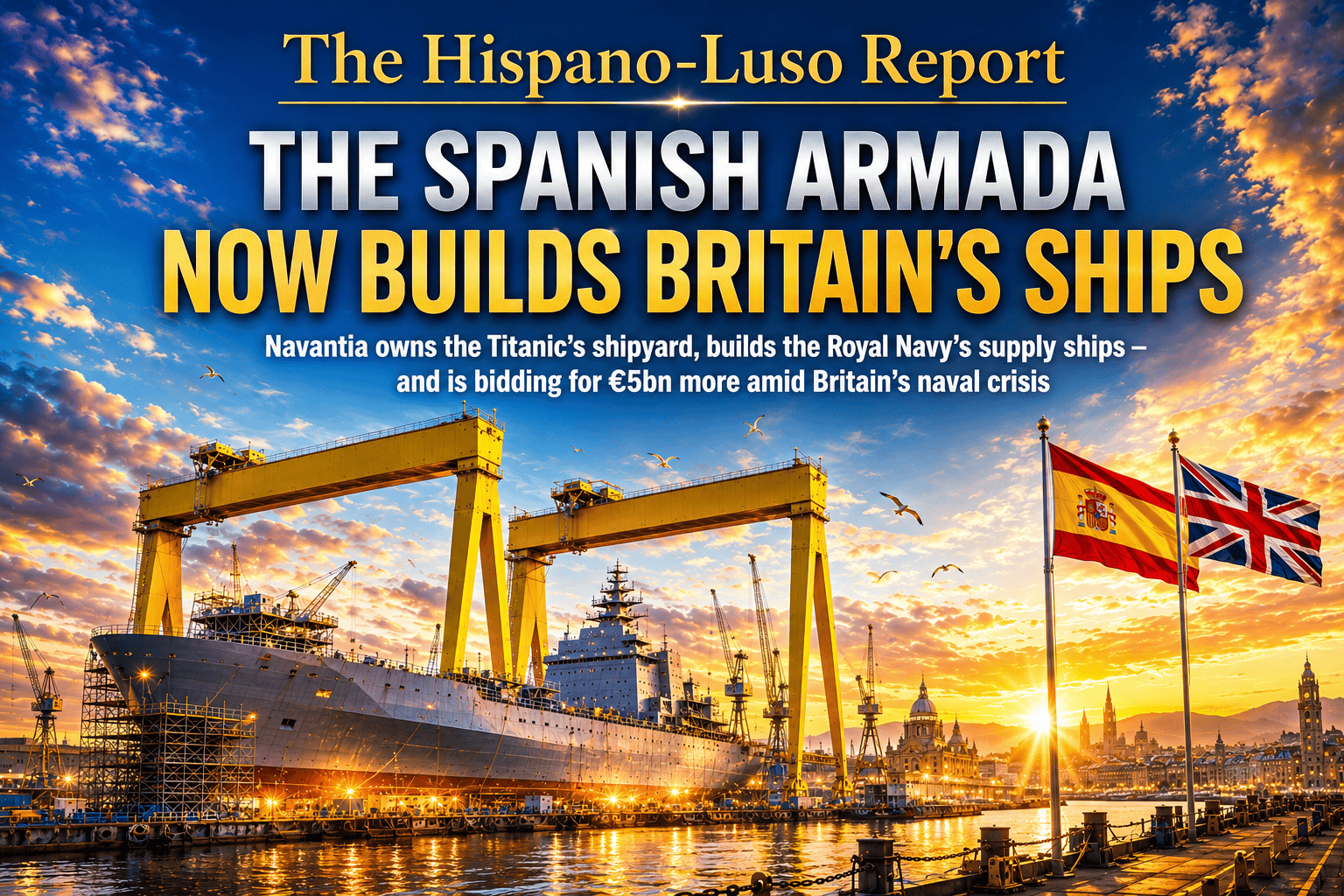
Navantia owns the Titanic’s shipyard, builds the Royal Navy’s supply ships — and is bidding for €5bn more amid Britain’s naval crisis
The Hispano-Luso Report
In 1588 the Spanish Armada sailed for England and met weather, luck and Drake. In 2025 it came back by invitation — and bought the shipyard that built the Titanic. Navantia, the Spanish state’s shipbuilder, completed its acquisition of Harland & Wolff last year: four yards — Belfast, Appledore in England, Methil and Arnish in Scotland — for £112 million, and with them the contract the collapse of the British firm had put at risk: the £1.6 billion Fleet Solid Support programme, three logistics ships to resupply the Royal Navy’s battle groups at sea, awarded in 2023 to the Team Resolute consortium of Navantia, Harland & Wolff and BMT. The Armada Española’s builder now builds Britain’s supply fleet — and this week the company is positioning for nearly €5 billion more.
The two bids, graded
The tense discipline first: these are bids, not awards, and the file ranks them as such. The larger is the £2.4 billion programme for eight amphibious ships for the United Kingdom and the Netherlands, to be built on British soil, with Navantia’s Belfast yard positioned to lead in collaboration with the rest of the sector. The second is the Euston Programme’s floating docks — some £1.9 billion — for the maintenance of the Royal Navy’s nuclear submarines, work Navantia aims to execute at Methil, where it employs 260 people. Neither is won. But the union GMB Scotland has campaigned publicly for the Spanish state’s company to be chosen, on the plain argument that the workload stays in Britain — the strangest and most telling sentence in the story: a British union lobbying for a Spanish government-owned yard.
The mercy price, and the money after
The acquisition’s mechanics deserve their paragraph, because they explain the welcome. Navantia bought Harland & Wolff, per sources, with a set of “facilities”: no retention commitments demanded, the £112m price — and, once closed, it waived the £28 million it had injected to keep the British firm afloat during its crisis. The stated logic on all sides: better an experienced shipbuilder that keeps the jobs than a fund that strips the yards. Since then, Navantia has committed more than £180 million to its British yards — £115m of it to Belfast, the historic heart where the Titanic was built and the city’s own icon — the smaller yards being, in the sources’ phrase, “docile” and cheap to keep. The investment is the credibility behind the bids; the bids are the return on the investment.
The vacuum
Why is Britain’s naval establishment receptive to a foreign state’s shipbuilder? Because the establishment is in crisis. This year, none of the Royal Navy’s five Astute-class submarines was operational — for want of docks to maintain them and specialists to crew the work — which is precisely the gap the Euston floating docks would fill. The pattern is one this masthead has watched across sectors: a British industrial vacuum, a Spanish champion arriving with expertise and patience, and an incumbent system relieved rather than resentful. Bankinter found it in Irish mortgages; Sacyr in NHS hospitals; Navantia has found it in the docks of the Royal Navy.
The next anglophone navy
Beyond Britain, the file notes the door Navantia is preparing to open with German help. Its two memoranda with TKMS — the German submarine builder that has just won Canada’s programme for 12 submarines, a mandate local media size at up to C$100 billion across construction and decades of support — point at two routes in: building complete boats in Spanish yards, or supplying hull sections (“rings”) for the German programme. That would buy time until Navantia’s own S-83 submarine, due 2028, proves the AIP air-independent propulsion system the export case depends on — a date marked in red in Cartagena. With Fincantieri, a separate memorandum covers the European corvette programme. The Armada’s builder is assembling, quietly, a network that reaches three anglophone navies.
The honest ledger
The counterweights, at full weight. Bids are bids — the €5 billion is positioning, and naval procurement stretches over years and political cycles (Croatia’s corvettes and Denmark’s frigates, the sources note, may shift with elections). A foreign state-owned yard inside a nuclear navy’s supply chain invites scrutiny — sovereignty review is a standing risk in any defence award, and the GMB’s enthusiasm is one input among several. The S-80’s AIP is unproven until 2028, and the export thesis waits on it. And the fifth check hums — “confianza” from sources close to the company is the bidder’s optimism, printed as such.
The scoreboard
Still, the history holds: the shipyard that launched the Titanic answers to Madrid, the Royal Navy’s supply ships are being built by Spain’s state, and the next decisions — the amphibious eight, the Euston docks, the Canadian rings — would make the Spanish Armada a permanent fixture of British naval industry. The watch-list takes the awards, the TKMS terms, and the 2028 AIP date. Four centuries after the weather won, the Armada found the sensible route into British waters: the tender box. Watch the awards.
The Hispano-Luso Report tracks the Spanish- and Portuguese-speaking business news that English-speaking coverage overlooks — analysed beyond the English-language headlines. Sources: elEconomista, Navantia, UK Ministry of Defence programme data.