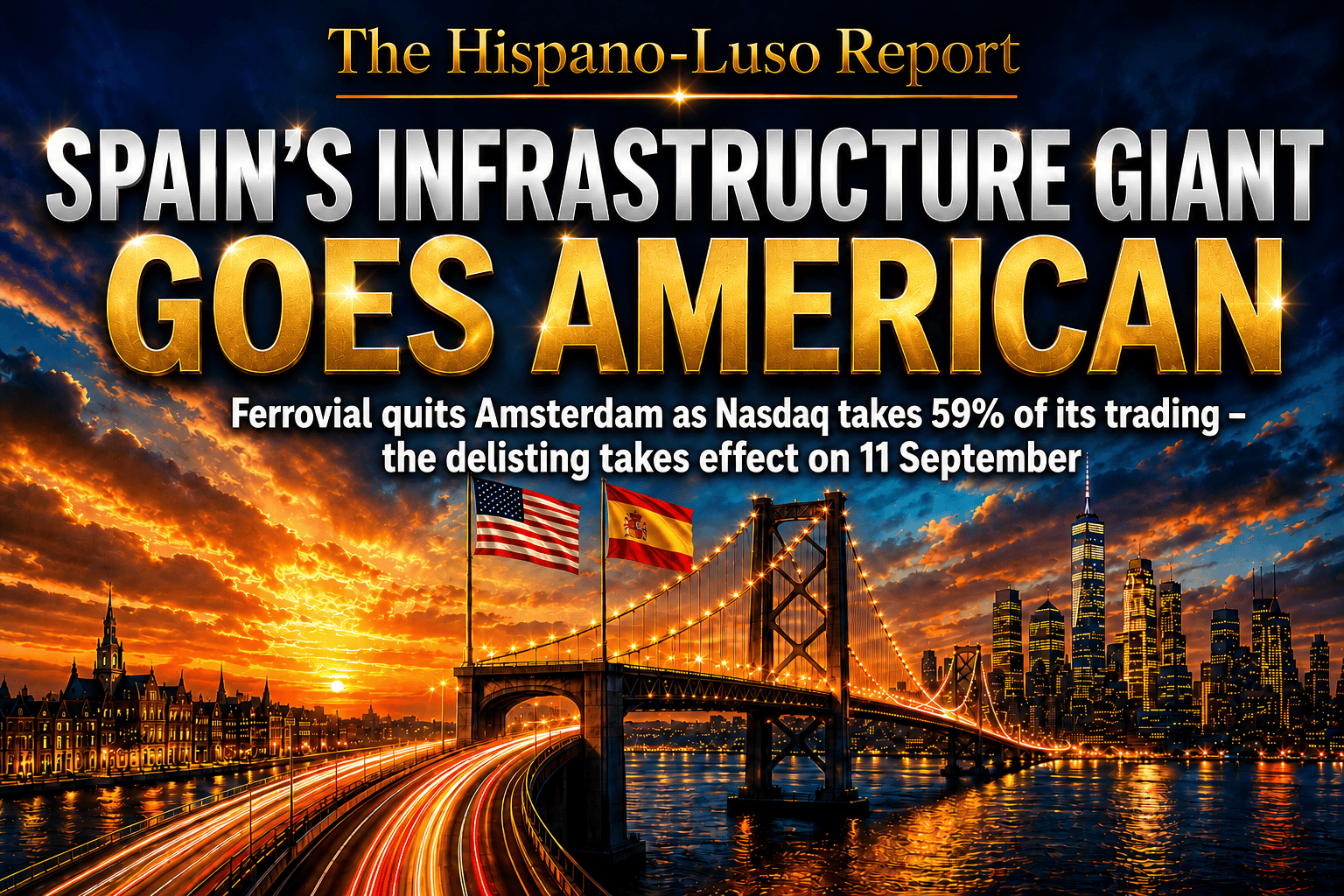
Ferrovial quits Amsterdam — the stepping-stone listing that carried Spain’s infrastructure giant to an American majority. Nasdaq now trades more of the company than Madrid does
The Hispano-Luso Report
Every bridge is judged by what crosses it. The one Ferrovial built in 2023 — a corporate seat in the Netherlands, a listing on Euronext Amsterdam, all of it assembled amid political fury to reach one destination — can now be judged precisely: 0.15%. That is Amsterdam’s share of Ferrovial’s daily trading today, three years after the move that convulsed Spanish politics. The crossing is complete, and this week the company told the CNMV it is dismantling the bridge: the last Amsterdam session is set for 10 September, delisting effective the 11th.
Where did the traffic go? To the destination the bridge was always for. Nasdaq now carries 59.21% of Ferrovial’s average daily volume. Spain’s exchanges carry 40.63%. By the plain arithmetic of where its equity changes hands, the builder of Texan highways and JFK’s newest terminal is now an American-majority-traded company — with a Spanish workforce, a Dutch seat, and a Madrid listing that has become the minority partner in its own national champion.
What goes, and what stays
Precision first, because this announcement is easy to over-read. What ends is the Amsterdam quotation — a listing that, at 0.15% of volume, the company says is simply no longer justified; the delisting “simplifies the structure and improves the efficiency of its market profile.” What continues: the Nasdaq and Spanish listings, and — the detail that matters — the Dutch corporate seat, untouched. Ferrovial remains a Netherlands-domiciled company under Dutch corporate governance; since 2024, every shareholder meeting and board session has been held there, in a jurisdiction the company praised at the time as triple-A rated — and one, as the Spanish press has never tired of noting, with a friendlier treatment of dividends flowing up from subsidiaries.
So the finished specimen looks like this: operated from Spain, seated in the Netherlands, traded principally in New York. The passport, the boardroom and the market have fully decoupled — and each landed where it was most useful.
The arc — and the row
Remember how this began. On 28 February 2023, Ferrovial announced the seat transfer, and official Spain erupted. Pedro Sánchez declared that there are great businessmen committed to their country — “no es el caso del señor Del Pino.” Nadia Calviño, then economy minister, called the strategy “erroneous” and the company lacking in “commitment” to the nation that built it. The company’s stated logic was calmly procedural: the Netherlands enabled a US listing in a way Spain’s plumbing then did not, and Amsterdam was the way through. Nobody pretended the Dutch exchange was the destination; it was scaffolding from the first press release.
Two years after the Nasdaq debut, the scaffolding has done its work so completely that it carries three trades a day, figuratively speaking. Judged as engineering — and Ferrovial is nothing if not an engineer — the manoeuvre was flawless: seat moved, US listing achieved, American liquidity captured, majority attained. Judged as politics, the wound reopens with every milestone, and this one hands both sides their vindication: the government can note that Spain’s exchange still holds 40% and the jobs never left; the company can note that the strategy its critics called erroneous produced exactly what it promised, to the decimal.
The pattern
Regular readers will recognise the species, because this Report has been assembling the genus for weeks: Santander’s chair telling American television “we are a US bank“; Azul — Brazil’s beloved carrier — legally Irish; Iberian champions everywhere separating the corporate passport from the centre of gravity, each organ of the company migrating to its optimal jurisdiction. Ferrovial is the purest specimen yet because the migration is measurable: 59.21% is not a strategy statement or an executive’s flourish — it is the daily verdict of the market on where this company now lives. Spain’s great infrastructure exporter has itself been exported, share by share, to the investor base nearest its assets: the managed lanes of Texas, the 407 in Toronto, the new Terminal One at JFK — the anglosphere portfolio that this masthead’s thesis says is not a foreign adventure but the company’s actual home market.
The honest ledger
The counterweights, duly recorded. Madrid’s 40.63% remains a very large minority — Spanish retail and institutions have not abandoned the stock, and the Ibex keeps its member. The BME question, however, is the uncomfortable one this milestone poses for Spain rather than for Ferrovial: when a national champion’s liquidity majority migrates to New York and the champion itself calls a European co-listing unjustifiable at 0.15%, the gravitational weakness of Europe’s mid-sized exchanges is the story underneath the story — one Madrid’s financial establishment would rather not headline. And the Dutch-seat honesty: the governance and fiscal advantages that drew the 2023 move persist quietly beneath every celebration of the American listing; the delisting simplifies the market structure, not the arrangement that angered the government.
The scoreboard
Mark the date: the Amsterdam listing ends on 11 September, and Ferrovial’s structure will state its identity with total clarity — New York first, Madrid second, nothing in between. The watch-list takes the delisting’s effective day as its receipt. For the masthead’s ledger, the specimen is filed beside Botín’s sentence and Azul’s Irish papers: the corporate passports of the Hispano-Luso world’s champions are becoming instruments of convenience, while their centres of gravity migrate to where the assets, the investors and the growth actually sit — which is, with remarkable consistency, the English-speaking world. The bridge served. The crossing holds. And the market, as ever, votes daily.
The Hispano-Luso Report tracks the Spanish- and Portuguese-speaking business news that English-speaking coverage overlooks — analysed beyond the English-language headlines. Sources: Expansión, CNMV filing, company statements.