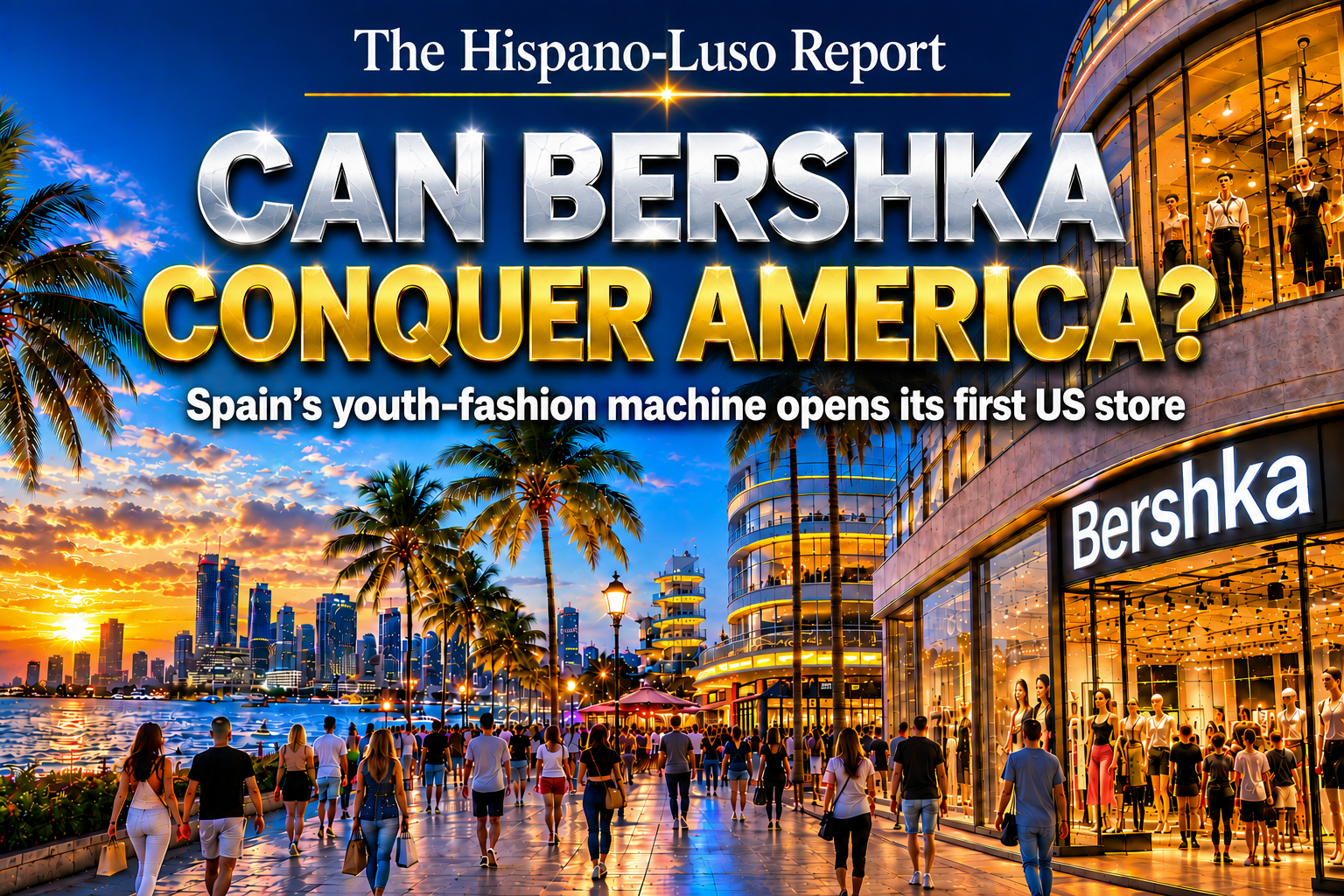
Inditex’s youth brand has opened its first US store. One shop is a test, not an invasion — but the timing is shrewder than it looks.
Bershka has opened its first US store. On 11 August, at Aventura Mall in Miami — the fifth-largest shopping mall in the United States — Inditex’s youth-fashion brand opened its first physical store on American soil, behind a 22-metre façade of stone, wood and ceramic.
Here’s the strange part. Bershka is not a startup testing a concept. It’s a 28-year-old brand with more than 850 stores in over 60 markets, and it’s the second-biggest business inside Inditex — the world’s largest fashion retailer, the group behind Zara. Bershka has conquered teenage wardrobes from Lisbon to Warsaw to Mexico City.
It has simply never, until last week, had a shop in the country that invented the shopping mall.
What actually happened: inside the Bershka US store
The new store gathers all three of the brand’s lines — Bershka, BSK and Man — under one roof, with click-and-collect, a dedicated returns station and self-checkouts. Prices match the website, because the shop is really the physical terminal of an online operation: Bershka.com was already serving American customers before the doors opened.
The launch campaign stars Meg Donnelly, an American actress and singer best known to the target customer from Disney’s Zombies films. You don’t hire a Disney star to reach fashion editors. You hire her to reach fifteen-year-olds who can’t yet pronounce “Bershka.”
A second Bershka US store is promised before the end of the year, expected to stay in the South. Inditex CEO Óscar García Maceiras announced the American push back in December, alongside a new Zara flagship on San Francisco’s Union Square. This is a plan, not an experiment.
Why America was the missing province
The 28-year absence was policy, not oversight. Inditex has always run America deliberately thin: while Zara blanketed Europe, its US footprint stayed at a fraction of what its sales would justify, with e-commerce doing the heavy lifting between flagship cities.
The caution was well earned, because the United States is where European fast fashion goes to be humbled. Topshop retreated from its American stores in 2019 and its parent collapsed soon after. Forever 21 — an American brand, on home turf — has been through bankruptcy twice, undercut into irrelevance by Shein and Temu. H&M has spent a decade closing more American doors than it opens.
The lesson of the graveyard was clear: scale in America is not the prize. It’s the trap.
So why now?
Three reasons — and together they make the timing look considerably shrewder than one store’s worth of headlines suggests.
America is now Inditex’s growth engine. The United States ranks second only to Spain among the group’s markets. Bershka isn’t tiptoeing into hostile territory; it’s reinforcing a position the group has already proven, brand by brand.
The price war just changed shape. Bershka’s natural predators in the American teen market are Shein and Temu, whose model rested on parcels from China slipping under the US customs de minimis threshold. Washington closed that loophole last year. The price gap that killed Forever 21 has narrowed at exactly the moment a mid-price European rival steps ashore — with a supply chain out of Galicia that answers to no tariff aimed at Beijing.
Miami is the one American city where Bershka needs no introduction. The brand is enormous in Latin America — Mexico is a stronghold — and Aventura Mall is where Latin America shops when it flies north. The opening-day queues, breathlessly documented on TikTok, were full of people greeting the store like a friend from home. Inditex hasn’t landed among strangers; it’s landed among its own customers and let them do the marketing. The conquest begins, sensibly, in the province that was already half-converted.
Why this matters beyond one store
For readers outside the retail world, this is worth watching for two reasons that have nothing to do with teen fashion.
First, it’s a live test of the one playbook that has never yet failed in America. Topshop and Forever 21 bet on square footage; Inditex bets on logistics and opens square footage only where it amplifies the website. If the online-first, store-as-anchor model cracks the US teen market, every European consumer brand eyeing America will copy it.
Second, it’s another data point in a pattern this Report keeps meeting: Spain’s biggest companies quietly re-weighting toward the United States. The bank on every British high street is buying its way into Boston. The world’s biggest fashion group is now sending its second brand across the Atlantic. Spanish corporate ambition increasingly speaks with an American accent.
The uncomfortable question
None of this answers the question in the headline, and honesty requires saying that one store in a Miami mall can’t. Inditex’s own language is studiedly modest — a “milestone,” a first step, ambitions “represented.”
The hard part is everything Miami conveniently postpones: whether a brand with zero name recognition beyond the Hispanic corridor can compete for the American teenager’s attention against Shein’s algorithm and a mall culture that has buried better-funded invaders. Bershka’s price point sits in an awkward middle — dearer than the Chinese apps, cheaper than the athleisure giants — and awkward middles are where fast fashion dies in America.
But here’s what the sceptics should sit with: Inditex is the one European retailer that has never lost a land war it chose to fight, precisely because it chooses so slowly. It watched the American graveyard fill for twenty years before committing its second brand. It waited until tariffs handicapped its cheapest rivals, until a Miami store could function as a website with a door, and until it could land in a city where the customers already knew the song.
So watch two things: where the second store opens, and whether a third is announced by spring. Empires tell you their intentions in real estate.
That’s not something this week’s headlines will tell you. It’s the thing worth watching anyway.
The Hispano-Luso Report tracks the Spanish- and Portuguese-speaking business news that English-speaking coverage overlooks — analysed beyond the English-language headlines. Sources: Inditex/Bershka statements via Europa Press and Forbes España; WWD; Drapers; FashionUnited; Modaes; Aventura Mall.