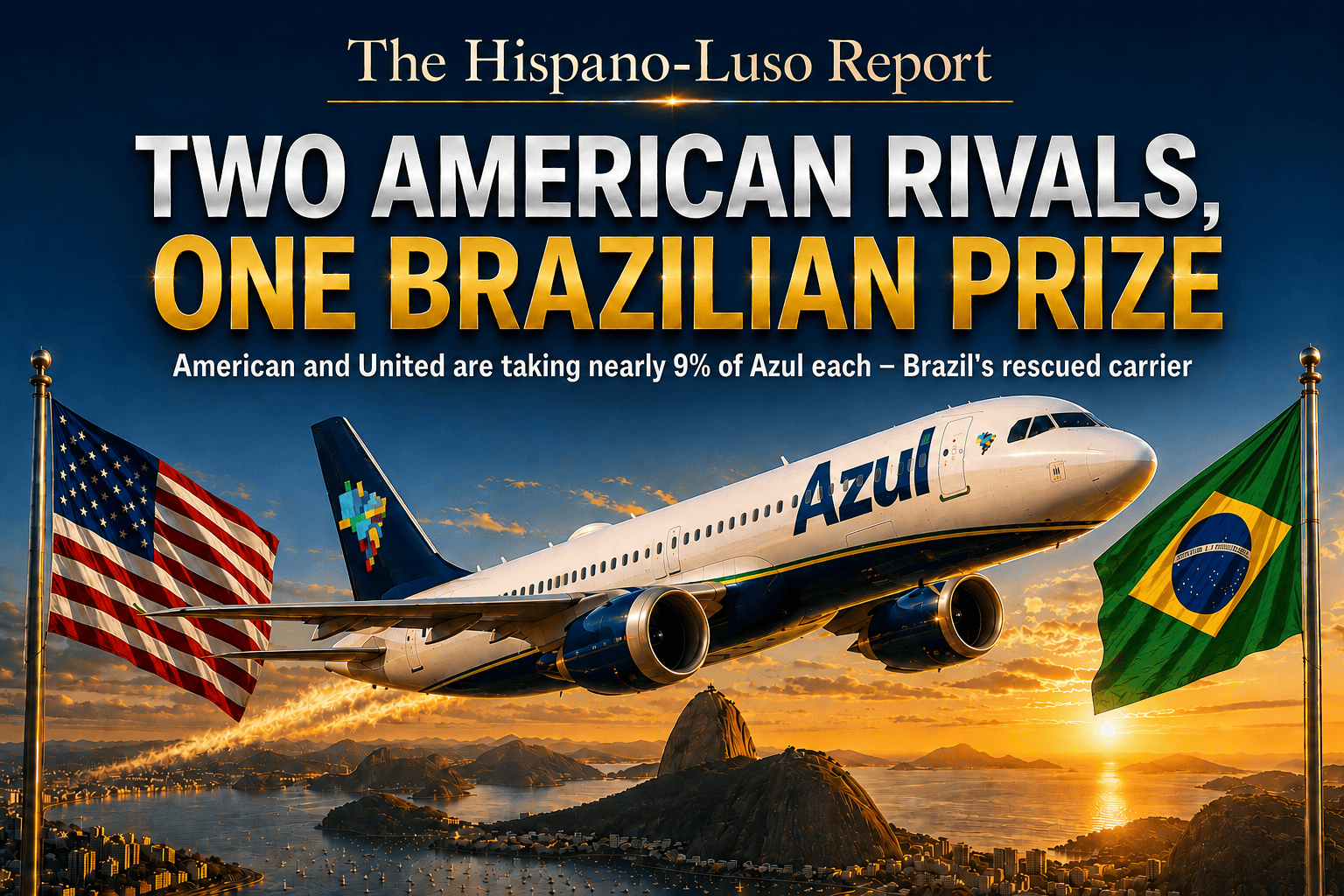
American and United are taking nearly 9% of Azul each — how Brazil’s rescued carrier became the shareholding battlefield of US aviation
The Hispano-Luso Report
Yesterday in Brasília, the general superintendence of Cade — Brazil’s competition authority — issued a favourable opinion on American Airlines’ $100 million investment in Azul, clearing the way for a stake of almost 9% in the country’s third-largest airline. Barring an appeal within fifteen days, the last gate falls on one of the stranger shareholder registers in global aviation: American Airlines and United Airlines — the fiercest rivalry in US skies — each holding roughly the same stake in the same Brazilian carrier.
The English-language wires will record the approval. The story underneath is better: how a bankrupt Brazilian airline became the asset both sides of America’s aviation war decided they could not let the other have alone.
Nine months from Chapter 11 to courtship
Azul’s crisis was real. Pandemic losses, a real that collapsed 50% against the dollar — inflating the lease bills of a fleet rented in dollars — and interest costs ten times their 2019 level pushed the airline into Chapter 11 in New York in May 2025. What followed was one of the fastest major airline restructurings on record: nine months, roughly $2.5 billion in debt and lease obligations shed, leverage cut from 4.9 times to 2.5, and $850 million of new equity raised at emergence in February.
Buried in that rescue capital were the two commitments that created today’s situation: $100 million from United, completed at emergence, and a matching $100 million pledged by American — contingent on antitrust clearance. Yesterday’s opinion is that contingency clearing. The rivals didn’t stumble into the same register; they wrote themselves into it while the patient was still on the table.
What $100 million actually buys
Not aircraft, and not routes. Foreign carriers cannot operate Brazil’s domestic network — cabotage rules see to that. What the money buys is position inside the airline that owns that network: Azul flies 800 daily departures to some 130 cities with 175 aircraft — many of those cities served by no other carrier — and moved 32 million passengers last year. For a US giant, that network is feed: the passenger from Brazil’s interior who connects onward to Miami, Dallas or New York — and the question of whose hub she connects through is worth far more than $100 million over a decade of codeshares and loyalty integration.
Hence the mirrored logic. Whoever sits inside Azul influences where those passengers flow. Neither American nor United could cede that seat to the other — so both bought one, and Brazil’s third-largest airline now hosts the aviation equivalent of both Cold War embassies on the same street.
The founder’s price
There is a quieter story in the register, and it is the cost of survival. Azul was built by David Neeleman — the serial airline entrepreneur who founded JetBlue — as his Brazilian masterpiece: the carrier that connected the interior, invented routes nobody believed in, and made a rising middle class into flyers. The restructuring saved his airline and took his control: Azul emerged from Chapter 11 as a widely held corporation, its founder diluted from command, with two American giants installed as its reference shareholders.
There is something almost novelistic in the geometry: the American who built Brazil’s most beloved airline watching two American titans acquire the influence he surrendered to save it.
The objection from inside the family
The regulatory fight supplied the twist worth the price of admission. The formal third party arguing against American’s investment was Abra Group — the controlling shareholder of Gol, Azul’s great domestic rival. But Abra is also American’s own strategic partner in Brazil — and, for good measure, the counterparty of the Azul–Gol merger exploration that the restructuring consigned to history.
Abra’s arguments were substantive: that American, United and Azul together concentrate more than half of all flights between Brazil and the United States, and that American’s seat on Azul’s strategic committee amounts to control-level influence dressed as a minority stake. Cade’s superintendence disagreed on both counts — finding the market still subject to vigorous domestic and international rivalry, and concluding the investment increases Azul’s capacity to compete. Abra has fifteen days to appeal. If it declines, the register is final.
Read the alignment honestly: American’s Brazilian ally fought to keep American out of the rival’s boardroom — because an ally with a foot in your competitor’s strategy room is a new kind of ally altogether.
The pattern
Regular readers will recognise the shape from a different industry. Last week this Report covered Tesla arriving in Argentina to find BYD already commanding the market — great-power competition conducted through position in Latin American companies rather than products in Latin American showrooms. The Azul register is the aviation verse of the same song: the battlefield is the cap table, the weapon is rescue capital, and the prize is the standing relationship with Latin America’s largest market.
The scoreboard
An airline that was in a New York bankruptcy court a year ago now counts the two giants of American aviation as shareholders, each at arm’s length from the other, neither willing to leave. Azul got the cheapest capital of its life; the rivals got their embassies; the founder got survival at the price of command. And Brazil — whose regulator just concluded that all of this makes its aviation market more competitive, not less — gets to host the next chapter of America’s oldest airline war, at 35,000 feet over its own interior.
The Hispano-Luso Report tracks the Spanish- and Portuguese-speaking business news that English-speaking coverage overlooks — analysed beyond the English-language headlines. Sources: Cade, Brazilian press reporting, Azul SEC filings, FlightGlobal, Rio Times.