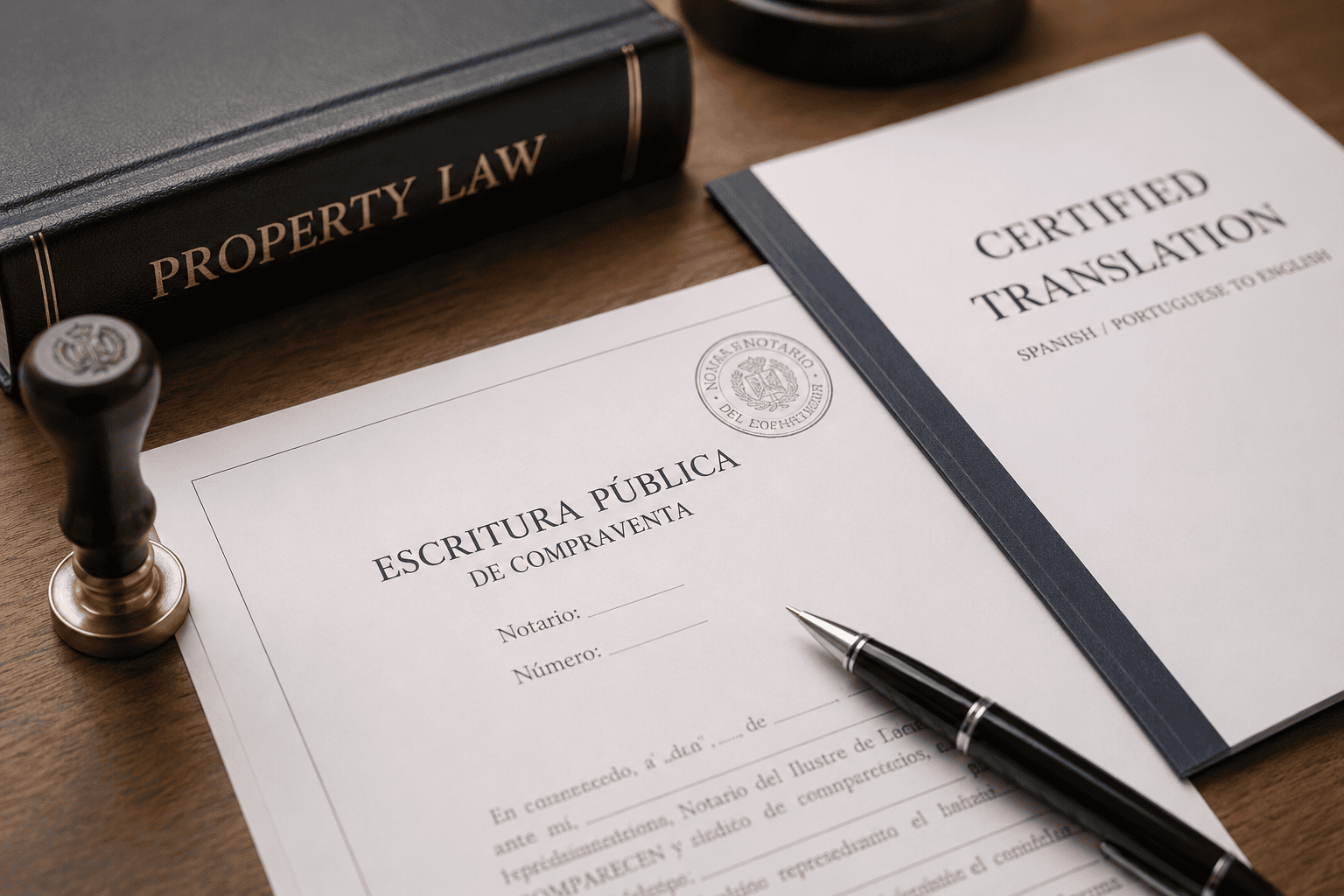
A property deed is the document that proves who owns a property and on what terms — so when a deed drawn up in Spanish or Portuguese needs to be used in the UK, the translation has to be exact. Whether you are buying, selling, inheriting, or registering a property, getting property deed translation right matters, because a solicitor, the Land Registry, a bank, or a court will not act on a document they cannot fully trust. An inaccurate or uncertified translation can delay a sale, hold up probate, or stall a registration.
This guide explains when you need a property deed translated, why certification is usually essential, what makes these documents demanding to translate, and what to look for before you commission one.
When do you need a property deed translated into English?
You will typically need an English translation of a foreign-language property deed in situations such as these:
You have inherited a property abroad, or in the UK from someone whose affairs were handled overseas, and the deed is in Spanish or Portuguese. You are buying or selling a property in Spain, Portugal, or Latin America, and a UK solicitor or lender needs to understand the title. A UK institution — a bank, a court, or HM Land Registry — needs to rely on a deed issued in another language. You are settling an estate that includes overseas property, alongside a will or power of attorney that may also need translating.
In each case, the institution must be confident that the English version reflects the original completely and precisely. That confidence usually comes from a certified translation.
Why certification usually matters
A property deed records legal ownership and the conditions attached to it, so the bodies that rely on one need assurance that nothing has been altered, summarised, or misunderstood. A certified translation provides that assurance: it is a complete, faithful translation accompanied by a signed statement from the translator confirming its accuracy and completeness.
For property matters, certification is normally expected rather than optional. A solicitor handling a conveyance, a registry recording a title, or a court resolving a dispute will want a document they can rely on without having to question the translation behind it. A certified translation gives them that, and removes a common reason for delay.
What makes property deeds demanding to translate
Property deeds — the Spanish escritura or the Portuguese escritura pública — are among the more technically demanding legal documents to translate, for several reasons.
They are dense with specialised terminology that has no exact English equivalent. A Spanish escritura is a notarial instrument with no direct counterpart in English property law, so the translator has to convey what it does without misleadingly forcing it into an English-law category like “deed” or “conveyance.” Concepts such as usufructo, nuda propiedad, carga, and finca registral carry precise legal meanings that must be rendered accurately, not approximated.
They describe the property in formal, structured detail — boundaries, measurements, registry references, and charges — where a single transposed figure or reference number can cause real problems at registration. They often record more than ownership: mortgages, easements, rights of way, encumbrances, and conditions, each of which must be translated with care because each has legal consequences. And they follow the notarial conventions of the country of origin, which a translator needs to understand to convey the document faithfully.
This is why property deeds reward an experienced legal translator rather than a generalist. The accuracy that a registry or solicitor depends on comes from understanding both the language and the legal context.
What the process usually involves
Commissioning a property deed translation is generally straightforward. You provide a clear, complete scan or copy of the deed — every page, including any notarial pages, stamps, and annexes, since these often carry legally relevant content. The translator reviews it, confirms scope and turnaround, and prepares a complete English translation, certified for UK use.
Property deeds frequently travel with other documents — apostilles, registry extracts (nota simple in Spain), or an accompanying will or power of attorney — so it is worth confirming at the outset whether those need translating too. Handling them together keeps the matter consistent and avoids a second round later.
What to look for in a translator
Because so much depends on a property deed being translated correctly, choose carefully. Look for someone who:
Translates into English as their native language, so the result reads precisely and naturally. Has genuine experience with legal and property documents, not just general translation. Provides certification as standard and can explain exactly what their certificate covers. Understands the notarial and registry conventions of the relevant Spanish- or Portuguese-speaking country. Treats your documents confidentially — property deeds concern private financial and personal matters.
A translator who works directly with you, rather than through a chain of intermediaries, means the person who understands the document is the same person you can ask questions of throughout.
Getting it right
A property deed exists to record ownership clearly and let property matters proceed with confidence. A translation problem should not be what holds them up. A properly certified, accurate translation of a Spanish or Portuguese property deed, prepared by an experienced legal translator, gives solicitors, registries, lenders, and courts a document they can act on without hesitation.
If you are dealing with an overseas property as part of an estate, you may also need to translate a will or a power of attorney — these documents often arise together, and handling them as a set keeps everything consistent.
If you need a property deed translated from Spanish or Portuguese into English — accurately, confidentially, and certified for UK use — I would be glad to help. Learn more about my certified translation service and legal translation service, or request a free, no-obligation quote.


