A power of attorney is one of the most consequential documents a person can sign — it lets someone act legally on another’s behalf, over property, finances, or personal affairs. So when a power of attorney drawn up in Spanish or Portuguese needs to be used in the UK, the translation has to be exact. Getting power of attorney translation right matters, because a bank, court, solicitor, or land registry will not act on a document they cannot fully trust, and an inaccurate or uncertified translation can stop a transaction in its tracks.
This guide explains when you need a power of attorney translated, why certification is usually essential, what makes these documents demanding to translate, and what to look for before you commission one.
When do you need a power of attorney translated into English?
You will typically need an English translation of a foreign-language power of attorney in situations such as these:
Someone abroad has granted you authority to act for them in the UK — for example, to manage property, operate a bank account, or handle a sale. A UK institution (a bank, solicitor, the Land Registry, or a court) needs to rely on a power of attorney issued in Spanish or Portuguese. You are dealing with the UK affairs of a relative who lives, or lived, in a Spanish- or Portuguese-speaking country. A cross-border transaction — a property purchase or sale, an inheritance, a business matter — depends on a power of attorney granted overseas.
In each case, the institution must be confident that the English version reflects the original completely and precisely. That confidence usually comes from a certified translation.
Why certification matters for a power of attorney
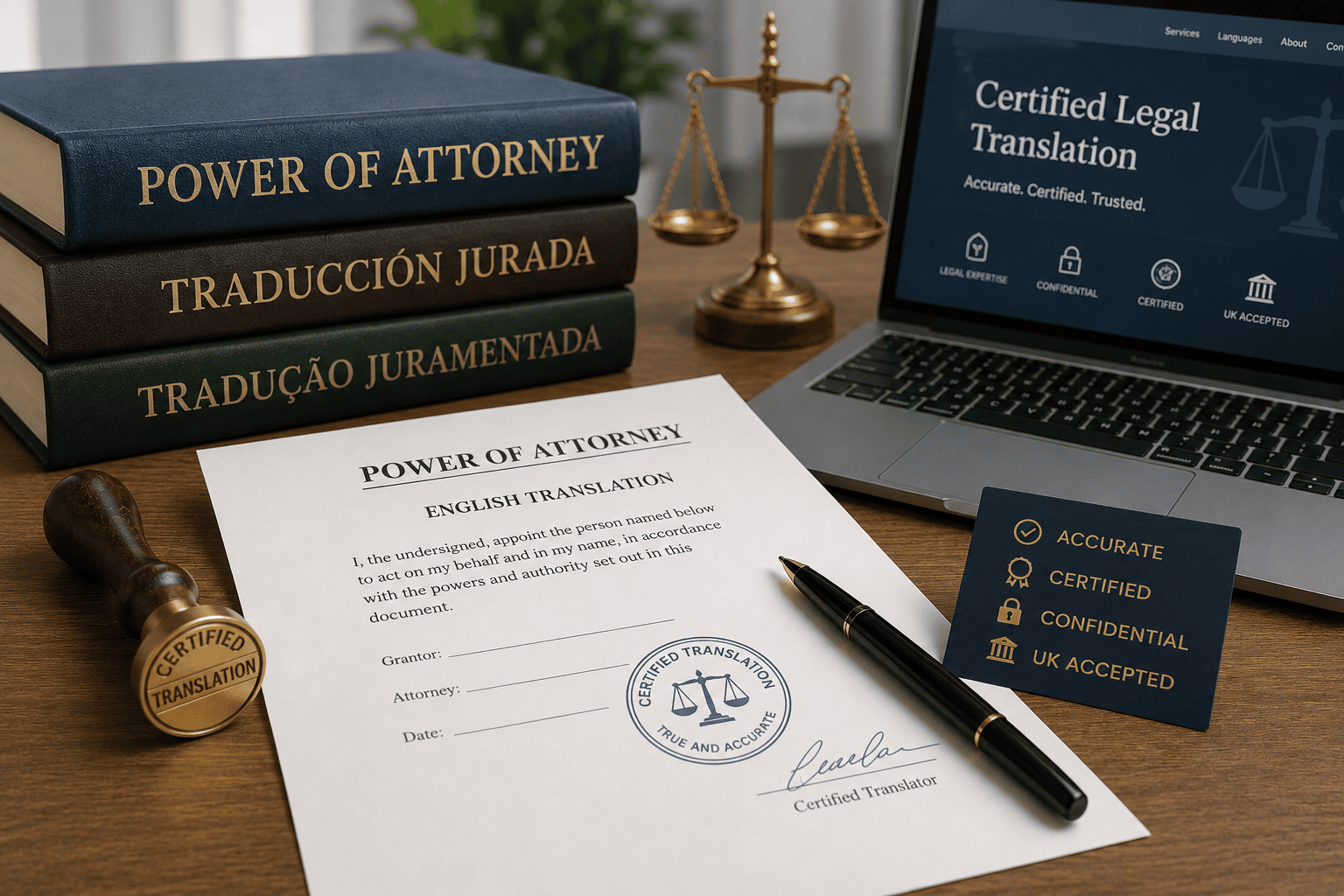
A power of attorney confers legal authority, and the bodies that rely on it need assurance that the translation is accurate and trustworthy. The UK does not use state-appointed “sworn” translators the way many civil-law countries do. Instead, official translations are self-certified: the translator provides a signed statement confirming the translation is a true and accurate rendering of the original, along with their details and credentials.
For a power of attorney, this certification is usually essential. An uncertified translation — however competent — may simply be refused, because the institution has no formal assurance behind it. A certified translation from a qualified professional carries that assurance and is accepted by UK banks, solicitors, registries, and courts.
It is worth understanding how certification, notarisation, and an apostille differ, because powers of attorney sometimes involve more than one. Certification is the translator’s signed declaration of accuracy, and is what most UK matters require of the translation itself. Notarisation involves a notary public and is sometimes requested for the original document or the signatures on it. An apostille authenticates an official document for international use under the Hague Convention, and a power of attorney crossing borders may carry one. The translation of the document — and often of the apostille itself — is what a certified translator provides. Always check the specific requirement of the body asking for it, as these vary.
What makes power of attorney translation particularly demanding
A power of attorney is a precise legal instrument, and translating one is far from a mechanical task. Several features make it especially exacting:
The scope of authority must be rendered exactly. A power of attorney defines precisely what the appointed person can and cannot do. Whether an authority is general or limited to a specific act, whether it extends to selling property or only managing it, whether it can be delegated onward — these distinctions carry real legal weight, and a loose translation can dangerously widen or narrow what was granted.
Legal terminology must be precise. Terms describing the grantor, the attorney or agent, the powers conferred, and any conditions or limitations all have specific legal meaning that must be carried over faithfully.
Legal systems differ. A Spanish, Latin American, or Portuguese power of attorney reflects civil-law concepts and notarial conventions that do not always map neatly onto English law. A good translator conveys the meaning accurately without distorting it to fit English assumptions, and flags genuine ambiguities rather than guessing.
Names, dates, and identifying details must be exact. In a document that authorises someone to act over another’s money or property, a misread name, date, or identification number is not a minor slip — it is a material error that can invalidate the document’s use.
Regional variation matters. A power of attorney from Argentina, Mexico, Spain, Brazil, or Portugal may use different legal vocabulary, formats, and notarial wording. Familiarity with the conventions of the specific country is part of doing the job properly.
What the process involves
Getting a power of attorney translated is usually straightforward once you know what to expect.
You provide a clear scan or photograph of the original document — you do not normally need to part with the original itself. The translator reviews it, confirms the scope and a fixed price, and produces the translation. The finished English version is supplied with a signed certificate of accuracy, ready to present to the bank, solicitor, registry, or court that requested it. For a single document, turnaround is often quick — frequently within a working day or two, depending on length and complexity.
If the body requesting the translation has specific requirements — particular certificate wording, or notarisation in addition to certification — it is best to establish that at the outset so the translation is fit for purpose first time. Powers of attorney often accompany apostilles or other official documents, so it is worth confirming whether those need translating too.
What to look for in a translator
Because so much authority rests on a power of attorney being translated correctly, choose carefully. Look for someone who:
Translates into English as their native language, so the result reads precisely and naturally. Has genuine experience with legal documents, not just general translation. Provides certification as standard and can explain exactly what their certificate covers. Understands the legal and notarial conventions of the relevant Spanish- or Portuguese-speaking country. Treats your documents confidentially — powers of attorney concern private financial and personal matters.
A translator who works directly with you, rather than through a chain of intermediaries, means the person who understands the document is the same person you can ask questions of throughout.
Getting it right
A power of attorney exists to let important matters proceed smoothly, even at a distance. A translation problem should not be what holds them up. A properly certified, accurate translation of a Spanish or Portuguese power of attorney, prepared by an experienced legal translator, gives banks, solicitors, and registries a document they can act on with confidence.
If you need a power of attorney translated from Spanish or Portuguese into English — accurately, confidentially, and certified for UK use — I would be glad to help. Learn more about my certified translation service and legal translation service, or request a free, no-obligation quote.


