
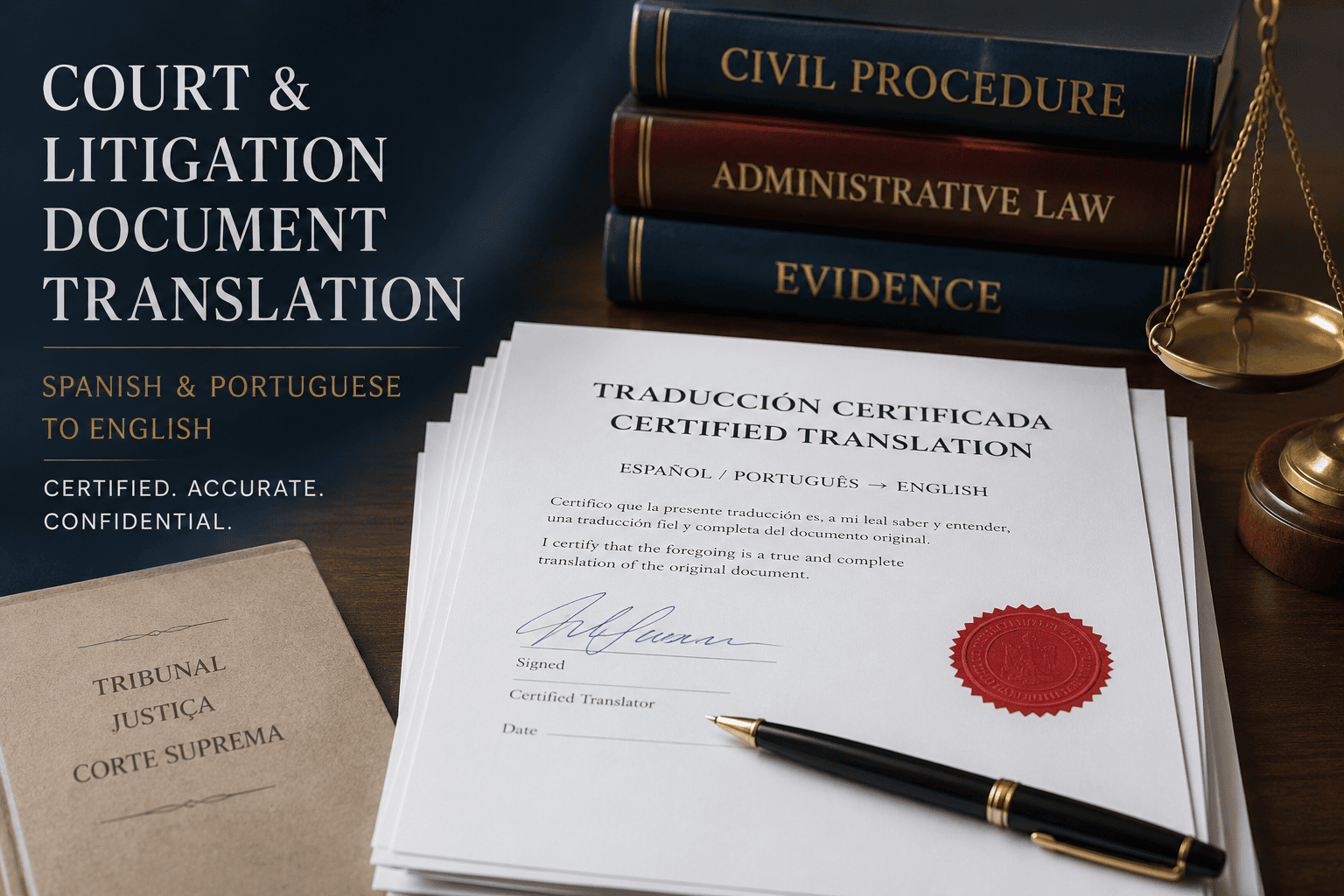
When a legal dispute crosses borders, the documents at its heart often have to cross a language barrier too. A claim filed in a Spanish court, a judgment handed down in Brazil, a witness statement taken in Portugal — any of these may need to be presented, relied upon, or enforced in an English-speaking jurisdiction. And when they are, the translation has to be exact. Court and litigation document translation is among the most demanding legal translation work there is, because the stakes are immediate and the audience is unforgiving: a judge, an opposing party, or a tribunal will scrutinise every word, and an inaccurate translation can itself become a point of dispute.
This guide explains when you need court and litigation documents translated, why certification is almost always essential, what makes these documents so demanding to render accurately, and what to look for before you commission the work.
When do you need court and litigation documents translated into English?
You will typically need certified English translations of foreign-language legal proceedings in situations such as these:
You are a solicitor, barrister, or law firm handling a matter with a Spanish-, Portuguese-, or Latin American–connected party, and documents from the foreign proceedings need to be understood and used in England, Wales, Scotland, or Northern Ireland.
You are enforcing or contesting a foreign judgment in the UK, and the judgment, along with the proceedings behind it, must be translated for the English court.
You are involved in cross-border litigation, arbitration, or family proceedings (such as international divorce or child arrangements) where evidence, pleadings, or orders originate in Spanish or Portuguese.
You need to submit foreign court documents to a UK court, regulator, or authority that requires them in certified English.
You are conducting due diligence, an investigation, or a dispute assessment and need to understand the precise content and effect of foreign legal documents before deciding how to proceed.
In each of these, the common thread is that the document carries legal weight and will be acted upon — which is exactly why the translation must be accurate and properly certified.
Why certification is almost always essential
Courts and tribunals do not accept translations at face value. When a foreign-language document is submitted to a UK court, it is generally required to be accompanied by a certified translation — a translation accompanied by a signed statement from the translator attesting to its accuracy and completeness. Without it, the document may simply not be admitted.
Certification matters here for a reason that goes beyond procedure: in litigation, the translation becomes part of the evidential record. The court relies on it as a faithful rendering of the original. If the accuracy of a translation is challenged, it can delay proceedings, undermine a party’s position, or require the work to be redone under time pressure. A properly certified translation, prepared by an experienced legal translator, gives the court a document it can rely on without hesitation — and gives you confidence that your evidence will stand up to scrutiny.
Depending on the jurisdiction and the nature of the matter, you may also encounter requirements for notarisation or, for documents crossing certain borders, an apostille. The certified translation itself is the foundation; these further steps, where needed, build on it.
What makes court and litigation documents demanding to translate?
Legal proceedings are written in a language of their own, and that language does not map neatly from one legal system to another. Several features make these documents particularly demanding:
Procedural concepts with no clean equivalent. Spanish and Portuguese legal systems are built on civil-law traditions, while English law is a common-law system. Many procedural terms — the names of specific actions, remedies, court stages, and instruments — have no exact English counterpart. A competent legal translator does not invent a false equivalent or reach for a misleadingly familiar English term; instead, they render the concept accurately and, where necessary, make its meaning clear without distorting it.
Court and institutional names. The names of courts, chambers, and judicial bodies carry specific meaning about jurisdiction and level. Translating these requires knowing how each system is structured, so that a reader in English understands precisely which body issued a document and what authority it carries.
Precision that can decide outcomes. In litigation, a single rendered term can matter enormously. The difference between “shall” and “may,” between a claim being “dismissed” and “struck out,” between liability “admitted” and “alleged,” is not stylistic — it is substantive. A mistranslation is not a cosmetic flaw; it can change the apparent meaning of a pleading or judgment, and may itself become contested in the proceedings.
Formal register and fixed formulae. Court documents use established forms of words, and a translation must reflect that formality and convention rather than paraphrasing it into plain language. Faithfulness to register is part of faithfulness to meaning.
Names, dates, figures, and references. Case numbers, party names, dates, monetary sums, and cross-references to statutes or other documents must be reproduced with absolute accuracy. An error in a reference can make a document impossible to match to its place in the proceedings.
What the process involves
A sound approach to court and litigation translation reflects the seriousness of the material. The translator first reads and understands the document in full — not only the words but the procedural context, so that the translation reflects what the document actually does. Specialist terminology is researched and rendered consistently throughout, so that the same term is not translated two different ways. The translation is then carefully reviewed for accuracy, completeness, and consistency, and a signed certification is prepared confirming that it is a true and faithful rendering of the original.
Confidentiality is fundamental throughout. Litigation documents are by their nature sensitive, often containing privileged or commercially significant information, and they must be handled with appropriate discretion at every stage.
A translator who works directly with you, rather than through a chain of intermediaries, means the person who understands the document is the same person you can ask questions of — which matters when a deadline is tight or a point of meaning needs to be clarified.
What to look for before you commission a translation
When the document will be relied upon in court, it is worth checking a few things before you commission the work:
That the translator has genuine experience with legal and litigation material, not just general translation, and understands the conventions of court documents.
That the translation will be certified, and that the certification will meet the requirements of the court or authority you are submitting to.
That the translator works confidentially and is comfortable handling sensitive, privileged material.
That you can communicate directly with the person doing the work, so questions of meaning or terminology can be resolved quickly.
That the work will be delivered to the deadline your proceedings require, with the formatting and presentation a court expects.
Getting it right
Court and litigation documents exist to record and advance a legal process in which a great deal may be at stake. A translation problem should never be the thing that undermines a party’s position or delays a hearing. A properly certified, accurate translation of Spanish or Portuguese court documents, prepared by an experienced legal translator, gives judges, opposing parties, and tribunals a document they can act on with confidence — and gives you the assurance that your evidence reads in English exactly as it does in the original.
If your matter also involves other foreign-language legal documents, you may need to translate a will, a power of attorney, or property deeds — these often arise alongside proceedings, and handling them together keeps terminology and presentation consistent.
If you need court or litigation documents translated from Spanish or Portuguese into English — accurately, confidentially, and certified for UK use — I would be glad to help. Learn more about my certified translation service and legal translation service, or request a free, no-obligation quote.


