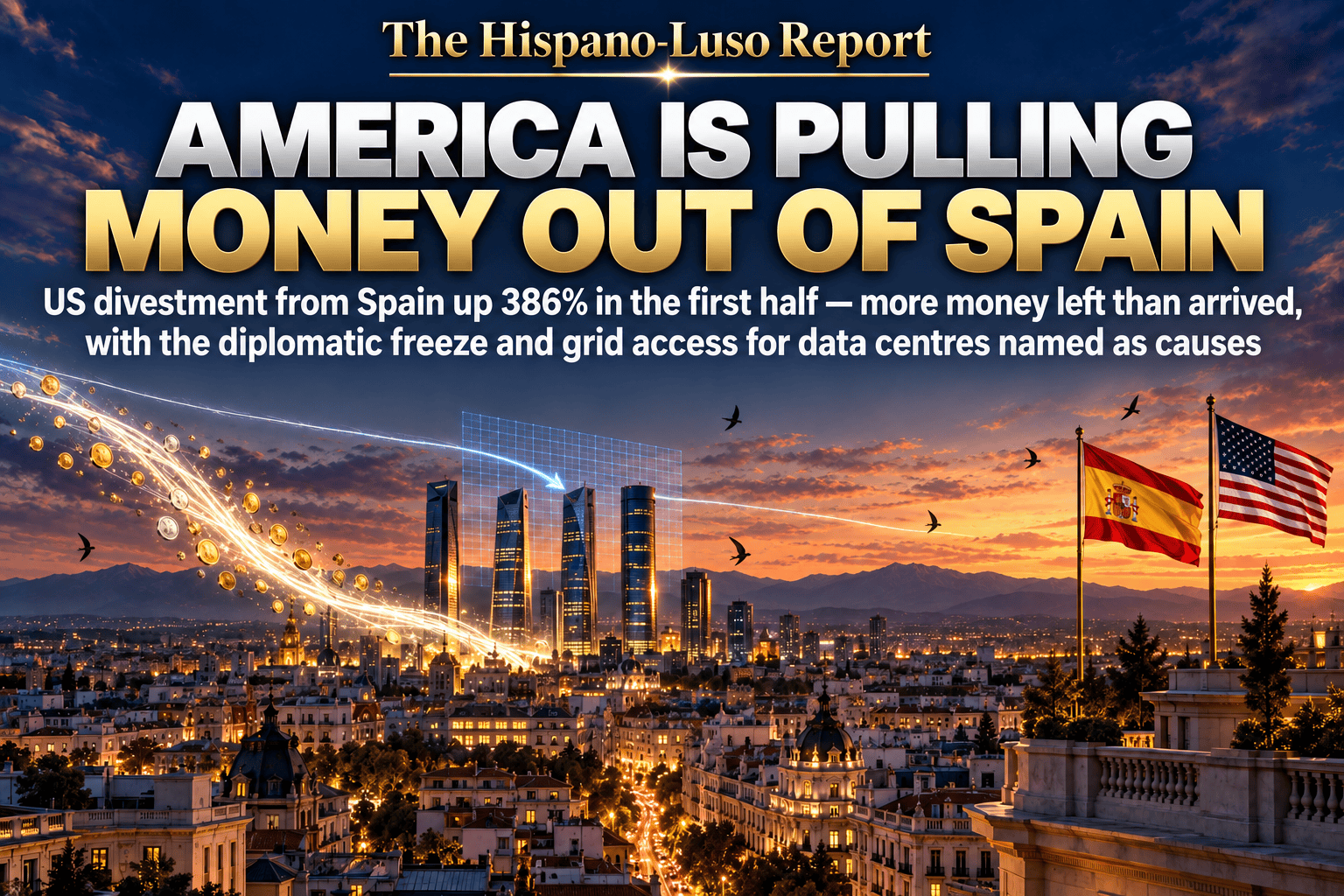
US divestment from Spain up 386% in the first half — more money left than arrived, with the diplomatic freeze and grid access for data centres named as causes
The Hispano-Luso Report
Three weeks ago this Report read the tariff year’s invoice for Spain’s exporters. This week the Economy Ministry published the investment year’s, and the American page is worse. US divestment from Spain rose 386% in the first half of 2026, to €3.85 billion — already 84% of 2025’s full-year total, which was itself the highest in a series running back to 1993 — and, for the first time the file has seen, more American money left Spain than arrived: gross US investment, up 84% to €2.86 billion, fell short of the capital withdrawn. Net US investment, the measure that counts depreciation and is therefore the real one, was down 231%. The ministry’s own word for the American numbers is demoledor. This Report prints them with tongs and reads the causes, because the causes are the season’s own threads.
The numbers, precisely
The inventory. Out: €3,851.7 million of American capital and equity withdrawn between January and June, the largest of any country, on pace to beat last year’s record before autumn. In: €2,857.8 million gross — up sharply, and enough to keep the United States as Spain’s first gross investor, which the honest ledger records before the pattern is drawn — of which €1.2 billion went to acquisitions and €2.0 billion landed in Madrid. The sectors the American money still likes: sport, leisure and recreation; land and pipeline transport; and, rising fast among the funds, real estate. The sectors it is leaving: the high-value-added ones — computing infrastructure, data processing and hosting received €43 million of American investment in six months; telecoms €56 million; research and development €24 million. The capital that arrives buys stadiums, roads and buildings. The capital that leaves is the kind that builds the next economy.
The causes, named
The ministry’s statisticians do not editorialise; the piece’s sources do, and their two explanations are both in this masthead’s files. The first is diplomatic. The rupture between the Trump administration and the Sánchez government — sharpened, the sources say, by Spain’s position on the American-Israeli war with Iran — turned a trend (divestment up 54% in 2025) into a flight. Confidence, not arithmetic, is the reason given for the exits. The second is regulatory, and it is the file’s own story: restrictions on access to the electricity grid are cited as a principal reason American money is retreating from data centres — the exact battleground of the decree fight this Report filed a fortnight ago, when Amazon, Microsoft and Google took Spain’s draft data-centre regulation to the Consejo de Estado and operators discussed compensation claims. The €43 million figure is the fight’s first receipt: the hyperscalers’ capital did not wait for the decree’s final text. It is already going elsewhere.
The contradiction, completed
Regular readers will recognise the shape, because the file has been drawing it for a month. Spain bids to host Europe’s AI gigafactory; Spanish contractors wire London’s and Australia’s data centres; a Valencian chipmaker takes Nvidia’s money; the electron layer thesis ran five layers deep — and at home, the theatre that courts compute capital everywhere else regulates it hardest, and the capital answers by leaving. The investment wars’ grammar inverted, on the masthead’s own doorstep: certainty is what the money buys, and in the first half of 2026 Spain sold it less than any American investor expected. The divestment table is the mood referee and the money referee agreeing, which is the rarest and least comfortable reading the file’s two-referee tool can produce.
The anglosphere’s other half
The comparison the corridor keeps. The same ministry’s trade data showed Britain the steadier customer when the American tariffs bit; the investment data will want the same test — and the file notes, from the same release, that the retreat is not only American: foreign divestment overall rose 142% to €9 billion, net foreign investment fell 41%, and gross foreign investment (up 31% to €12.4 billion) is below half of last year’s pace. The American exit leads a wider one. Whether British capital held, as British trade did, is the question the second-half data will answer — and the corridor’s whole thesis rests on it.
The honest ledger
The counterweights, at full weight. A half-year is a half-year, and divestment series are lumpy — a handful of large exits (the American Chamber counts 280 member firms at 15% of GDP; a few restructurings move billions). Gross investment rose 84% — the money is not only leaving; it is arriving in different sectors, and “first investor” is still true. The diplomatic reading is the sources’, not the statisticians’ — printed as the explanation offered, adjudicated by nobody here. Grid access is a physical constraint as well as a regulatory one — Spain’s renewable build-out outran its network, and the barrier the hyperscalers cite is partly engineering. And the fifth check hums in a ministry whose release, read one way, is an argument for policy it may want to change.
The scoreboard
Still, mark the receipt at its size: in six months, American investors withdrew more from Spain than they put in, the high-value sectors emptied fastest, and the two causes named are the season’s diplomatic freeze and the file’s own decree fight. The watch-list takes the second-half data (the full-year verdict), the decree’s final text and any claims filed, the grid-connection reforms the sector has demanded, and — the corridor’s test — whether British money held. The tariff invoice measured what America stopped buying. This one measures what it stopped building. Watch the second half.
The Hispano-Luso Report tracks the Spanish- and Portuguese-speaking business news that English-speaking coverage overlooks — analysed beyond the English-language headlines. Sources: Secretaría de Estado de Comercio, Ministry of Economy foreign-investment statistics, elEconomista, AmCham Spain.