A new 179km transmission award — and the pattern behind it: Spanish firms keep winning the grid the AI age runs on
The Hispano-Luso Report
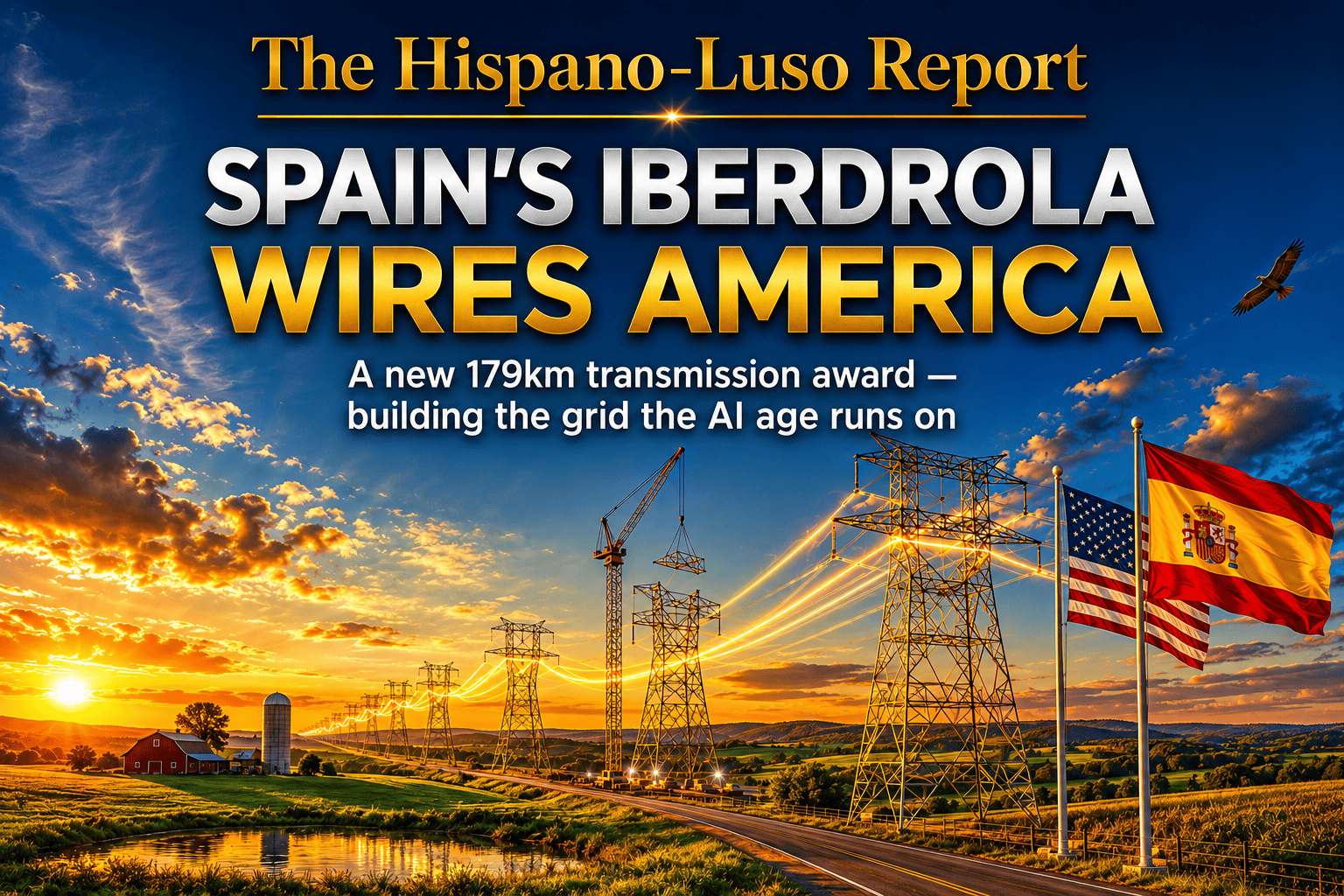
Taken alone, this week’s news is modest, and this Report says so plainly: Iberdrola has won the construction of a new 179-kilometre transmission line in the United States — for a utility group whose American commitments run to the tens of billions, a single line is ordinary metabolism, the kind of award its US business collects in the course of doing what it does. But this masthead has learned to watch what keeps repeating — and the 179 kilometres land as the latest entry in a pattern the file has been assembling all season: wherever the English-speaking world is building the electrical backbone of the AI age, a Spanish company keeps signing the work. The award is small. The pattern is the story.
The award, and the empire behind it
The facts as reported: a 179km line, won for construction in the US market where Iberdrola — through its American platform — ranks among the largest grid investors in the country, operating regulated utilities across the Northeast and pouring capital into the wires at a scale few rivals match. Transmission is the least glamorous asset class in energy: steel towers, conductor cable, decade-long permits — and it is precisely where Iberdrola has built its American fortress, because regulated wires earn steady returns on invested capital for decades, the patient-money economics this Report keeps finding wherever Spanish champions dig in abroad.
The load returns
Why do new lines matter now more than at any point in a generation? Because American electricity demand is growing again — after some two decades of near-flat consumption, the data-centre build-out, electrification and reshored industry have reignited load growth across the US, and the binding constraint is not generation but transmission: the country’s interconnection queues are jammed with projects waiting for wires that don’t yet exist, and every serious analysis of the AI age’s infrastructure ends at the same bottleneck — the grid. A new 179km line is, in this context, not routine at all: it is a unit of the scarcest commodity in American energy, and the companies that can permit, build and operate transmission are holding the shovels of the decade.
The electron layer
Now the pattern, assembled from this season’s file. In London, ACS’s Hochtief is delivering National Grid’s billion-pound upgrade — sixty kilometres of cabling whose explicit purpose includes unlocking connections for five data centres drawing a gigawatt. In Australia, the same group’s UGL lays the first AI-grade fibre between Sydney and Melbourne. In America, ACS’s Turner builds the hyperscaler sheds themselves — and now Iberdrola strings more of the wires that feed them, while in Spain, the gigafactory consortium bids to host Europe’s sovereign compute. Stack the entries and the claim writes itself: Spanish firms are positioned beneath every layer of the AI build-out — the sheds, the power, the fibre, the compute — across three continents, in two distinct corporate species: the contractors (ACS and kin) who build for clients, and the operator-investors (Iberdrola) who own the assets and collect the regulated returns for decades after the contractors go home. The second species is the quieter and, over time, likely the richer position.
Why the wires keep going Spanish
The structural answer deserves its paragraph. Spain ran one of the world’s fastest renewables build-outs, which forced one of its fastest grid expansions — and the companies schooled in that decade (utilities and contractors alike) converted the home curriculum into an export franchise, exactly as the high-speed-rail builders did before them. Add the regulated-utility model’s fit with Spanish corporate patience — decade-horizon capital, inflation-linked returns, political-risk management as a core skill — and the anglosphere’s grid programmes keep finding the same names at the table. It is the masthead’s oldest thesis in its newest costume: hard-won domestic schooling, sold to the English-speaking world at scale.
The honest ledger
The counterweights, at full weight — and this piece owes an extra one. The award’s own details remain thin as reported — route, client and value per the trade coverage, graded accordingly, and this Report upgrades the entry as the specifics publish. One line is one line: the pattern-claim rests on the season’s accumulated entries, not on this award’s size, and the machine’s own first ranking filed it as routine — the piece exists because the file’s pattern crossed a threshold, and the reader deserves that candour. US transmission is permitting purgatory — American lines routinely take a decade from proposal to energisation, and construction awards sit at the end of that gauntlet, which cuts both ways: the hard part is done, and the hard part is why supply stays scarce. And the fifth check hums gently — grid operators announce awards because growth narratives support rate cases and share prices alike.
The scoreboard
Mark the entry, sized honestly: a modest award, filed atop a pattern that is no longer modest at all. The watch-list takes the thesis rather than the line: each new electron-layer entry (the file’s threshold for the full theme edition — “Spain wires the AI age” — is close), Iberdrola’s next American grid commitments, and the load-growth numbers that keep the whole layer scarce. The AI age will be remembered for its models; it will have been built of concrete, copper and conductor cable — and the hands on the conductor keep speaking Spanish. Watch the wires.
The Hispano-Luso Report tracks the Spanish- and Portuguese-speaking business news that English-speaking coverage overlooks — analysed beyond the English-language headlines. Sources: elEconomista, company statements, US grid and load-growth data.