The Hispano-Luso Report — Monday 6 July 2026
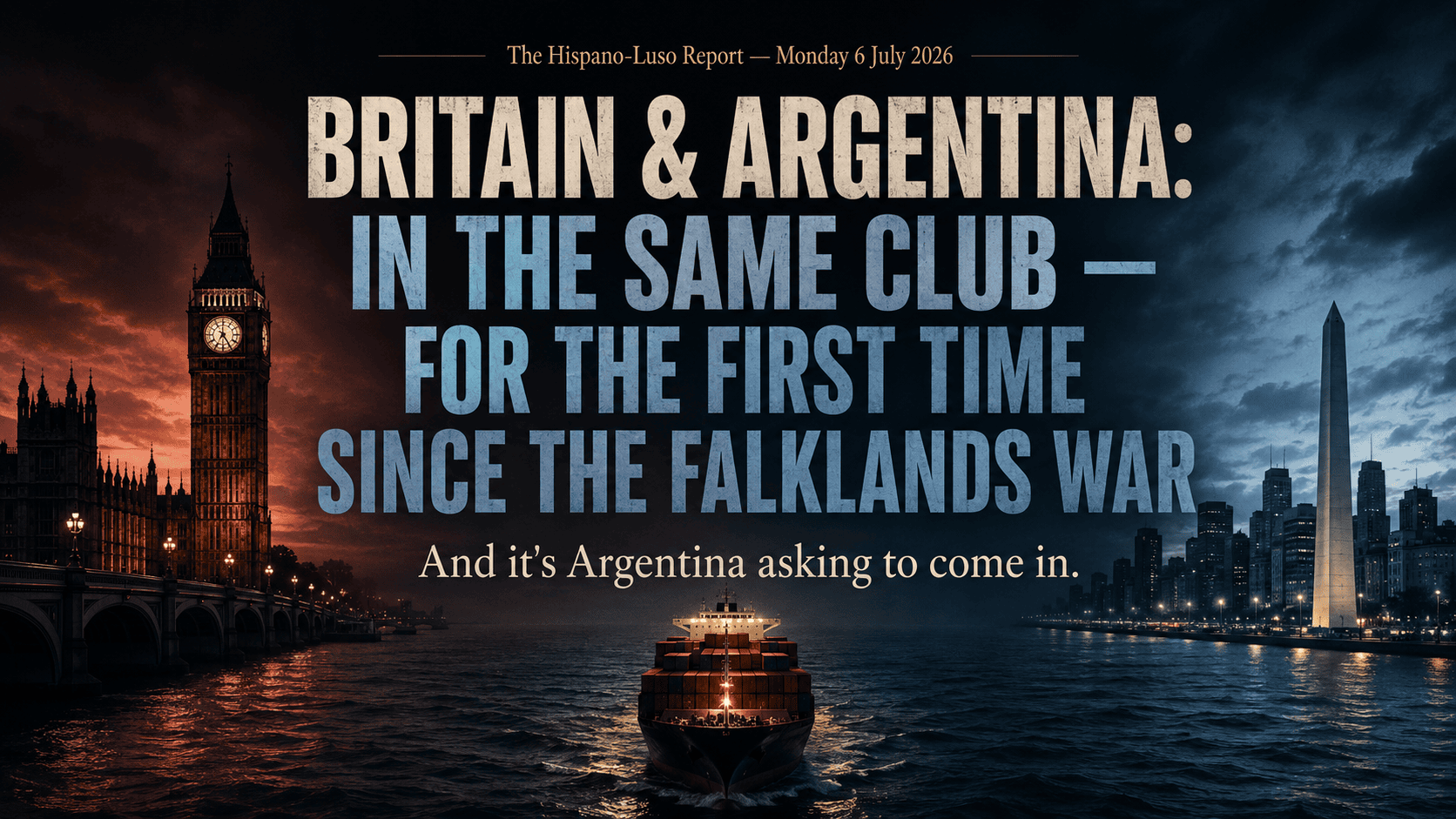
For the first time since the Falklands War, Britain and Argentina could end up inside the same trade pact — the CPTPP — and it is Argentina asking to come in.
In early June, Argentina’s foreign minister, Pablo Quirno, hand-delivered a formal note to New Zealand’s trade minister, Todd McClay — New Zealand being the treaty’s depositary — requesting accession to the CPTPP, the Comprehensive and Progressive Agreement for Trans-Pacific Partnership. The bloc’s twelve members — Australia, Brunei, Canada, Chile, Japan, Malaysia, Mexico, New Zealand, Peru, Singapore, Vietnam and, since December 2024, the United Kingdom — account for roughly 15% of global GDP and a market of nearly 600 million people.
Quirno announced it himself, in a post on X:
“Le entregué al Ministro de Comercio e Inversiones de Nueva Zelanda, Todd McClay, la nota de intención formal para integrarnos a uno de los acuerdos comerciales más amplios, modernos y dinámicos del mundo.”
“I formally handed New Zealand’s Trade and Investment Minister, Todd McClay, our letter of intent to join one of the world’s largest, most modern and most dynamic trade agreements.” (my translation)
The announcement was made mid-tour in Europe, almost in passing. The English-language press has barely registered it. Yet what it sets in motion is historic: the CPTPP would be the first international trade agreement since the 1982 war in which Argentina and the United Kingdom sit as partners.
The footnote nobody read
The sovereignty question is where this stops being a routine trade story — and the detail is buried, quite literally, in a footnote.
When Britain negotiated its own accession, the working group report that assessed its entry (document CPTPP/AWGUK/2023/R001) defined the agreement’s territorial scope. On page 5, footnote 2, the Falkland Islands — Malvinas, together with South Georgia and the South Sandwich Islands — are expressly listed among the Overseas Territories for which the UK claims international responsibility. The treaty does not currently apply to the islands; extending it to them would require the agreement of every member government, formalised by an exchange of diplomatic notes.
Read that mechanism forward and a remarkable symmetry appears. Every CPTPP member holds a veto over new entrants — so Britain today holds a veto over Argentina’s application. But if Argentina completes its CPTPP accession, it would sit at the table for any future decision on extending the treaty’s benefits to the Falklands. Forty-four years after the war, each country would hold a veto over the other’s ambitions.
Argentine diplomats insist the sovereignty claim itself is untouched — no accession document requires Buenos Aires to recognise anything, and Argentine practice is well stocked with “without prejudice” formulas for exactly these situations. But legal analysts in Buenos Aires have already flagged the scenario that matters: if the Falklands question surfaces during accession talks, Argentina would need to lodge a reservation or interpretative declaration to keep its claim intact. The islands’ government, for its part, has reason to watch closely — fishing generates the great majority of its export income, and the CPTPP contains some of the world’s most demanding rules on fisheries subsidies and traceability.
Why Milei wants in
For President Milei’s government, the application is the logical next step in a rapid-fire opening of the Argentine economy — alongside negotiations with the European Union, EFTA, Singapore and Canada, and the accession process to the OECD.
Three motives stand out. First, market access: Argentina already runs a trade surplus of roughly US$8.9 billion with CPTPP countries, on exports of some US$16.3 billion in 2025 — beef, grains, wine, lithium, energy and knowledge-economy services, with Japan in particular eyeing Argentine food, gas and critical minerals. Second, lock-in: treaty obligations are far harder for a future government to reverse than domestic decrees, and anchoring liberalisation in international law is explicit strategy. Third, geopolitics: with Washington raising tariff walls, the CPTPP has become the alternative rules-based bloc of choice — China and Taiwan both have pending applications, and the EU has drawn closer to the group. Argentina — and Uruguay, which is also seeking entry — would pull South America’s Atlantic coast toward the Pacific system.
The move is not without friction at home. Critics question the exposure of Argentine industry to Asian competition, the compatibility of a unilateral application with Mercosur’s rules — Uruguay’s earlier solo run raised the same objection — and whether the government has fully gamed out the Malvinas implications.
Why this is a translation-industry story too
There’s a more direct professional angle here, and it’s one I’d be remiss not to flag: trade-pact accession is one of the most translation-intensive processes in international law — and this one comes with a sovereignty dispute attached, where wording is everything.
Start with the treaty itself. The CPTPP’s authentic texts exist in English, French and Spanish — a legacy of Mexico, Chile and Peru being founding members — which means Argentina is negotiating entry to an agreement whose Spanish version is legally authoritative, not a courtesy rendering. But everything Argentina must submit runs the other way: years of accession work in which Argentine laws, regulations, tariff schedules and technical standards are assessed by working groups operating largely in English. Every market-access offer, every regulatory equivalence claim, every piece of the country’s legal architecture placed on the table will need to survive scrutiny across languages — and the whole footnote question at the heart of this story is itself a lesson in why close reading of official documents in their original language matters.
Then there’s the sovereignty layer. If Argentina lodges a reservation or interpretative declaration on the Malvinas — as its own legal analysts anticipate — the precise rendering of formulas like sin perjuicio de la posición argentina becomes diplomacy conducted at the level of the individual word. “Without prejudice” clauses are exactly where a translation nuance stops being stylistic and becomes a matter of state.
And downstream of all of it sits the commercial paper trail: Argentine beef, wine, lithium and energy exporters entering Japanese, Canadian and Vietnamese markets under CPTPP rules of origin will generate certificates, customs documentation, sanitary and phytosanitary filings and contracts — a bilingual compliance infrastructure that has to be built before a single container ships under preference. Nobody writes the headline “translators kept the accession on track,” but accession doesn’t happen without them.
What happens next with the Argentina CPTPP bid
CPTPP accession is a matter of years, not months: technical negotiations, regulatory reviews, and ultimately the unanimous approval of all twelve members — Britain included. Nobody in Buenos Aires or London has to answer the hard questions yet.
But the direction of travel is the story. Two countries that fought a war over islands in the South Atlantic are now negotiating their way into the same Pacific trade club — and the relationship between them may soon be conducted through tariff schedules and dispute panels rather than communiqués about sovereignty.
Whether that counts as trade quietly doing what forty years of diplomacy couldn’t — or a collision postponed to the accession table — is the question the next few years will answer.
The Hispano-Luso Report covers business, legal and political news from the Spanish- and Portuguese-speaking world — from Mexico to Angola — summarised in English by a specialist translator, before it reaches the English-language press. Get the Report by email → https://hispano-luso-report.subscribepage.io/.