If you are preparing research, a thesis, or a journal submission that began life in Spanish or Portuguese, getting it into English is rarely a simple matter of swapping words. Academic translation is its own discipline, and choosing the wrong translator can weaken strong scholarship before a single reviewer reads it. Here is what to look for before you hand your work over.
Subject knowledge matters as much as language
The single most important thing to check is whether the translator understands your field. A scholarly text carries an argument, a specialist vocabulary, and conventions that readers in the discipline recognise instantly. A translator fluent in Spanish or Portuguese but unfamiliar with, say, political theory or economic history may render the words accurately yet miss the meaning — and academic readers notice immediately.
Be wary of anyone who claims to translate academic work in any field. A responsible translator works within defined areas of expertise. Strong academic translation in the humanities and social sciences comes from someone grounded in those subjects; highly technical fields such as medicine or engineering call for a different specialist again.
Citations, terminology and register
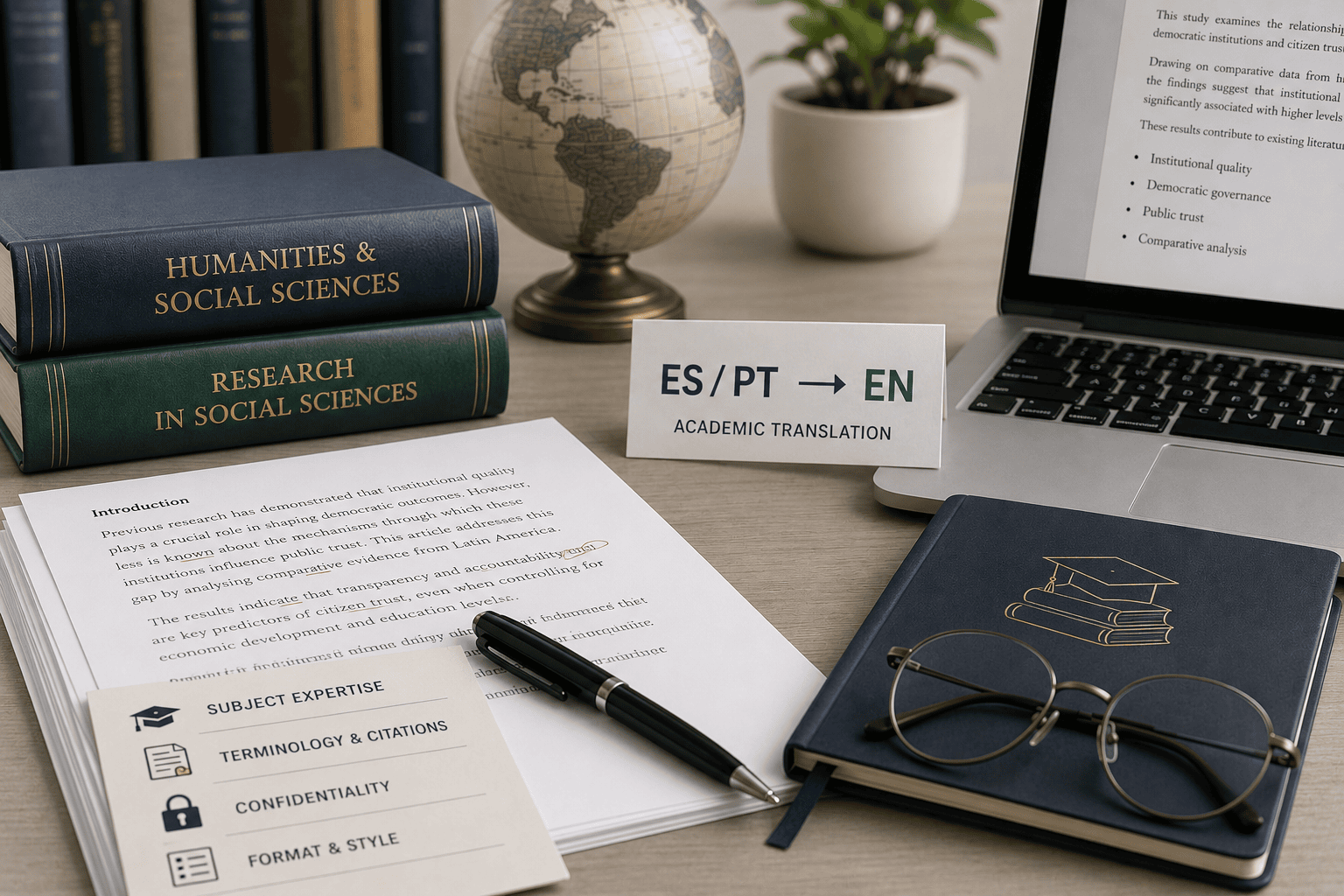
Good academic translation preserves more than the sentences. Ask how the translator will handle:
Citations and references, which must stay consistent with your chosen style. Specialist terminology, which should be rendered the way your discipline actually uses it, not improvised. Academic register, so the finished text reads as serious scholarship rather than a loose paraphrase.
If a translator cannot explain how they approach these, that is a warning sign.
Confidentiality and formatting
Unpublished research is sensitive. Check that the translator treats your work as confidential and is willing to format the translation to your target journal’s or institution’s requirements. These practical details often make the difference between a submission that is accepted smoothly and one that is sent back.
One accountable person, start to finish
Much academic translation is sold through agencies, where your work may pass through several hands. Working directly with a qualified translator means the person who understands your field is the same person who translates, checks, and answers your questions. For nuanced scholarly work, that continuity protects the quality of the result.
Getting it right
Your research has taken months or years. The translation deserves the same care. If you are looking for academic translation from Spanish or Portuguese into English in the humanities and social sciences, I would be glad to help — accurately, confidentially, and within my areas of expertise.
Learn more about my academic translation service or request a free quote.


