
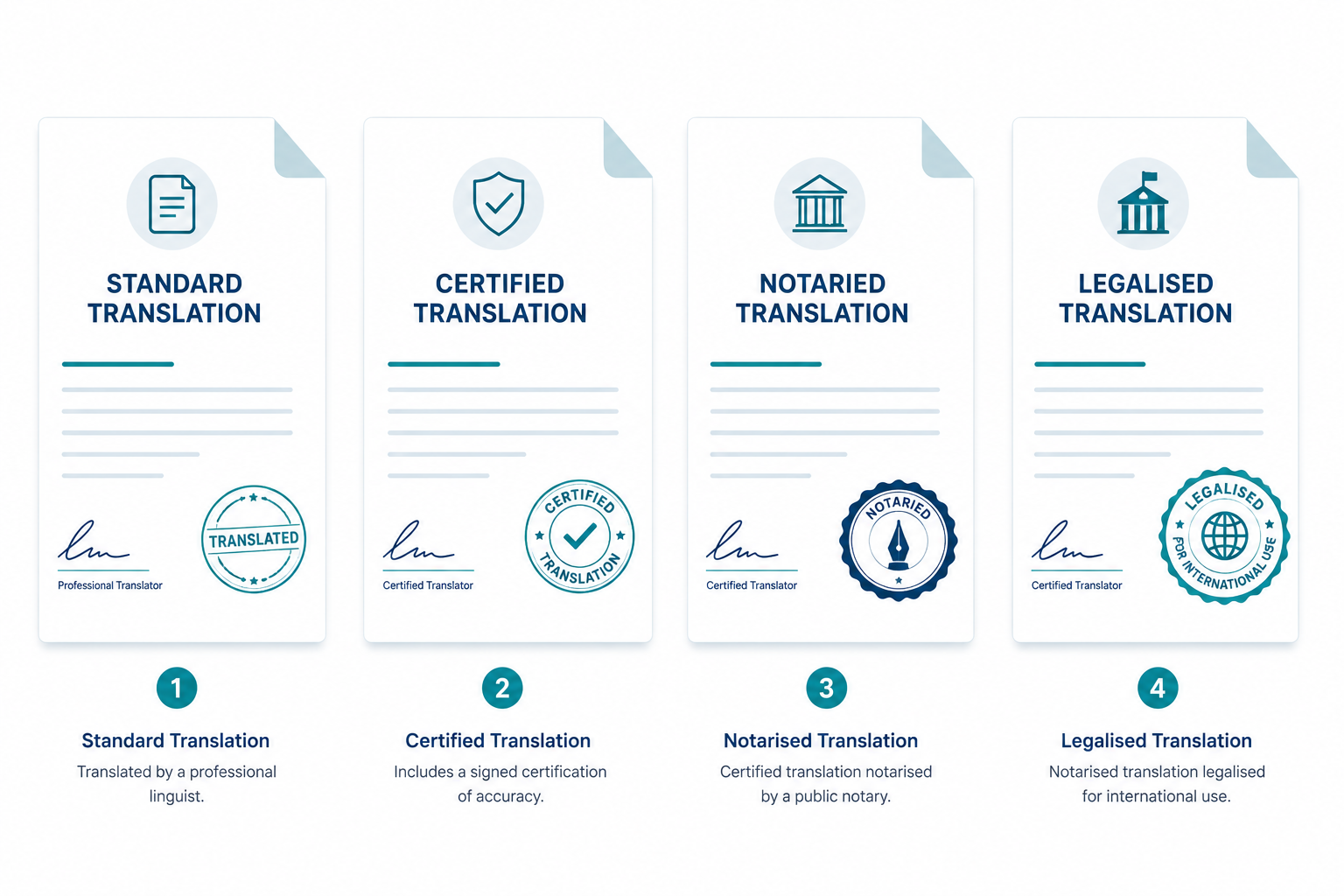
If you’ve ever tried to get a Spanish or Portuguese document accepted by a UK authority, a court, or an overseas institution, you’ve probably come across these four terms and wondered what on earth the difference is. You’re not alone — these terms are widely confused, even by people who deal with official documents regularly. This guide cuts through the jargon and tells you exactly what each one means, when you need it, and how much it typically costs.
Standard Translation: The Starting Point
A standard professional translation is simply the conversion of a document from one language to another by a qualified translator. The translator reads the original Spanish or Portuguese document and produces an accurate, complete English version.
This is what most businesses need most of the time. If you need to understand a supplier contract, review a report from a Latin American partner, or get the gist of a foreign legal document for internal purposes, a professional translation is all you need. No stamps, no declarations, no additional authentication required.
What standard translation does not provide is any formal guarantee or legal standing. For that, you need to step up to certified translation.
Certified Translation: Adding Legal Weight
A certified translation is a professional translation accompanied by a signed declaration from the translator or translation company confirming that the translation is a complete and accurate representation of the original document. In the UK, this declaration is typically stamped and signed by a translator accredited by a recognised professional body such as the Chartered Institute of Linguists (CIOL), the Institute of Translation and Interpreting (ITI), or a member company of the Association of Translation Companies (ATC).
This signed declaration gives the translated document legal standing. It tells the receiving authority that a qualified professional is accountable for the accuracy of what they are reading.
Certified translation is required whenever you submit a foreign-language document to an official body — the UK Home Office, a court, a bank, Companies House, or a university admissions office. It is the standard requirement for UK visa and immigration applications, legal proceedings, company registrations, and academic qualification recognition.
One important point: a certified translation confirms the accuracy of the translation itself. It does not verify the authenticity of the original document. If the original is fraudulent, a certified translation of it remains fraudulent.
Typical cost: varies by document length and complexity, but expect to pay from around £30–£80 for a standard single-page document such as a birth certificate.
Notarised Translation: An Extra Layer of Authentication
A notarised translation is a certified translation that has been taken a step further — a notary public has verified the identity of the translator and witnessed them signing a sworn statement confirming the translation is accurate. The notary then stamps and signs the document.
It is important to understand what a notary does and does not do here. A notary does not check the translation itself for accuracy — they are not a linguist. What they do is independently verify that the person signing the accuracy declaration is who they claim to be, and that the signature is genuine. This adds an additional layer of legal credibility to the document.
Notarised translations are typically required when documents will be used in legal proceedings, property transactions, or when a foreign authority specifically requests notarisation. Many people assume notarisation is required when it is not — for example, the UK Home Office explicitly states that certified translations are sufficient for all visa and immigration applications and that notarisation is not needed.
Before paying for notarisation, always check with the receiving authority whether they actually require it. It adds significant cost for no benefit if it is not needed.
Typical cost: notarisation adds approximately £150–£200 or more on top of the translation cost, as notary fees are set independently.
Apostille: For International Use
An apostille is an official government-issued certificate that authenticates a document for use in another country. In the UK, apostilles are issued by the Foreign, Commonwealth and Development Office (FCDO). An apostille does not translate a document, verify its contents, or guarantee it will be accepted for any particular purpose — it simply certifies the authenticity of the document and the authority that issued or signed it, so that it can be legally recognised abroad.
Apostilles are used when a UK document needs to be recognised in another country, or when a foreign document needs to be authenticated for use in the UK through an equivalent process in the originating country. As of 2026, over 120 countries are members of the Hague Convention — the international framework that governs apostilles — including the UK, all EU member states, the United States, Australia, and many Latin American nations.
A few important points about apostilles in the UK context:
- The FCDO can only apostille UK public documents — documents issued by or certified by a UK public authority. Private documents such as contracts or letters cannot be apostilled directly.
- Some documents must be notarised by a solicitor before the FCDO will issue an apostille.
- A translation must be notarised before it can be sent to the FCDO for an apostille.
Apostilles are most commonly needed for overseas adoption, international business contracts, foreign property transactions, and education applications abroad.
How the Four Levels Work Together
Think of it as a ladder of authentication, with each level building on the one before:
| Level | What It Is | When You Need It |
|---|---|---|
| Standard Translation | Accurate English version of your document | Internal use, business reference, personal understanding |
| Certified Translation | Translation + signed declaration of accuracy | UK immigration, courts, banks, Companies House, universities |
| Notarised Translation | Certified translation + notary verification | International legal proceedings, foreign authorities, property transactions |
| Apostille | Government authentication for international recognition | Documents needing legal recognition in another country |
Each level is appropriate for different situations. The most common mistake people make is over-specifying — paying for notarisation or an apostille when a simple certified translation would have been accepted. The second most common mistake is under-specifying — submitting a standard translation when a certified one was required, resulting in rejection and delay.
Which Do You Need for Spanish and Portuguese Documents?
For the most common scenarios involving Spanish and Portuguese documents in an English-speaking context:
- UK visa or immigration application — certified translation only. Notarisation is not required by the Home Office.
- UK court proceedings — certified translation, and possibly notarised if the court or opposing party requests it.
- Submitting a document to a Spanish, Portuguese, or Latin American authority — likely to require an apostille on your English document, potentially with notarisation first.
- Business use between private companies — standard professional translation is almost always sufficient.
- Academic applications — certified translation in most cases.
When in doubt, always ask the receiving authority what they require before commissioning the translation. A few minutes of clarification upfront can save significant time and cost.
Need a Translation of a Spanish or Portuguese Document?
Whether you need a straightforward professional translation or a fully certified document ready for submission to UK authorities, I can help. With over 12 years of experience translating Spanish and Portuguese documents across business, legal, and official contexts, I provide accurate, professionally certified translations with fast turnaround times.


