
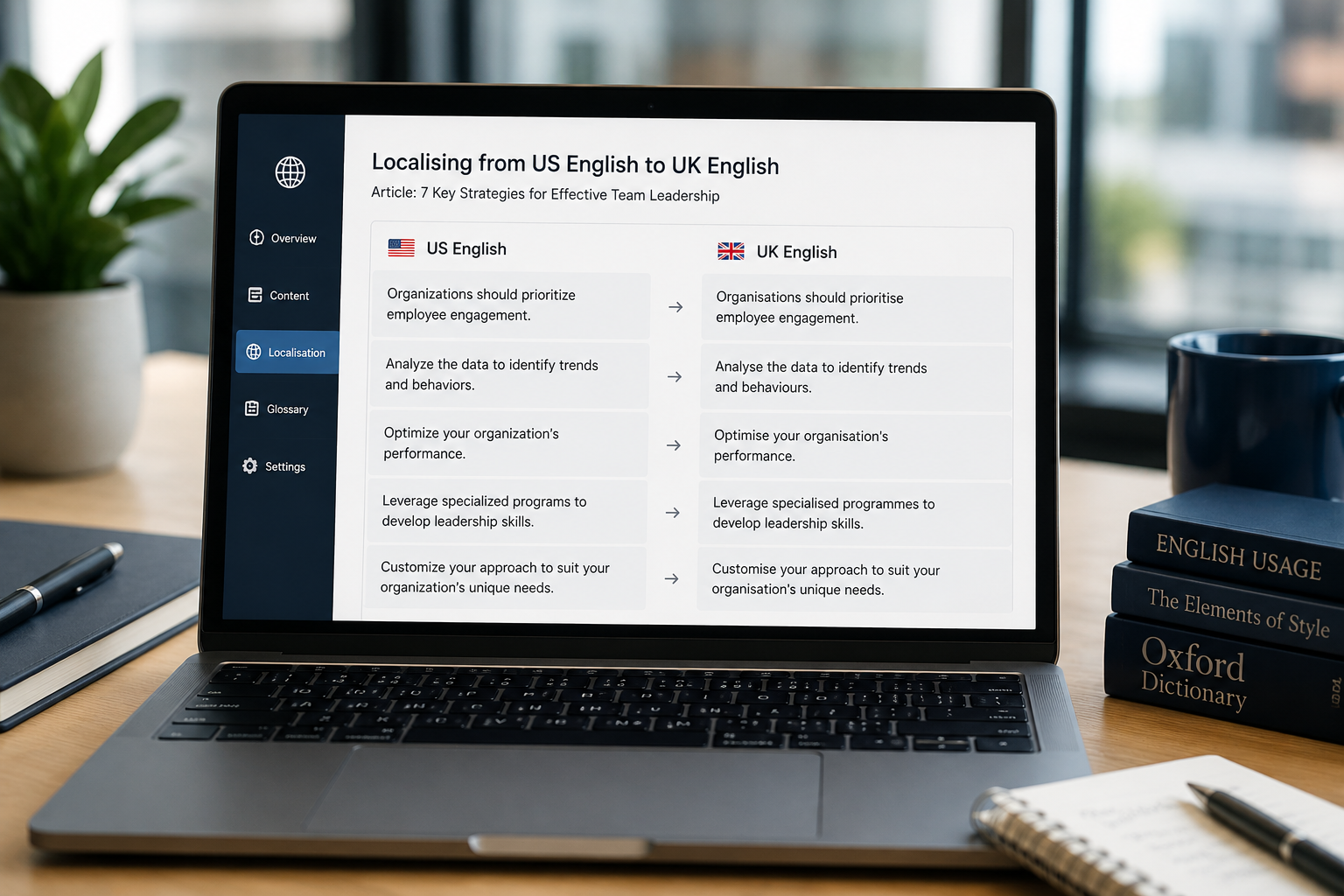
Your copy is already in English, so localising it for Britain should be trivial — change a few zs to ss and you are done. That assumption is exactly why so much American content lands awkwardly with UK audiences. The differences run far deeper than spelling, and British readers notice the ones you cannot see. If your company is bringing a product, website, or campaign from the US into the UK market, this guide explains what actually changes between American and British English, why it matters commercially, and what to look for when adapting your content.
Same Language, Different Reader
English is not one market. American and British English have diverged across spelling, vocabulary, idiom, tone, and a host of everyday conventions — and the gap is widest in precisely the writing that has to build trust and sell.
The risk is subtle, which is what makes it dangerous. American copy rarely breaks in the UK; it just quietly signals “this was not written for you.” A British reader may not be able to name what feels off, but the impression lands all the same: this brand does not really understand my market. In categories where trust drives the purchase — finance, professional services, anything considered — that impression has a cost.
Localising US content for the UK is not about correcting it. American English is not wrong; it is simply written for a different audience. The job is to make the copy feel native to a British reader, so nothing distracts from the message.
Where US Content Most Often Gives Itself Away in the UK
The tells fall into several layers, from the obvious to the genuinely invisible.
Spelling. The familiar ones — color/colour, organize/organise, center/centre, traveler/traveller — are the easy layer, and the one a spellcheck can mostly handle. They are also the least important, because they are the differences a British reader expects to see corrected and barely registers when they are.
Vocabulary. This is where it gets commercially real. The everyday word is often simply different: pants versus trousers, vacation versus holiday, cell phone versus mobile, math versus maths, sidewalk versus pavement, gas versus petrol, fall versus autumn. Use the American term and a UK reader is gently but constantly reminded they are reading foreign copy. Some differences can even mislead — quarter and fiscal year conventions, or terms like first floor, which is the ground floor in the US and the floor above it in the UK.
Idiom and phrasing. Americanisms like “touch base,” “out of the gate,” “Monday through Friday,” or “a quarter of” (for time) read as distinctly un-British. The UK equivalents — “Monday to Friday,” “from the outset” — are not better English, just the version that sounds native.
Tone and register. This is the deepest and least visible difference. American marketing tends to be more direct, more superlative, more openly enthusiastic. British audiences, broadly, are more sceptical of overt salesmanship and respond better to understatement, dry wit, and confidence expressed quietly. Copy that reads as energising in the US can read as overselling — even slightly suspect — in the UK. Recalibrating this is the part no spellcheck and no quick edit will ever catch.
Conventions and formats. Dates (US writes month-first: 03/04 is March 4th; the UK reads it as 4th March), measurements (miles and pints sit alongside metric in odd British ways), currency, phone-number formatting, and address order all carry small signals of origin. Getting them right is part of looking like you belong.
Legal and regulatory wording. Terms and conditions, privacy notices, guarantees, and pricing claims often need adapting not just in style but in substance — UK consumer law, advertising standards, and data rules differ from US ones. This is where “just change the spelling” can move from awkward to actually non-compliant.
What Proper US-to-UK Localisation Actually Involves
Adapting content for the UK well takes more than find-and-replace.
A native British reader doing the work. The only reliable way to catch what reads as foreign is to have the adaptation done by someone for whom British English is native — someone who hears the wrong note instinctively, the way your US audience would hear British phrasing. This is not a task where non-native fluency is enough; the entire value is in native judgement.
Vocabulary and idiom mapped, not swapped. Good localisation replaces American terms and expressions with their natural British counterparts in context — not mechanically, but with an ear for what a real British reader would actually say.
Tone recalibrated to the British ear. The enthusiasm, directness, and superlatives of US copy are dialled to the register a UK audience trusts, without losing the brand’s personality or its persuasive intent.
Brand voice preserved. The goal is a UK version that still sounds unmistakably like your brand — just speaking to British customers in their own register, with their own vocabulary and conventions.
Substance checked, not just style. Dates, units, currency, and any legal or regulatory wording are reviewed for the UK context, so the localised copy is correct as well as native-sounding.
What to Check Before You Launch US Content in the UK
Before your American content goes live for a British audience, run through this:
- Was the adaptation done by a native British English speaker, not just run through a US-to-UK spellcheck?
- Has vocabulary been mapped to natural British equivalents, not only the obvious spelling changes?
- Have Americanisms and idioms been replaced with phrasing a British reader would actually use?
- Has the tone been recalibrated for a UK audience’s lower tolerance for overt salesmanship?
- Are dates, measurements, currency, and formats in British conventions?
- Has any legal, regulatory, or compliance wording been reviewed for the UK, not just the US?
- Does the copy still sound like your brand — just British?
If any answer is no, your UK launch may be quietly working against you.
A Quick Reference Guide
| If you are adapting… | What you need |
|---|---|
| A website or landing pages for UK customers | Full US-to-UK localisation by a native British speaker |
| Marketing and ad copy | Localisation with tone recalibrated for a UK audience |
| Product names, listings, and descriptions | Vocabulary and convention mapping, brand voice preserved |
| Terms, privacy notices, or pricing claims | Localisation reviewed for UK legal and regulatory context |
| Internal documents for your own UK team | Standard British-English adaptation |
| Content where only spelling matters, low stakes | A light British-English pass may suffice |
| Anything run through spellcheck alone | Not ready for a UK audience |
Bringing US Content into the UK Market?
I am a professional translator and a UK native, with over 12 years of experience adapting English content for British audiences. I localise American English into natural British English — not just spelling, but vocabulary, idiom, tone, and convention — so your copy reads as though it was written in the UK from the start, with your brand voice fully intact. From a single landing page to a complete website or campaign, I can make sure your message feels native to your British customers rather than imported.


