
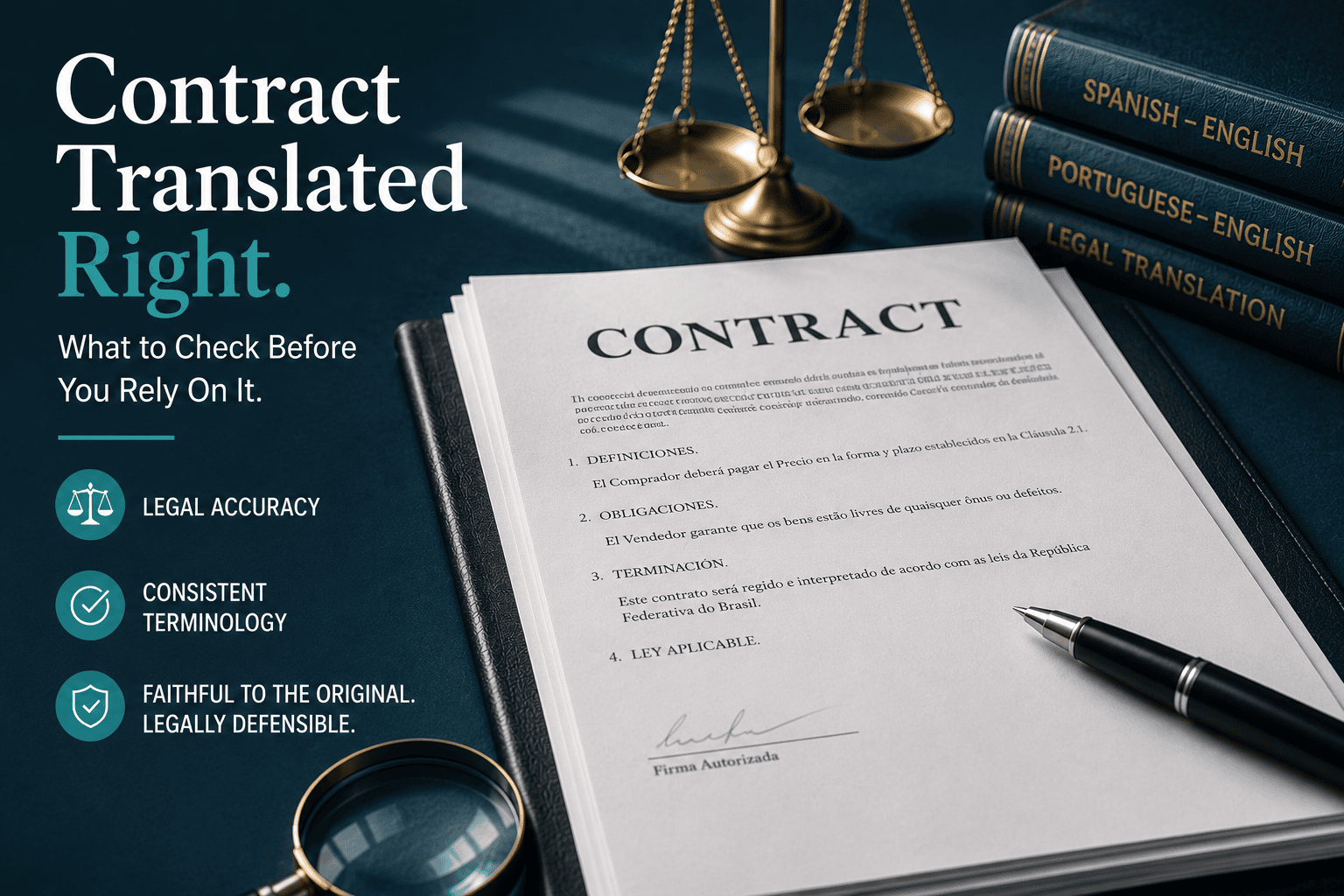
If you are about to sign, enforce, or rely on a contract that began life in Spanish or Portuguese, the translation in front of you is doing more work than you might think. A single misread clause can shift liability, change a deadline, or quietly hand the other party a right you never meant to grant. This guide explains where contract translations go wrong, what separates a defensible translation from a risky one, and what to check before you put your name to anything.
Why a Contract Is Not Like Any Other Document
Most documents communicate. A contract governs. Every word is a potential obligation, and the difference between «shall» and «may,» or between «terminate» and «rescind,» can decide who pays when something goes wrong.
That is why a contract translation cannot be judged on whether it reads smoothly. It has to be judged on whether it produces the same legal effect as the original. A translation can be perfectly fluent English and still be wrong in the only way that matters — by altering what the parties are actually bound to do.
This is also why machine translation, however impressive it has become, remains a genuine liability for legal text. It optimises for plausible-sounding output, not for legal equivalence, and it has no awareness of the consequences of choosing one term over another.
Where Spanish and Portuguese Contracts Most Often Go Wrong in English
Certain problems recur so reliably that they are worth watching for specifically.
False friends with legal consequences. Some of the most dangerous errors come from words that look familiar. Spanish prescripción is not «prescription» — it is the lapsing of a right or claim through the passage of time (closer to «limitation» or «the statute of limitations»). Portuguese prejuízo usually means «loss» or «damage,» not «prejudice.» A translator who renders these literally can invert the meaning of a whole clause.
Civil-law concepts with no clean English equivalent. Spanish and Portuguese contracts are written within civil-law systems, while English contracts assume common law. Terms such as arras (a deposit that can carry specific penalty or withdrawal consequences), saneamiento (the seller’s warranty against defects and eviction), or the Brazilian cláusula penal do not map neatly onto English concepts. A competent legal translator does not force a false equivalent; they choose the closest functional term and, where necessary, preserve the original alongside it so nothing is lost.
The Latin American versus European divide. A contract drafted in Mexico does not use the same terminology, register, or legal references as one drafted in Spain — and a Brazilian contract differs again from a Portuguese one. Vocabulary, court structures, and even the names of standard documents vary by country. A translator working only from «Spanish» or «Portuguese» without knowing the jurisdiction risks importing the wrong legal frame entirely.
Numbers, dates, and formatting. A misplaced decimal comma (used where English uses a point), an ambiguous date, or a misread currency can change a payment obligation. In a contract these are not typos — they are disputes waiting to happen.
What a Defensible Contract Translation Actually Involves
A translation you can rely on in a negotiation, a transaction, or a courtroom is built differently from a quick informational rendering.
Terminology consistency. A defined term in a contract must be translated identically every time it appears. If el Comprador becomes «the Buyer» in clause 3 and «the Purchaser» in clause 9, you have created an ambiguity that a counterparty’s lawyer can exploit. Professional legal translators maintain a glossary for each contract precisely to prevent this.
Fidelity to structure. Clause numbering, cross-references, and defined-term capitalisation all carry meaning and must be mirrored exactly. A clause that refers to «the obligations set out in 7.2» is worthless if 7.2 has shifted in translation.
Preserving ambiguity where it exists. This is counterintuitive but important. If the original is deliberately or accidentally ambiguous, the translator’s job is not to tidy it up. Resolving an ambiguity in translation means making a legal decision that was never yours to make. A good translator flags it instead.
A human translator who understands the field. Legal translation sits at the meeting point of two languages and two legal systems. It requires someone who recognises when a term is a term of art, knows when no direct equivalent exists, and understands the consequences of getting it wrong.
What to Check Before You Rely On a Contract Translation
Before you act on a translated contract, run through this:
- Was it produced by a professional human translator with demonstrable legal experience — not raw machine output?
- Are key defined terms translated consistently throughout?
- Does the clause and cross-reference numbering match the original exactly?
- Has the translator flagged any terms that have no direct English equivalent, rather than silently substituting one?
- Does the translation identify the source jurisdiction, and does the terminology fit that jurisdiction?
- If this contract may be used in legal proceedings, has the question of certification been addressed?
If you cannot answer yes to these, the translation is a risk rather than a safeguard.
A Quick Reference Guide
| If the contract is for… | What you need |
|---|---|
| Your own understanding before negotiating | Professional human translation, terminology-consistent |
| Signing or executing an agreement | Professional legal translation, structure mirrored exactly |
| Submission as evidence in a UK court | Certified legal translation |
| A cross-border transaction or filing | Certified, possibly notarised — check the receiving body |
| Quick internal gist only, low stakes | Standard professional translation |
| Anything machine-translated and unreviewed | Do not rely on it for legal purposes |
Need a Spanish or Portuguese Contract Translated?
I am a professional Spanish and Portuguese to English translator with over 12 years of experience and a track record translating contracts, agreements, and legal documents for global brands and institutions. I provide accurate, terminology-consistent legal translations — certified where required — across both European and Latin American variants. Whether you have a single agreement or a full set of transaction documents, I can deliver a translation you can rely on, with a fast turnaround.


