If you’ve received a Spanish or Portuguese document and need to submit it to a UK authority, a court, a bank, or a government body, you’ve probably asked yourself this question. The short answer is: it depends on who is asking for it and why. But don’t worry — this guide will walk you through exactly when you need a certified translation, when you don’t, and what to look for when commissioning one.
What Is a Certified Translation?
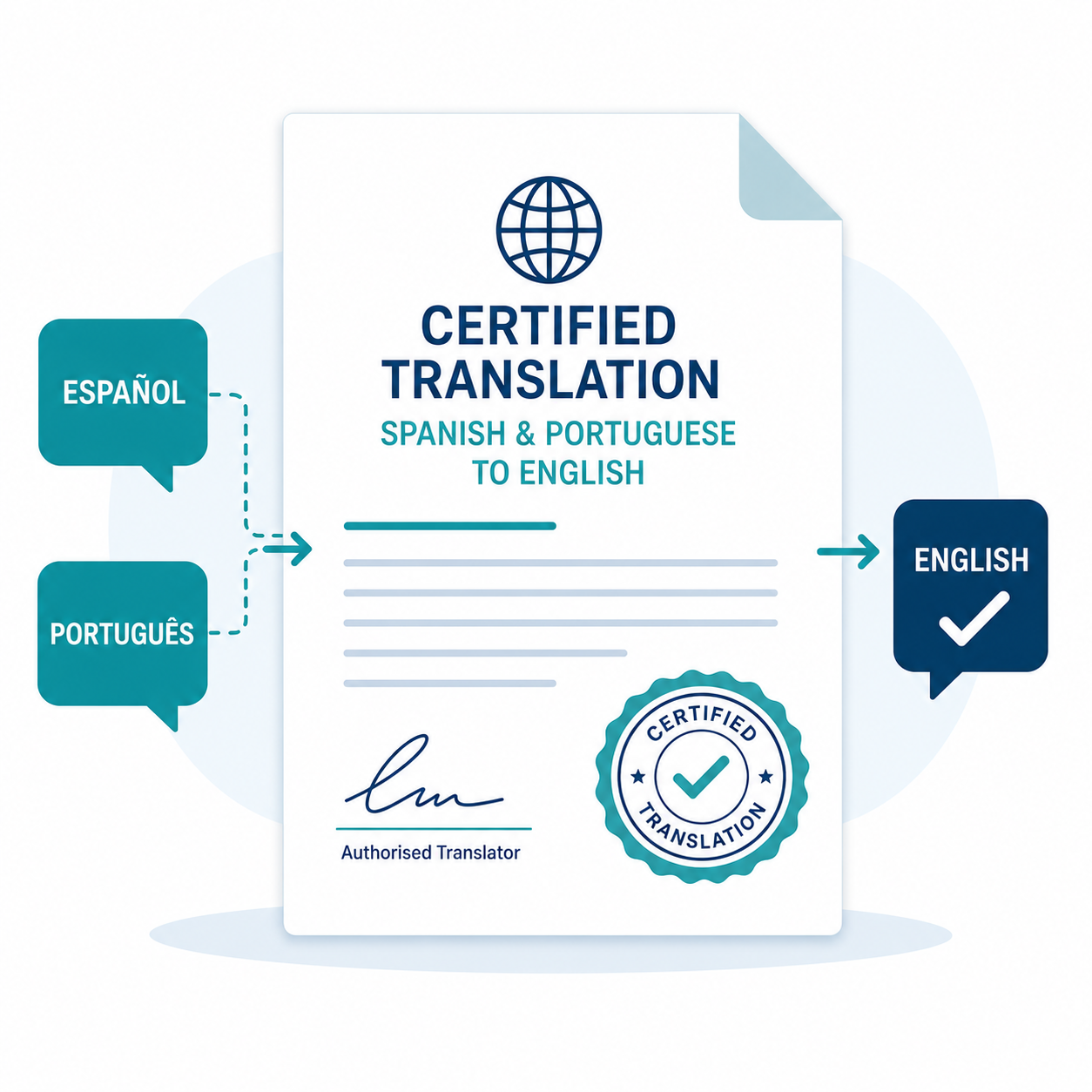
A certified translation is not just a translated document — it comes with a signed declaration from the translator or translation company confirming that the translation is a complete and accurate representation of the original. In the UK, certified translations are typically stamped and signed by a professional translator accredited by a recognised professional body, such as the Chartered Institute of Linguists (CIOL), the Institute of Translation and Interpreting (ITI), or a member company of the Association of Translation Companies (ATC).
This declaration gives the translated document legal weight. It tells the receiving authority that a qualified professional stands behind the accuracy of the translation.
When Do You Need a Certified Translation?
As a general rule, you will need a certified translation whenever you are submitting a foreign-language document to an official body. Here are the most common scenarios:
Immigration and visa applications
The UK Home Office requires certified translations for all non-English documents submitted in support of visa, residency, or citizenship applications. This includes birth certificates, marriage certificates, bank statements, employment records, and criminal record checks. If your document is in Spanish or Portuguese and you are submitting it to UK Visas and Immigration, it must be certified.
Legal proceedings
If a Spanish or Portuguese document is being submitted as evidence in a UK court — whether it is a contract, a deed, a will, or correspondence — a certified translation will almost certainly be required. Judges and legal teams need assurance that the translation they are reading is accurate, and certification provides that assurance.
Business and commercial documents
If you are registering a foreign company in the UK, submitting articles of association, or presenting financial statements from a Spanish or Portuguese-speaking country to Companies House or a financial institution, certified translations are typically required.
Academic applications
Universities and professional bodies in the UK, US, Australia, and Canada routinely require certified translations of foreign academic qualifications, transcripts, and diplomas.
When Do You Not Need a Certified Translation?
Not every situation calls for certified translation. If you need a Spanish or Portuguese document translated purely for your own information — to understand a supplier contract, review a report, or get the gist of a foreign correspondence — a standard professional translation is perfectly sufficient.
Similarly, many business-to-business transactions do not require certification. If a UK company is working with a Brazilian supplier and needs a product specification sheet or a set of technical instructions translated, a high-quality professional translation without a formal certification is usually all that is needed.
The key question to ask is: who will receive this translation, and what will they do with it? If the answer involves a government body, a court, a bank, or any other official institution, opt for certified. If it is for internal use or commercial purposes between private parties, standard professional translation will do the job.
What About Notarisation and Apostilles?
These are two additional levels of authentication that are sometimes confused with certification:
Notarisation means a notary public has verified the translator’s signature and identity. Some authorities — particularly in legal proceedings or international transactions — require a notarised translation on top of certification.
An apostille is an official stamp issued by the Foreign, Commonwealth and Development Office (FCDO) in the UK that authenticates a document for use in another country. If you need your translated document to be recognised internationally, an apostille may be required. Note that a translation must be notarised before it can be sent to the FCDO for an apostille.
For most everyday business and immigration purposes, simple certification is sufficient. Notarisation and apostilles are typically only needed in more complex legal or cross-border scenarios.
Does It Matter Who Provides the Certified Translation?
Yes — significantly. While the UK does not legally mandate that translators hold specific qualifications, the receiving authority’s requirements matter enormously. The UK Home Office, for example, requires translations to be provided by a member of a recognised professional organisation, signed and stamped by the translator.
When commissioning a certified translation of a Spanish or Portuguese document, look for a translator who:
- Is a member of the ITI, CIOL, or works with an ATC-accredited company
- Provides a signed declaration of accuracy with every certified translation
- Has demonstrable experience in the relevant field — legal, business, immigration, or otherwise
- Can provide references or evidence of previous work accepted by UK authorities
Choosing an unqualified or uncertified translator to save money is a false economy. A rejected translation means starting the process again, often under time pressure.
A Quick Reference Guide
| Situation | Certified Translation Needed? |
|---|---|
| UK visa or immigration application | ✅ Yes |
| Court or legal proceedings | ✅ Yes |
| Company registration / Companies House | ✅ Yes |
| Academic qualification recognition | ✅ Yes |
| Bank or financial institution submission | ✅ Usually |
| Internal business use | ❌ No |
| Supplier contracts for your own reference | ❌ No |
| Marketing or website content | ❌ No |
| Technical manuals for internal use | ❌ No |
Need a Certified Translation of a Spanish or Portuguese Document?
I am a professional Spanish and Portuguese to English translator with over 12 years of experience, providing certified translations accepted by UK authorities, courts, and institutions. Whether you have a single-page certificate or a complex legal document, I can provide an accurate, professionally certified translation with a fast turnaround.


