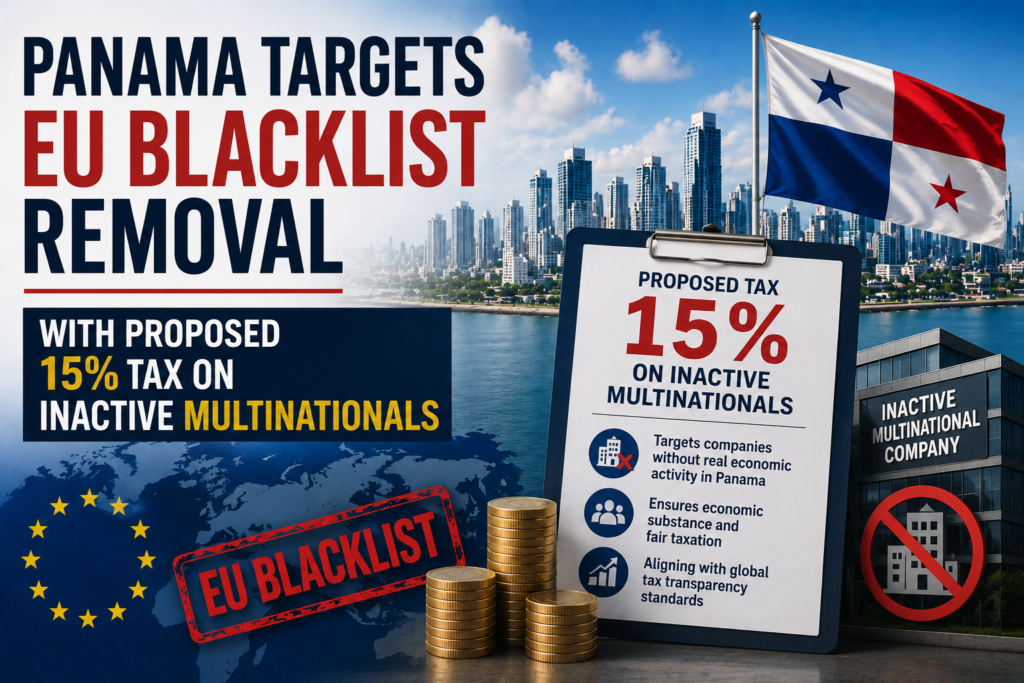
Panama’s government is pushing forward legislation that would impose a 15% tax on the gross income generated in the country by multinational companies that cannot demonstrate genuine economic activity there. The proposal forms part of Panama’s effort to be removed from the European Union’s blacklist of non-cooperative tax jurisdictions.
The draft law, known as the “economic substance” bill, is being treated as a priority by President José Raúl Mulino during extraordinary sessions of the National Assembly running from May to June 2026. Economy Minister Felipe Chapman described the reform as the most important condition required by the EU for Panama’s removal from the blacklist, potentially by October 2026 or early 2027.
Under the proposal, multinational firms benefiting from passive foreign-source income would need to prove they have real operations in Panama, including employees, operating expenses and strategic decision-making within the country. Companies failing to meet these “economic substance” requirements would face the new 15% levy.
Panamanian officials insist the measure does not abandon the country’s territorial tax system, under which only income generated domestically is taxed. Instead, they argue it aligns Panama with global tax transparency standards while reducing regulatory friction for international businesses. The government also believes the reform could attract new foreign investment by improving Panama’s international financial standing.